- Flooring
Veterinary Clinic Flooring: A Madison Buyer’s Guide
October 1, 2026
Choosing veterinary clinic flooring is not the same job as choosing any other commercial floor, and the difference is not durability. It is chemistry. Animal urine, daily disinfectant cycles, claws, standing water in a grooming room, and the noise of a full kennel attack a floor in ways office and retail specifications never account for. If you are planning a practice, boarding facility, grooming salon, or shelter in the Madison, WI area, this guide is for you.
We will cover what an animal care floor has to survive, which materials earn a place in which zone, and what a Harmony Flooring consultation covers before anyone writes a specification. If you run a human medical or dental practice instead, our medical office flooring buyer’s guide is the companion to this one: https://www.harmonyflooring.com/medical-office-flooring-madison-buyers-guide/ .
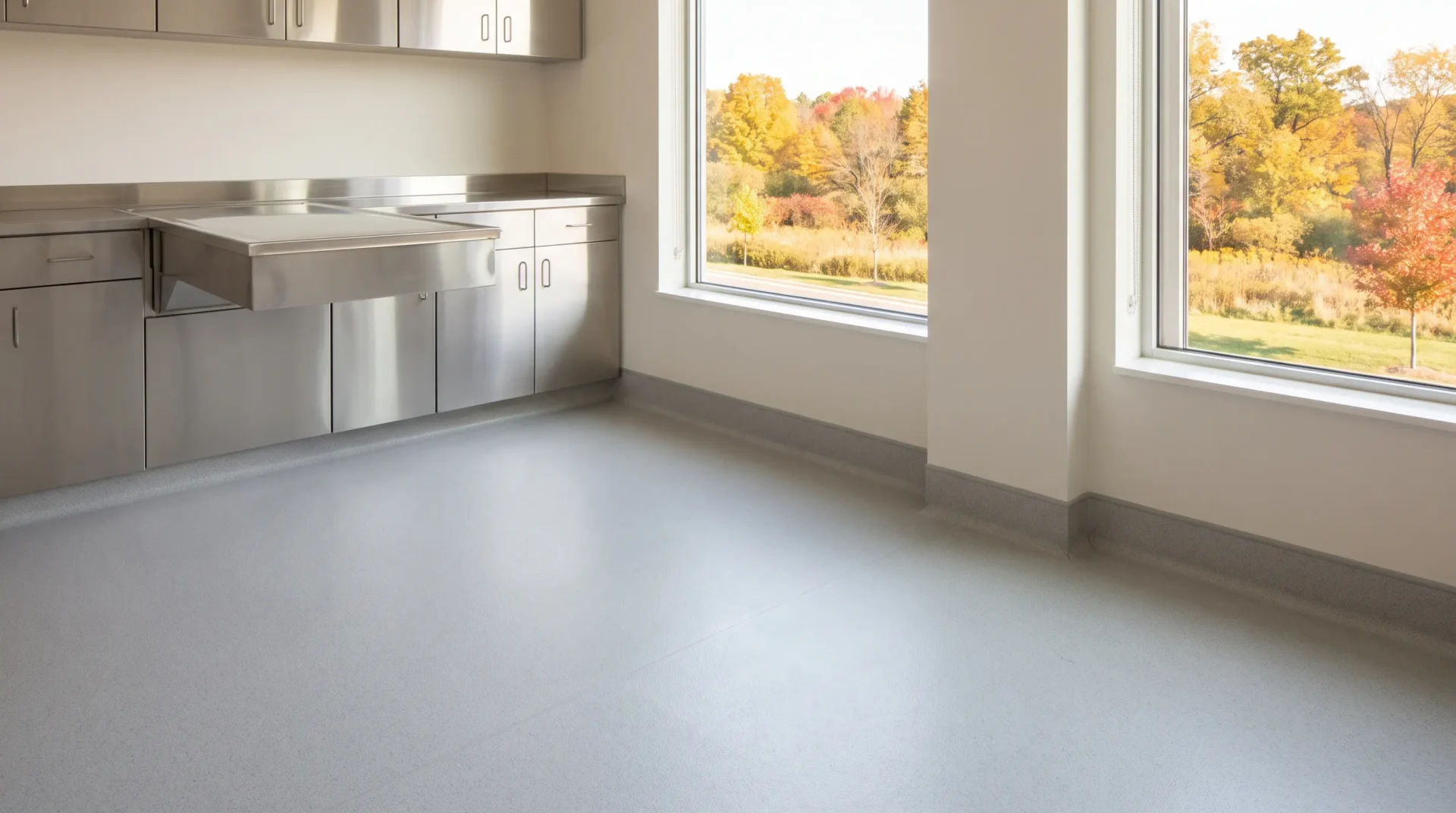
The Short Version: For treatment, surgery, kennel runs, and grooming areas, heat-welded sheet vinyl with an integral coved base is the specification to beat, because it gives urine no seam to penetrate. Commercial luxury vinyl fits lobbies and exam rooms. Grouted tile and carpet belong nowhere near a wet animal zone.
Key Takeaways
Urine, not foot traffic, is what fails veterinary floors. It finds seams and grout, and the odor outlasts the cleaning.
Slip resistance has to be specified for the wet condition, for animals and for staff carrying them.
Barking is a real acoustic problem, and the floor is part of the answer.
One material throughout is a compromise everywhere. Zone it.
Why Veterinary Flooring Is Its Own Category
Veterinary and animal care flooring in Madison solves a sanitation problem first and a durability problem second. Other commercial floors handle dirt. An animal facility floor faces urine, feces, blood, and the aggressive chemistry used to remove them, daily. Get that wrong and the building smells no matter how clean the staff keeps it.
The American Animal Hospital Association is direct about this in its 2018 Infection Control, Prevention, and Biosecurity Guidelines. Porous surfaces, and it names unsealed wood, concrete, and grout specifically, or surfaces with poor integrity such as cracks, are difficult to effectively clean and disinfect, and AAHA’s guidance is that they be repaired or replaced.
Read that as a flooring specification, because that is what it is. The profession’s own infection-control guidance rules out porous surfaces first. What is left is a short list of seamless, non-porous options, and how they are installed matters as much as what they are made of.
Grouted Tile Usually Loses in Wet Animal Zones
Porcelain tile is an excellent material that is often the wrong system for a kennel or treatment room, and the reason is the grout, not the tile. The tile face is dense and non-porous. The grout lines are not, and they run through the entire floor in a continuous grid.
Here is the mechanism most guides skip. Urine carries uric acid salts with very low solubility in water. When urine soaks into a porous material and dries, those salts crystallize inside the pore structure. Mopping cleans the surface but does not carry crystallized uric acid back out of the pores, so when humidity rises the material re-mobilizes and the ammonia odor returns. You get a floor that looks spotless and smells like a kennel, and more cleaning cannot fix it, because the problem is below the surface you are cleaning.
Every grout line is also a joint, and joints move, craze, and open under years of thermal cycling and equipment loads. AAHA’s language about surfaces with poor integrity applies directly. That is why a seamless system wins where urine exposure is heaviest, and why we treat grouted tile as a lobby and restroom material in an animal facility.
What a Veterinary Floor Has to Survive
An animal care floor in Wisconsin has six jobs, and no single material is best at all six. Ranking them for your facility is the first real decision.
1. Urine and fluid resistance. The defining requirement. Non-porous at the surface, continuous through the field, with no seam, grout line, or floor-to-wall joint for liquid to enter.
2. Disinfectant compatibility. AAHA guidance notes that a quaternary ammonium compound is reasonable for routine disinfection in general animal areas, while an extended-spectrum oxidizing agent is indicated in isolation or critical care. It also states disinfectants must stay wet for the full contact time, generally five to ten minutes, and be reapplied if they dry early. Your floor sits saturated in active chemistry every cycle, every day. AAHA lists material compatibility as a selection criterion, so ask the manufacturer for published chemical resistance data.
3. Slip resistance when wet. ANSI A326.3, published with the Tile Council of North America, sets a wet dynamic coefficient of friction of 0.42 or greater for level interior spaces expected to be walked on when wet. Treat 0.42 as a floor, not a finish line. The standard compares surfaces and does not predict whether a person will slip, and it says nothing about a wet dog on four paws or a technician carrying a sedated retriever.
4. Claw, impact, and rolling load resistance. Claws, dropped instruments, cage banks, and carts rolling the same path a hundred times a day. Specify a commercial-grade wear layer and check the rolling load rating.
5. Acoustics. Not a comfort issue, a welfare and staffing one. A peer-reviewed study of kennel noise in Applied Animal Behaviour Science (Sales et al., 1997) recorded daytime peaks that regularly exceeded 100 decibels and often reached 125, with continuous levels of 65 to 100 decibels, attributed mainly to barking. Hard, reflective floors make that worse. Sound-absorbing resilient flooring and rubber take energy out of the room instead of returning it.
6. Standing comfort. Your team is on its feet all shift. Resilient flooring and rubber have real underfoot give. Concrete and tile do not.
Flooring Options for Madison Animal Care Facilities
For Madison-area animal care facilities the shortlist is short on purpose: heat-welded sheet vinyl, commercial luxury vinyl, and rubber, with everything else limited to specific zones.
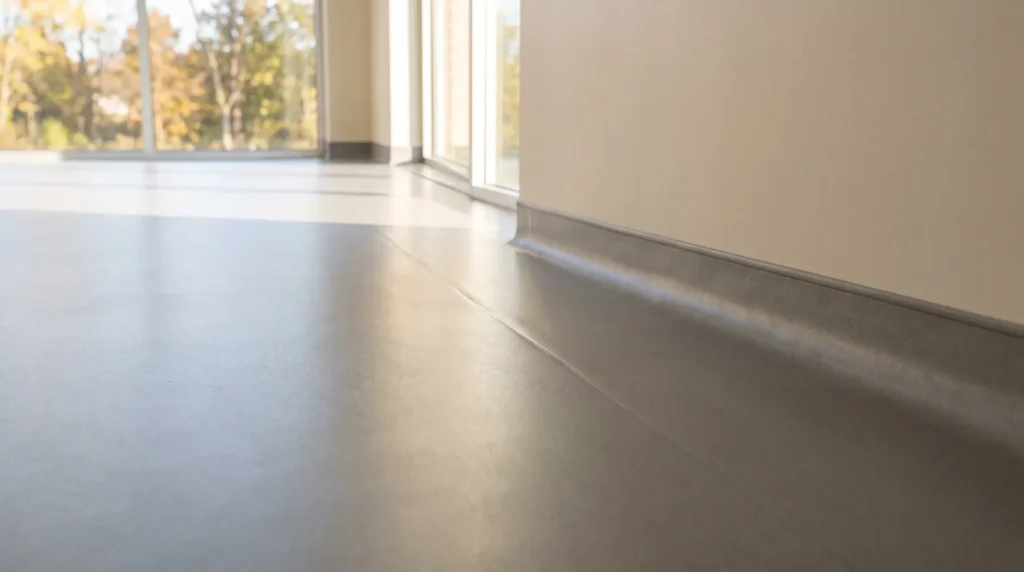
Heat-welded sheet vinyl. The reference specification for clinical and wet zones. Commercial sheet vinyl (https://www.harmonyflooring.com/vinyl/) installs in wide rolls, and the seams are heat-welded with a matching rod that fuses the sheets into one continuous surface. Pair it with an integral coved base, where the sheet curves up the wall and terminates in a cap, and you eliminate the floor-to-wall joint too, the hardest place in any room to keep clean. That is why this system belongs in treatment, surgery, kennel runs, and grooming rooms.
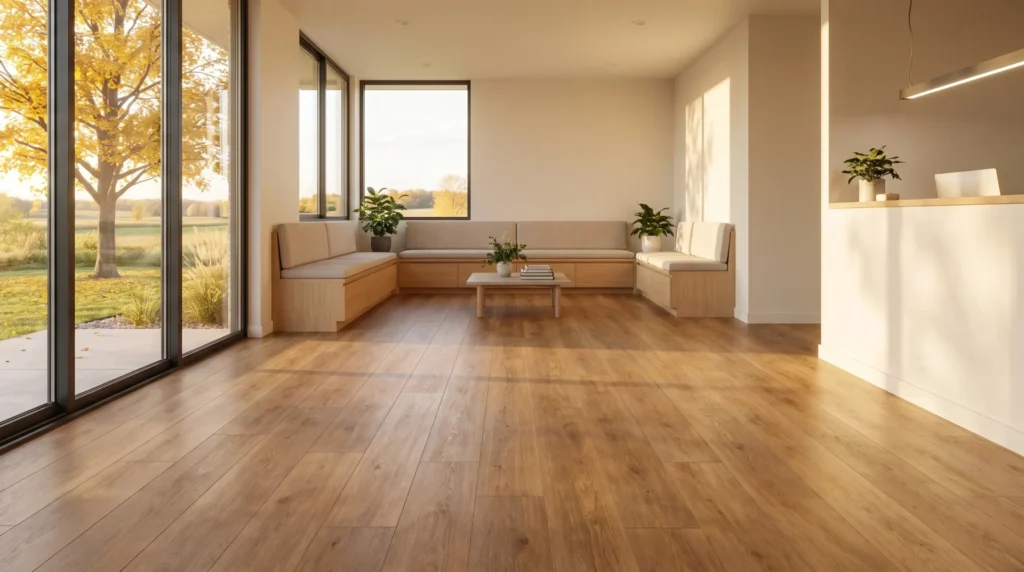
Commercial luxury vinyl tile and plank. Waterproof, hard-wearing, and available in wood and stone visuals that make a lobby feel welcoming. It has seams, which is why we position it in owner-facing and low-incident areas rather than a kennel.
Rubber. The comfort and quiet specialist. It absorbs footfall and impact noise, cushions staff, and handles rolling traffic. Sealed, non-porous rubber suits treatment, recovery, and corridors. Recycled crumb rubber matting is semi-porous and does not belong in a clinical wet zone.
Sealed resinous systems. Poured seamless coatings have a real place in wash-down kennel runs over a sloped, drained slab.
What we steer away from, and why. Carpet and carpet tile cannot be disinfected to a clinical standard, so they stay out of treatment, kennel, and grooming areas, though carpet tile is defensible in a business office where no animals go. Natural stone is porous and needs ongoing sealing, so it is never fully waterproof. Hardwood, engineered wood, and laminate are not waterproof and do not belong in any animal-contact zone. The full range we install is on our commercial flooring page: https://www.harmonyflooring.com/commercial/ .
Zone by Zone: Matching the Floor to the Room
A veterinary facility is not one space, it is seven, and one material throughout means a compromise in every room. This is how we map surfaces to zones.
Zone |
Recommended surface |
Why |
|
Lobby and waiting |
Commercial LVT or LVP, with heavy-duty walk-off matting at the entry |
Owner-facing, so appearance matters. Waterproof and easy to maintain, and the matting catches the salt, slush, and grit that come in on paws and boots. |
|
Exam rooms |
Heat-welded sheet vinyl, or commercial LVT in practices with lighter incident rates |
Accidents happen here regularly. Welded sheet removes the seam risk entirely; LVT is defensible where the cleaning load is lighter. |
|
Treatment and surgery |
Heat-welded sheet vinyl with integral coved base |
Continuous, non-porous, no floor-to-wall joint, and built to take an extended-spectrum disinfectant on a full contact-time cycle. |
|
Kennel and boarding runs |
Heat-welded sheet vinyl with coved base, or a sealed resinous system where drains and washdown are designed in |
The heaviest and most continuous urine exposure in the building. Seams and grout fail here first. |
|
Grooming and bathing |
Heat-welded sheet vinyl with coved base, wet slip resistance specified |
Standing water is constant, and staff and animals are both moving on a wet floor. |
|
Isolation ward |
Heat-welded sheet vinyl, coved, minimal penetrations |
Has to be disinfected to the highest standard in the building, which means giving pathogens nowhere to sit. |
|
Business office and staff areas |
Carpet tile or LVT |
No animal fluids. Acoustics, comfort, and section-by-section replacement matter more here. |
Not sure where the zone lines should fall? Talk through your project with us at https://www.harmonyflooring.com/contact/ and we will map materials to rooms before anyone writes a specification.
What Drives the Investment
In veterinary flooring the material is rarely the largest line, the detail work is. Heat welding, coved base termination, subfloor preparation, slab moisture testing, and drain coordination all take skilled labor, and they decide whether the floor lasts or starts holding odor in year three. The second driver is schedule: a plan that closes a practice for a week costs more than any material difference, so phasing belongs in the conversation from the start.
Wisconsin Realities for Animal Care Facilities
Wisconsin adds two problems a national flooring guide will not mention, and both hit animal facilities harder than ordinary commercial spaces. The first comes through the front door from November into April. Every dog arriving at a Madison clinic tracks in snowmelt, road brine, and ice-melt residue on four wet paws, and every owner does the same on two boots. That mix is corrosive and abrasive, and it turns an entry into a wet floor for most of the day, which is why a real walk-off matting system at the vestibule is a flooring decision and not an accessory. Freeze-thaw cycling at entry slabs adds movement right where thresholds already work hardest.
The second is the building, and around Dane County it splits two ways. Established communities like Middleton and Monona hold older commercial stock, and practices there are often built into converted buildings where the slab has history: previous adhesives, old moisture problems, uneven substrate, and drains never located for an animal facility. Those projects live or die on subfloor preparation. Growing communities to the south like Oregon are seeing newer purpose-built construction, where the slab is clean but young, and new concrete holds construction moisture long after it looks dry. Testing slab relative humidity first is how you avoid pulling up a failed floor two winters later.
Harmony Flooring is based in Madison and serves businesses across Dane County and the surrounding communities, with Design · Measure · Install handled by one team.
Veterinary Clinic Flooring FAQs
What is the best flooring for a veterinary clinic?
Heat-welded sheet vinyl with an integral coved base is the best flooring for the clinical and wet zones of a veterinary clinic, including treatment, surgery, kennel runs, grooming, and isolation, because it forms one continuous non-porous surface with no seam or floor-to-wall joint for urine to enter. Commercial luxury vinyl tile is better for lobbies, exam rooms, and corridors, where appearance carries more weight than absolute seam control.
What flooring is most resistant to pet urine?
Seamless, non-porous sheet flooring with heat-welded seams is the most urine-resistant option for an animal facility. Urine damage is a seam and porosity problem, not a surface problem, so the specification that wins removes the entry points. A coved base matters as much as the field material, because the floor-to-wall joint is where liquid collects.
Who installs commercial flooring for Dane County businesses?
Harmony Flooring installs commercial flooring for businesses throughout Madison and Dane County, including Middleton, Monona, and Oregon. We handle the full process, Design · Measure · Install, with one team from first walkthrough to final detail work. Reach our commercial team at 608-221-5500.
Can you replace commercial flooring in a Madison business without shutting down?
In most cases, yes. Zone-by-zone phasing, evening and weekend work, and contained work areas let a Madison business keep operating while the floor goes in section by section. An animal facility takes extra planning, because adhesive cure times, boarding schedules, and where the animals go all have to be sequenced together. Build the phasing plan before you select the product.
How Harmony Flooring Works
Design. We match materials to each zone, from the lobby through the kennel runs, and turn that into a specification your contractor can build from. Measure. A site visit checks the substrate, tests slab moisture, and looks at drains, transitions, and your operating schedule. Install. Our trusted local installers handle preparation, heat welding, coved base termination, and the detail work that decides whether the floor lasts. One coordinator start to finish, so the person who specified the coving is accountable for how it goes in. That is what Covering Every Detail means where the details are the whole job.
Let’s Plan Your Facility’s Floors
An animal care floor has to do something no ordinary commercial floor is asked to do: stay genuinely sanitary under daily biological load and still feel like a place people want to bring their pets. Get the zones right and the materials follow. Ready to plan your practice, boarding facility, or clinic build-out? Schedule a consultation at https://www.harmonyflooring.com/contact/ with our commercial team, or call 608-221-5500.
Questions About Your Floors?
Call or text 608-221-5500Schedule a Free Consultation
Shop our floors: Hardwood · Vinyl · Carpet · Tile · Laminate
Showroom: 2125 S. Stoughton Rd, Madison, WI 53716