- Commercial Flooring
Best Flooring for a Retail Store, From Door to Stockroom
November 17, 2026
Reviewed by Kevin Sill, Co-owner, Harmony Flooring
The best flooring for a retail store isn’t one product. It is a short list of floors matched to zones: a hard entry floor that stands up to salt and grit, glue-down commercial LVT (luxury vinyl tile) across the sales floor, a quieter surface in fitting rooms, and a tough, quick-mopping floor in the stockroom.
This guide is for shop owners and landlords planning a remodel or a new lease in the Madison, WI area.
In Madison, check one local program first. The City’s Building Improvement Grant lists new flooring as an eligible cost for independent retail businesses in or near certain tax increment districts, including the State Street, Park Street and East Washington Avenue areas. The grant must be approved before work begins, so ask the City before the floor is ordered.
The Short Version: The best flooring for a retail store changes by zone, not wall to wall. Glue-down commercial LVT is the best all-around choice for most sales floors. Plan the floor around fixture resets, the cleaning crew and your slowest month.
Retail Store Flooring Options by Zone
Retail store flooring is a set of floors chosen zone by zone for what each part of the store has to survive: weather at the door, carts and fixtures, socks in fitting rooms, standing staff at checkout, and pallet jacks in back.
Store zone |
What we usually suggest |
Why it holds up |
|
Entry and vestibule |
Commercial tile or LVT behind a long run of walk-off matting |
Salt, sand and meltwater get caught before they reach the sales floor |
|
Sales floor |
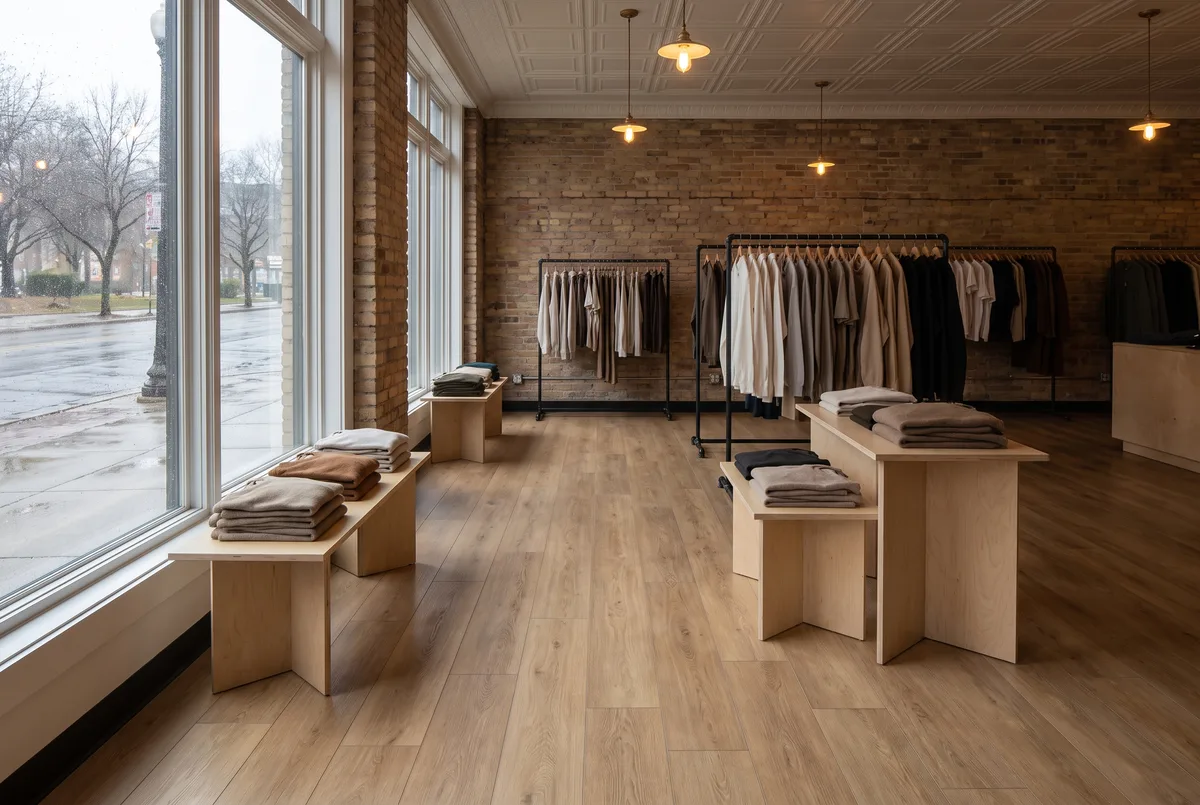
Glue-down commercial LVT in a wood, stone or concrete look |
Takes carts and fixture moves; one damaged plank comes out on its own |
|
Fitting rooms |
Low-pile carpet tile, or the sales floor LVT |
Quiet and warm underfoot; a stained tile swaps out singly |
|
Checkout and service counter |
LVT with a non-staining anti-fatigue mat |
Staff stand and pivot in one spot all day; the mat takes that wear |
|
Stockroom and receiving |
Existing sound concrete or glue-down heavy commercial LVT |
Pallet jacks and dropped cartons; mops clean fast |
|
Restrooms and wet spots |
Slip-rated commercial tile |
Standing water and frequent cleaning |
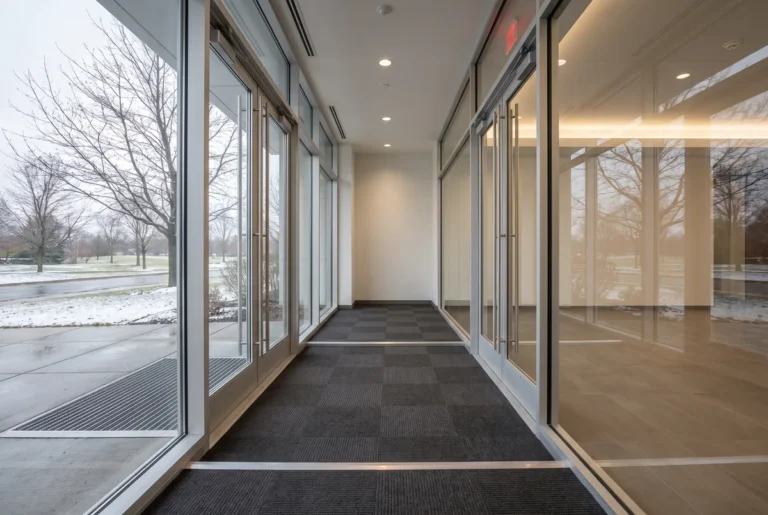
Commercial tile behind built-in matting suits a salty Wisconsin door, and carpet tile fits where quiet matters most.
Harmony Flooring has worked on Madison floors since 2009, and we plan retail jobs zone by zone, with a single project manager from bid through punch list. Browse the LVT, carpet tile and commercial tile lines we source for commercial flooring in Madison.
Why Store Floors in Madison Wear Out at the Door First
Store floors in Madison wear out at the door first, because from November into April shoppers carry salt, grit and meltwater across the first few steps inside. Those same steps are the first thing a customer judges.
That makes the entry a merchandising decision as well as a maintenance one. A hazy, scratched patch inside the door says tired store before anyone reaches a display. Give the entry the toughest surface in the building, keep the brand look on the sales floor behind it, and fit the longest walk-off run the vestibule allows. Our commercial walk-off guide covers the three-zone mat system and how long the run should be.
Sales Floor Flooring: Why Commercial LVT Leads
Glue-down commercial LVT is the best all-around sales floor for most Madison stores, because it takes carts and steady traffic, mops clean, and lets one gouged plank come out on its own.
Commercial LVT usually carries a thicker wear layer (the clear top film that takes the scuffing) and a commercial warranty. Confirm both on the spec sheet. Glue-down matters more in a store than in a home. A floating click floor, with planks locked together instead of glued, gets pinned in place by heavy fixtures and can shift under rolling loads.
The look follows the brand. A wood visual warms a boutique, a stone visual suits a gift or jewelry shop, and a concrete visual gives an industrial brand that raw feel while staying quieter and warmer than a bare slab. Our high-traffic business guide shows how to map traffic lanes before you choose.
Moving Store Fixtures on New LVT
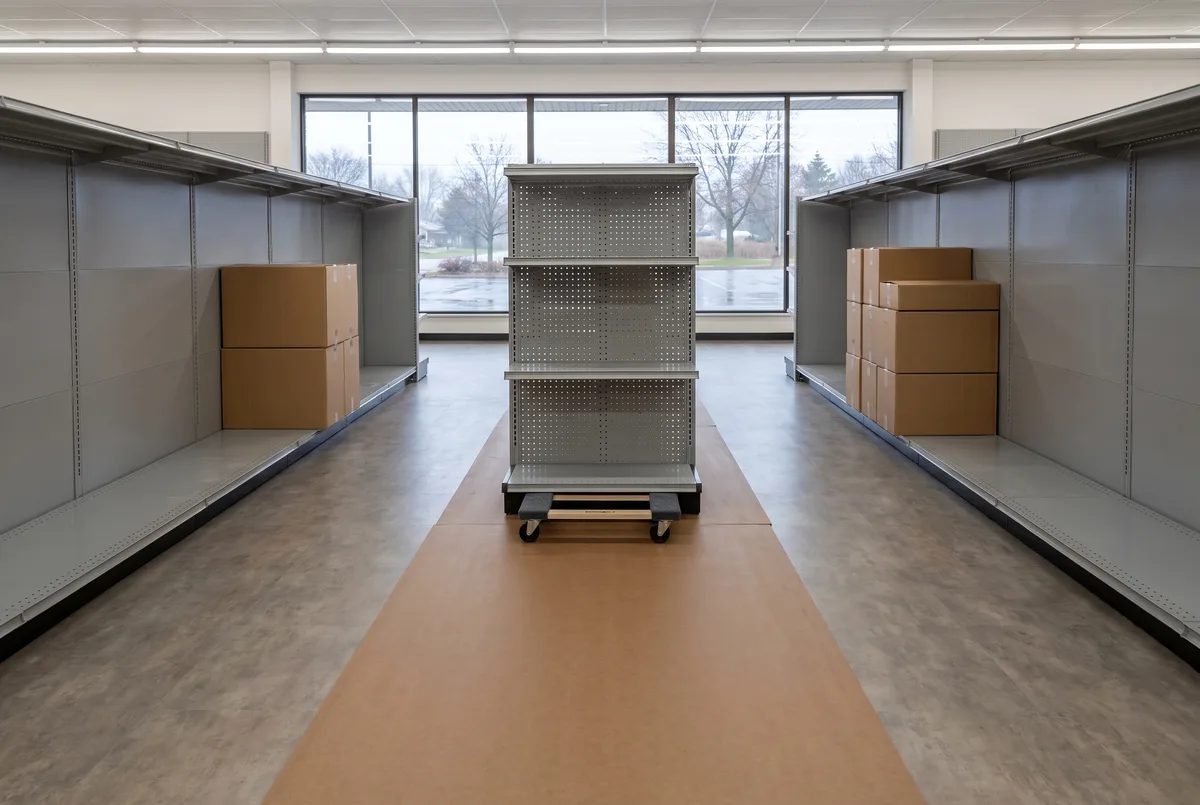
A retail floor’s hardest day is often reset day, not the busiest shopping weekend, because loaded gondolas (freestanding shelving runs), glass cases and display tables get rolled or dragged to new spots.
New LVT is most exposed right after install. J+J Flooring’s LVT installation instructions call for plywood or hardboard laid over new LVT whenever heavy furniture travels on carts or dollies, and a full spread of adhesive under heavy rolling or heavier static loads. Our team plans heavy-fixture zones the same way.
Two decisions at the measure pay off at every reset:
- Run the floor under movable fixtures. A floor laid around a gondola leaves a bare footprint behind the day that gondola moves.
- Keep attic stock. Extra cartons ordered with the job, all from one production run, let a plank scraped during a reset be replaced with a match. Our holiday install guide explains attic stock and floors that repair in pieces.
Fitting Room Flooring for Boutiques
Fitting room flooring in a boutique should feel warm and quiet under socks and bare feet, and it has to stay easy to roll a wheelchair across. Low-pile carpet tile does both well, and the sales floor LVT is the quick-clean alternative. Our carpet tile vs LVP comparison weighs sound against cleaning.
Accessibility sets the details. The U.S. Access Board’s guide to ADA floor surfaces says an accessible surface is firm, stable and slip resistant. Carpet pile on that route can be no more than 1/2 inch, measured to the backing, which rules out plush carpet in an accessible fitting room. The doorway where carpet tile meets LVT also has to stay within the guide’s limits on changes in level, so it is the detail to get right. Your architect or code official confirms what applies to your store.
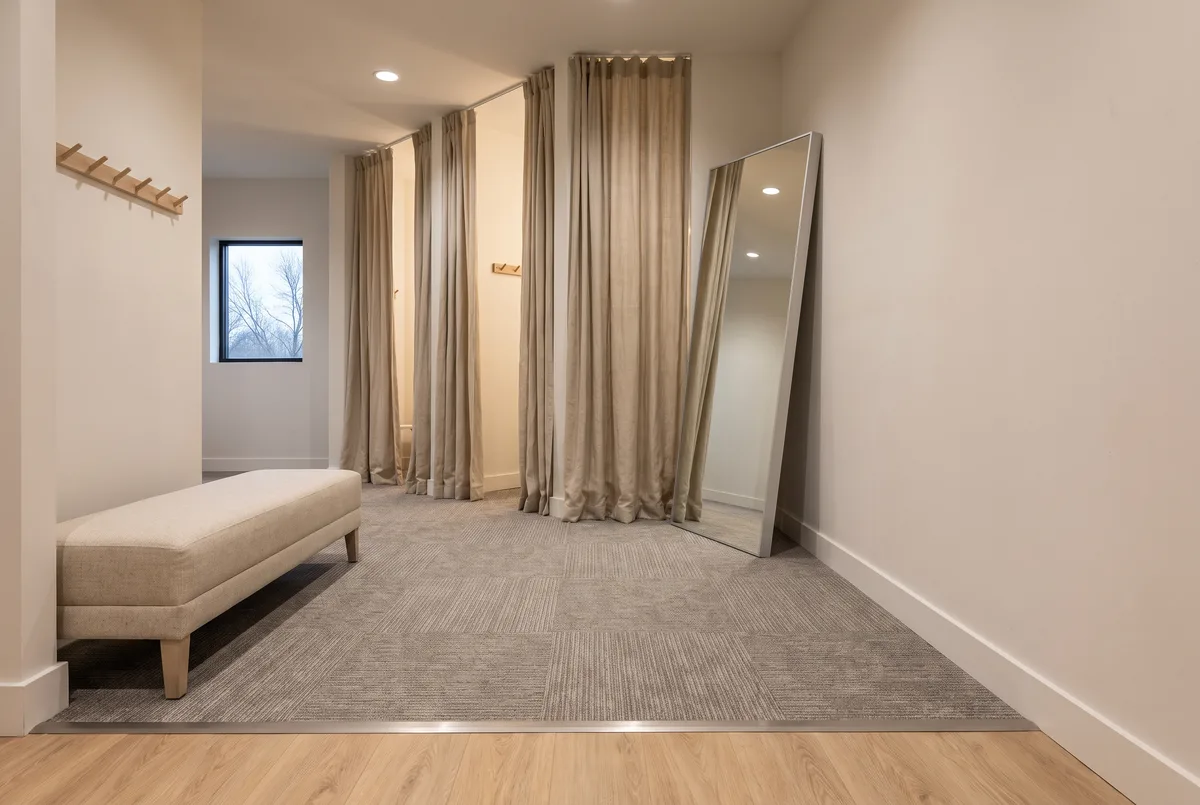
Our commercial carpet tile guide covers how single stained tiles get swapped.
Flooring and Mats Behind a Checkout Counter
Checkout is often the most concentrated wear spot on a sales floor, because staff stand, turn and shift their weight in the same few square feet for a full shift. A good mat matters more there than a softer floor.
Put a commercial anti-fatigue mat on the resilient floor behind the counter, and check its backing first. J+J Flooring’s vinyl tile maintenance guide warns that latex or rubber backed mats can permanently stain vinyl, and it asks for mats labeled non-staining. The same check applies to the mats at the door.
Stockroom and Back-of-House Flooring
Stockroom flooring has one job: take pallet jacks, hand trucks and dropped cartons while mopping clean fast. Where the existing concrete is sound and dry, leaving it bare is a reasonable choice.
When the back room needs a covering, glue-down heavy commercial LVT is the usual pick. Ask the manufacturer for its rolling load guidance and compare it with your heaviest loaded pallet jack. Rubber flooring is the other common back-room pick, because it cushions dropped stock and long shifts on foot, and some sporting goods and fitness shops use it on the sales floor too. Older back rooms often have VCT (vinyl composition tile, the foot-square tiles common in older stores), which asks for a regular strip-and-wax routine that LVT usually does not.
The doorway between stockroom and sales floor deserves a flush or beveled transition. A lip there catches cart wheels and tips stock.
Retail Floor Colors and Finishes That Hide Dirt
A mid-tone, multi-colored or patterned floor with a matte finish hides dirt best on a retail floor, and the best-looking floor is the one your cleaners can keep that way.
The same J+J maintenance guide notes that solid colored floors show scuffs, scratches and dirt more than multi-colored or patterned floors, and that lighter colors show stains more than darker ones. A crisp white floor near a Wisconsin door is a daily mopping commitment.
Finish matters too. A matte or low-sheen surface tends to hide fine scratches better than gloss, and the J+J guide lists floor wax and one-step cleaner polishes among the products not to use on its vinyl tile. Ask your cleaning company which machines and chemicals they bring, then pick a floor whose maker approves them.
Weighing a brand look against what your cleaners can maintain? Talk through your options with us.
Phasing a Retail Flooring Remodel Around Open Hours
A retail flooring remodel is phased by zone, so the store keeps selling while one section at a time comes up and goes back down. January and February, after the holiday rush, are a common window for Madison shops, so the planning happens in November and December.
In each zone, fixtures come off, the new floor goes down, and fixtures return once the adhesive maker’s wait time allows. We work during business hours when we can, and when a store cannot spare an aisle by day, after-hours scheduling is something we can discuss. Our no-shutdown guide walks through the zone-by-zone sequence.
Do this before the holiday rush ends:
- Pick your slow weeks and book the walkthrough in November or December, so the measure, any slab moisture test by a testing firm or your general contractor, any grant approval and the product order land before January.
- Mark every fixture that moves, and which zones can close on which nights.
- Share the plan with staff and your cleaning company, so closing shifts and the crew know which aisles are off limits.
Store Flooring in Madison, Middleton and Oregon
Retail flooring around Madison splits into two kinds of jobs: older storefronts on walkable streets, and larger, newer stores along the main roads.
Along Madison corridors such as State Street, Monroe Street and Williamson Street, shops often sit in older buildings. The floor may be wood-framed over a basement, not a slab, with old flooring layered underneath, so flatness decides the prep.
Middleton’s retail sits along the Beltline, University Avenue and Pleasant View Road, and a store there on a concrete slab should have the slab moisture tested by a testing firm or the general contractor before any glue-down floor goes in.
Oregon’s Main Street shops often sit in older buildings, so the same flatness check comes first.
Harmony Flooring serves retailers in Madison and across Dane County, within 45 minutes of the Capitol. Samples are at our showroom at 2125 S. Stoughton Rd in Madison.
Sources: City of Madison Building Improvement Grant, U.S. Access Board: ADA floor surfaces guide, J+J Flooring LVT installation instructions, J+J Flooring vinyl tile maintenance guide.
Retail Store Flooring FAQs for Madison Shops
Who chooses the flooring in a leased retail space in Madison?
Your lease decides. Retail leases can spell out who approves and pays for floor work, and some landlords publish tenant design criteria or require set products. Ask the landlord for those rules before you choose a sample. Harmony can price a landlord’s or architect’s spec as written, or help you pick a floor that fits the criteria.
Can a Madison retail shop get help paying for new flooring?
Some can. The City of Madison’s Building Improvement Grant lists new flooring as an eligible cost for independent (locally owned or managed) retail, restaurant and retail service businesses in or near certain tax increment districts, while funds last. Tenants need a lease of at least two years and the owner’s written approval, and approval must come before work starts. The City’s Office of Business Resources confirms eligibility.
Is hardwood good flooring for boutiques in Madison?
Hardwood can work in a boutique where the look leads, as long as it stays out of the entry and indoor humidity stays steady. Engineered hardwood moves less than solid through a Wisconsin winter. Grit wears traffic lanes in any wood finish, so plan a long walk-off run and a finish care routine before you commit.
What flooring works in a small grocery store in Wisconsin?
A small grocery store usually needs two floors: glue-down commercial LVT or commercial tile in the dry aisles, and a slip-resistant surface where water collects, such as produce misters, cooler doors and the receiving area. Commercial tile with an ANSI A326.3 wet slip rating fits those wet spots.
Can commercial LVT hold heavy gondola shelving?
Yes, when the LVT is glued down and the load is spread. Check the manufacturer’s static load limit against your loaded fixture, and set fixture feet on wide glides or load plates, because the heavier the fixture, the wider its footprint should be. A floating floor is the wrong base for fixed heavy shelving.
How Harmony Flooring Works
Every Harmony Flooring retail project runs on Design · Measure · Install. Design means we match a floor to each zone, working from your brand, your landlord’s criteria or an architect’s spec. Measure means your project manager walks the store, checks the slab or subfloor for flatness and maps which fixtures move. Install means Harmony schedules the trusted local installers we coordinate zone by zone around your open hours, with one contact from walkthrough to punch list (the final fix-it list before sign-off).
Get the door, the fixtures and the cleaning plan right, and a store floor stays in the background while you sell. That is Covering Every Detail. To plan a January or February remodel, book a store walkthrough or call or text us at 608-221-5500.
Planning New Floors in the Madison Area?
Get a free in-home estimate. We measure, bring samples to your kitchen table and give you one written price. No obligation.
Call or text 608-221-5500Schedule a Free Visit
Shop our floors: Hardwood · Vinyl · Carpet · Tile · Laminate
Showroom: 2125 S. Stoughton Rd, Madison, WI 53716
You Might Also Like
-
- Commercial Flooring
- Floor Care and Cleaning
November 10, 2026
Commercial Entrance Matting and Floors for Wisconsin Winters
-
-