- Commercial flooring
7 Reasons Madison Offices Choose Commercial Carpet Tiles
May 21, 2026
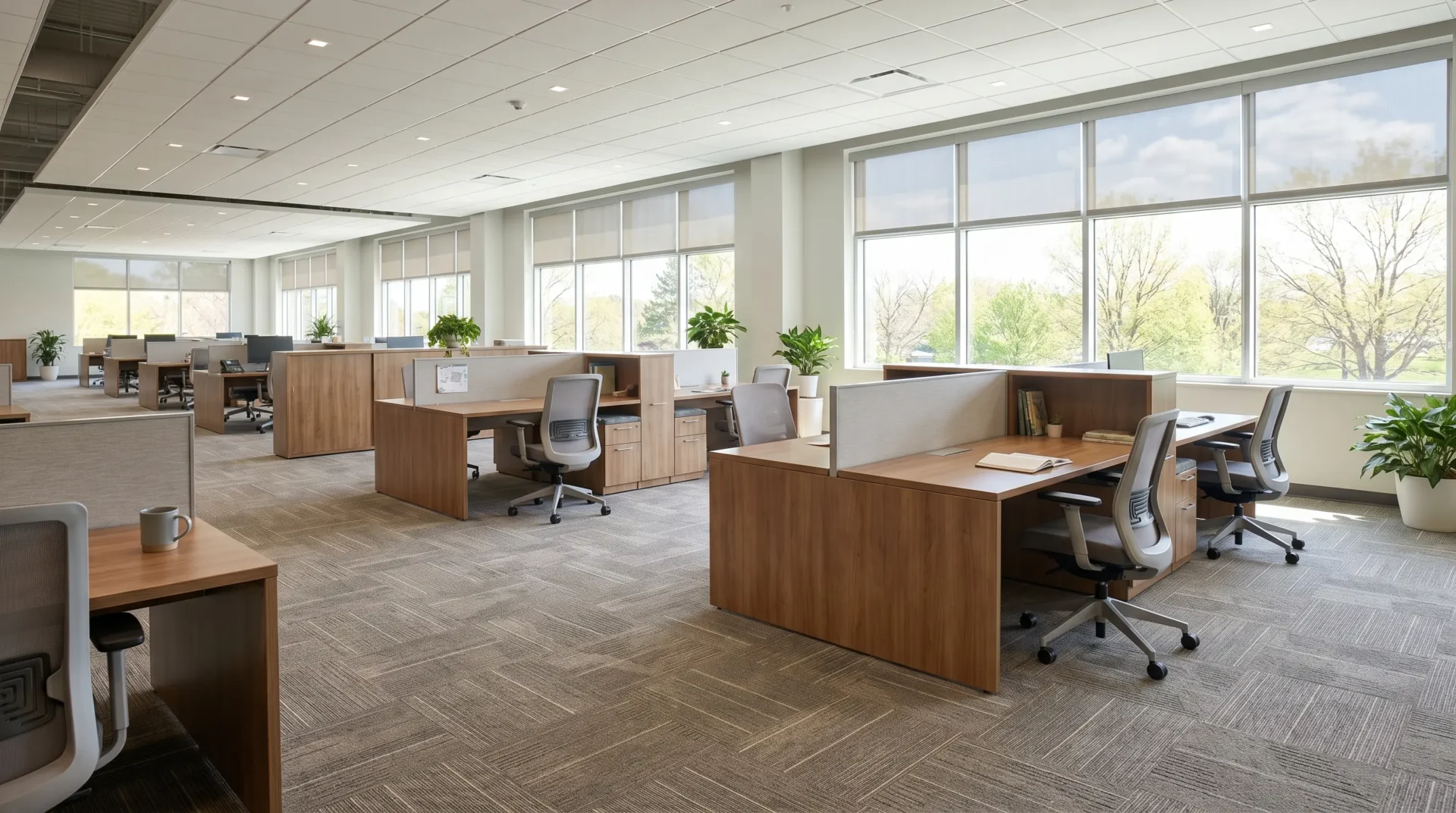
If you manage a Madison-area office, retail space, or professional services building, the floor under your feet is doing more work than most people give it credit for. It absorbs traffic from staff and visitors, takes the daily punishment of rolling chairs and dragged furniture, and quietly sets the tone for what your space feels like. See our commercial flooring page.
Commercial carpet tiles in Madison WI have become one of the most practical answers for that workload. Property managers, facility teams, and business owners across the area are revisiting carpet tile after years of writing it off, and the reasons aren’t just about aesthetics. They come down to uptime, replacement cost, design flexibility, and how the space actually performs day to day.
The Short Version: Commercial carpet tiles let you replace one damaged section instead of an entire floor, install faster with less business disruption, zone open offices visually, and dampen the noise that drains productivity. The 2026 designs look nothing like the flat utility squares from a decade ago.
Here are the seven benefits driving the shift in Madison commercial spaces.
1. Commercial Carpet Tiles Let You Replace One Square, Not the Whole Floor
This is the benefit that wins over most facility managers once they think it through. Broadloom carpet, the wall-to-wall rolled product, is a single piece. Spill coffee in the corner of a conference room and the whole room is on the table for replacement. Drag a desk leg and tear a strip near the door, same story.
Commercial carpet tiles work differently. Each tile is a self-contained 24×24 inch (or sometimes 18×36 or 24×48) piece. When one gets stained, burned, or worn, your team lifts that tile out and drops a fresh one in. The floor keeps running. Your operations keep running.
The math here is real. Keeping a small inventory of replacement tiles on hand means a single repair takes minutes and costs a fraction of a full reinstall. For high-traffic zones like reception areas, breakrooms, and circulation lanes, that’s the difference between an ongoing repair line item and a five-figure replacement project every few years.
2. Faster Install Means Less Business Disruption
Carpet tile installation moves quickly. Tiles are pre-cut, dimensionally stable, and don’t require the long stretching and trimming broadloom does. For a typical Madison office floor, that translates to shorter project windows, fewer evenings and weekends working around your operations, and less time with the space closed off.
This matters more than people expect. A two-day install versus a five-day install can mean the difference between a weekend project and a full week of disrupted staff. For retail and medical spaces in Sun Prairie or Fitchburg where every closed day is lost revenue, the install timeline often drives the product choice more than the look does.
Our team plans every commercial project around your business calendar, including phased room-by-room rollouts when the space can’t fully close. If you want to dig deeper into how that works, our breakdown of commercial flooring installation without shutting down covers the full approach.
3. Commercial Carpet Tiles Are Built for Heavy Punishment
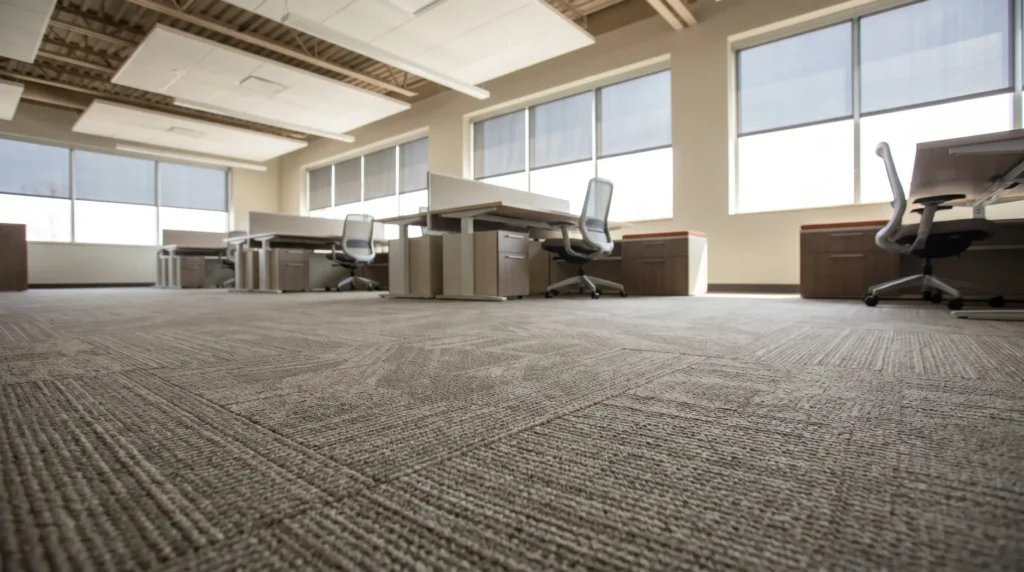
Commercial carpet tiles are engineered to a different standard than residential carpet. The fiber systems, backing layers, and construction methods are built for rolling chairs, dragged furniture, salt and slush at the entries, and the steady abuse of high-traffic foot patterns.
What professionals look for: face weight (a measure of fiber density), tuft bind strength (how well the fibers hold to the backing), and the construction type, typically nylon or solution-dyed nylon for high-performance commercial work. The backing matters too. Closed-cell cushion backings handle Wisconsin freeze-thaw moisture better than older felt-style backings at entry points where salt and slush track in.
The right spec for a 50-person professional services office is different from a high-volume retail floor. That’s not a product question. It’s an honest read of how the space actually gets used.
4. Design Flexibility That Open Offices Actually Need
Today’s commercial carpet tiles are not the flat beige squares that gave the category a reputation. Modern collections include geometric patterns, organic textures, color-blocked systems, and tile layouts designed to be mixed and matched. The 2026 designs hold their own next to wood-look LVT and stone-look tile.
Where they really earn their place is in open-plan commercial spaces. A carpet tile system can visually define a collaboration zone, a focused-work area, and a circulation path without building a single wall. You change the color or pattern at the floor level, and the brain reads the space differently.
For Madison businesses that have moved toward open layouts in Middleton office parks or downtown buildings, that visual zoning is one of the most effective interior design tools available without a construction budget.
5. Acoustic Performance That Quiets the Whole Room
Open offices have a noise problem. Hard floors bounce sound. Conversations carry, footsteps clack, rolling chairs echo, and the cumulative ambient noise wears people down by mid-afternoon.
Carpet tiles absorb sound at the surface, where most of the noise originates. For conference rooms, private offices, executive suites, and any space where focused work matters, that acoustic dampening is a real productivity factor. Healthcare clients tell us the same thing about reception and waiting areas: quieter rooms simply feel calmer.
The acoustic benefit also shows up in multi-tenant buildings. Sound transmission between floors and adjacent suites improves when at least one surface in the room absorbs rather than reflects. It’s a benefit that doesn’t show up on a spec sheet but shows up the first day staff walks in.
6. Less Waste Adds Up Over a Full Floor
Here’s a value detail most buyers don’t realize until they see it broken down. Broadloom carpet installation typically wastes 15 percent or more of the material. That’s product you pay for but never use, lost to the way rolls have to be cut and seamed against the room’s geometry.
Carpet tile waste is usually closer to 3 to 5 percent. For a full commercial floor, that gap is meaningful. It also means the spare tiles you keep on hand for repairs come from the original install rather than a separate purchase later, which keeps dye lots matched and the floor looking consistent over time.
The full value of a carpet tile floor isn’t just the per-square-foot product cost. It’s the install efficiency, the lower waste, the per-tile repair model, and the longer effective life when individual sections can be swapped instead of the whole floor replaced. Looked at over five to ten years, that math usually favors tile in commercial environments.
7. Comfort Underfoot for Staff Who Are on Their Feet
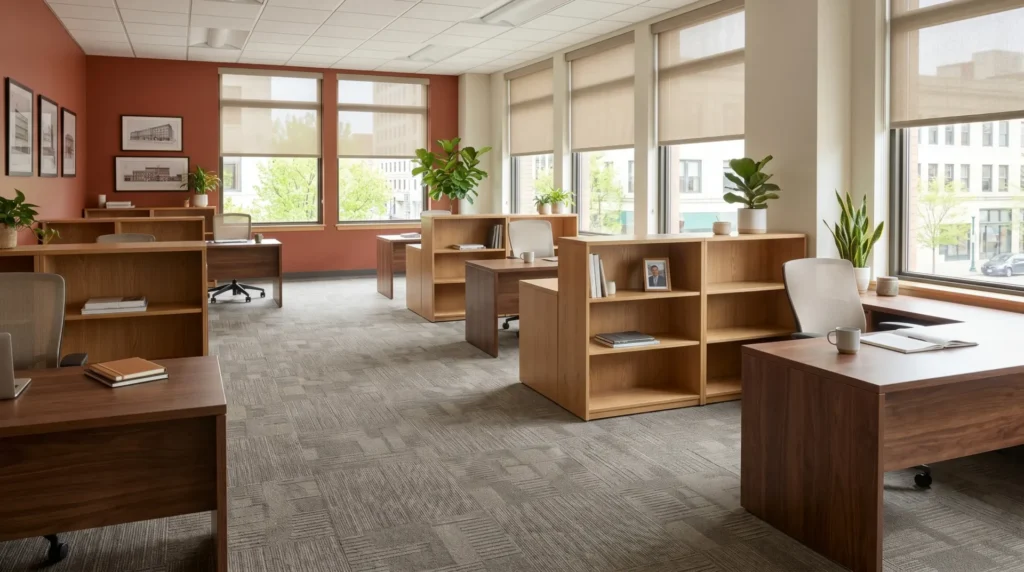
Hard commercial floors are tough on legs, knees, and lower backs over an eight-hour day. Carpet tile, especially with a cushion backing system, takes some of that strain off. Healthcare staff, retail employees, teachers, and anyone who spends most of the day standing or walking notices the difference.
For office environments, the comfort benefit is more subtle but still real. Rolling chairs glide more smoothly, dropped objects survive more often, and the space simply feels more livable. That’s a small daily quality-of-life factor that adds up across a workforce.
When Carpet Tiles Are the Right Call (And When They’re Not)
Carpet tile isn’t the right answer for every commercial space. Restaurants, food prep areas, and most healthcare clinical spaces need fully waterproof, non-porous flooring, where luxury vinyl tile or sheet vinyl is the usual answer. Spaces with frequent rolling equipment or heavy commercial casters sometimes need a harder surface or a specialty carpet tile rated for those loads.
For most office, professional services, education, hospitality common areas, and corporate environments, carpet tile is one of the strongest options available in 2026. The combination of modular replacement, design flexibility, acoustic benefit, and install efficiency lines up well with what those spaces actually need.
If you’re not sure where the line falls for your space, that’s exactly the kind of question we work through at the consultation. Walking through your traffic patterns, maintenance schedule, design goals, and operational constraints leads to a much better recommendation than picking from a swatch book. Schedule a walkthrough with us at harmonyflooring.com/contact when you’re ready to talk through your space.
Keep Reading
- Best Commercial Flooring Choices for Offices and Retail Spaces
- Quiet Flooring Solutions for Open Office Designs
- Commercial Flooring in Madison, WI: how we help businesses plan floors
How Harmony Flooring Works
Every commercial project at Harmony Flooring runs on the Design · Measure · Install framework. We help you choose the right carpet tile system for your building, your use case, and how the space gets lived in day to day. We come to you for a professional measure and substrate assessment so nothing’s left to guesswork. Our trusted local installers handle the full project, including phasing and after-hours work when staying operational matters. Covering Every Detail is how we approach every commercial floor we touch.
FAQ: Commercial Carpet Tiles
How long do commercial carpet tiles last?
A quality commercial carpet tile floor installed in a typical office environment usually performs well for 10 to 15 years before a full replacement is on the table. The modular format extends that further, since individual high-wear tiles can be swapped out as they go without affecting the rest of the floor. Heavy-traffic retail or hospitality settings sit closer to the lower end of that range.
Are commercial carpet tiles a better value than broadloom?
For most commercial settings, yes. Carpet tile waste is typically 3 to 5 percent versus 15 percent or more for broadloom, install times are shorter, and the per-tile repair model keeps long-term maintenance costs lower. Broadloom can still be the right call for large, simple spaces where seam-free continuity matters and the floor isn’t expected to take much localized damage.
Can commercial carpet tiles be installed over existing flooring?
Sometimes, depending on the existing floor’s condition. A flat, dry, well-bonded vinyl floor, sealed concrete, or older carpet tile in good shape can be a viable substrate. Anything with moisture problems, soft spots, or significant level variation needs to be addressed first. Our team handles that subfloor assessment as part of the measure visit so you know what the project actually requires.
Do the seams between carpet tiles come apart over time?
Properly installed tiles with the right adhesive system or pressure-sensitive release backing stay tight for the life of the floor. Visible seams are sometimes a concern with patterned products, especially in low-light installations. Choosing the right tile orientation and pattern at the design stage solves most of those concerns before the first tile goes down.
Are carpet tiles good for high-traffic office areas?
Yes, when the right spec is selected. Heavy-traffic commercial spaces need higher face weights, denser construction, and stain and soil treatments designed for daily abuse. Tile-by-tile replacement makes carpet tile especially well suited to high-traffic zones where damage will eventually happen no matter what’s installed.
How are stained or damaged carpet tiles replaced?
A single damaged tile gets lifted out, the substrate underneath is checked, and a fresh tile from the spare inventory drops into place. The repair usually takes a few minutes per tile. Keeping 5 to 10 percent of the original order as spares means the replacement matches dye lot, pattern direction, and texture across the floor.
Ready to Walk Through Your Commercial Floor?
A 30-minute conversation about your space (square footage, traffic patterns, design goals, schedule constraints) gets you a much clearer picture of whether commercial carpet tiles fit. We work with offices, professional services firms, retail spaces, and multi-tenant buildings across Madison, Middleton, Sun Prairie, Fitchburg, and the surrounding communities. Reach our team at harmonyflooring.com/contact or call 608-221-5500 to schedule a walkthrough. Our commercial flooring page covers the full process if you want to read up first.
Questions About Your Floors?
Call or text 608-221-5500Schedule a Free Consultation
Shop our floors: Hardwood · Vinyl · Carpet · Tile · Laminate
Showroom: 2125 S. Stoughton Rd, Madison, WI 53716