- Commercial Flooring
Commercial Flooring for Salons: A Madison Buyer’s Guide
October 22, 2026
Reviewed by Kevin Sill, Owner, Harmony Flooring
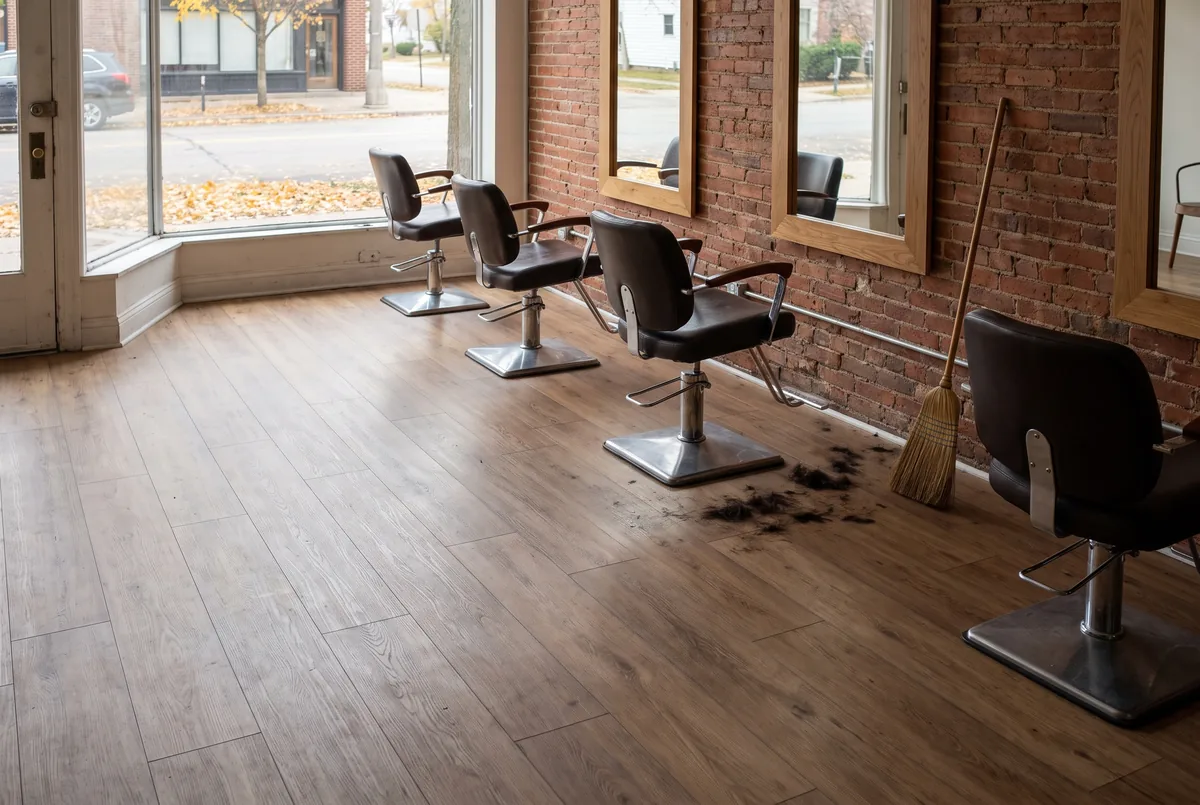
The best commercial flooring for salons is porcelain tile with epoxy grout at the color bar and shampoo stations and glue-down commercial LVT (luxury vinyl tile) on the styling floor and reception, because those zones fail in different ways. Color and developer land on the floor, acetone lands on it, water runs off the shampoo bowls all day, and fine cut hair works into every seam you give it.
This guide is for owners planning a buildout or a refresh, and it answers the real question: what survives your business and still looks good in year five. Harmony Flooring specs and coordinates installation of commercial flooring for salons across Madison and Dane County, and the patterns below come from what actually holds up here.
The Short Version: Commercial flooring for salons has to solve three problems at once: chemical resistance, water at the wash and pedicure stations, and standing comfort for staff. Porcelain tile with epoxy grout wins the wet and color zones. Commercial LVT wins the styling floor and reception. Carpet, natural stone, hardwood, and laminate do not belong in a working salon.
Why Salon Floors Fail Early
Salon floors fail early because of chemistry, standing water at the seams, and hair packed into joints, not because of foot traffic. A retail floor sees shoes. A salon floor sees oxidizers, solvents, dye, disinfectant, and constant moisture in specific spots, all day, every day.
Traffic ratings measure wear, not what happens when permanent color sits on a surface for ten minutes mid-application.
Does Hair Dye Stain Salon Floors? What Chemical Testing Shows
Hair dye can stain some commercial vinyl, and in testing it can be harsher on a floor than acetone or bleach. In published ASTM F925 chemical-resistance testing from one major commercial flooring manufacturer, hair dye caused a severe color change on their commercial luxury vinyl tile at both the five minute and twenty four hour marks. Acetone and ten percent bleach, tested on the same product panel, caused no change at all.
ASTM F925 is the industry test for chemical resistance of resilient flooring: reagents sit on the surface under a watch glass, then the surface is inspected for color change and surface attack. On that manufacturer’s LVT panel, hair dye was one of only a handful of agents that scored severe, alongside permanent marker.
Results vary from product to product, even inside one manufacturer’s resilient lines, because wear layer chemistry differs. That is why the exact product’s data matters more than the category.
Two takeaways. The risk is concentrated at the color bar and styling chairs, not only around the water. And “commercial grade” is not a spec: ask for the manufacturer’s ASTM F925 data for the exact product and confirm how it performed against dye. We do that check before recommending anything for a salon.
How Water and Cut Hair Damage Salon Floors
Water and cut hair damage salon floors at the joints, not the field (the open floor between seams). At shampoo bowls and pedicure stations, repeated wetting finds its way into any seam, edge, or transition and works underneath the flooring. Fine cut hair migrates into grout lines, plank joints, and carpet pile, and once it is packed in, sweeping and vacuuming stop reaching it.
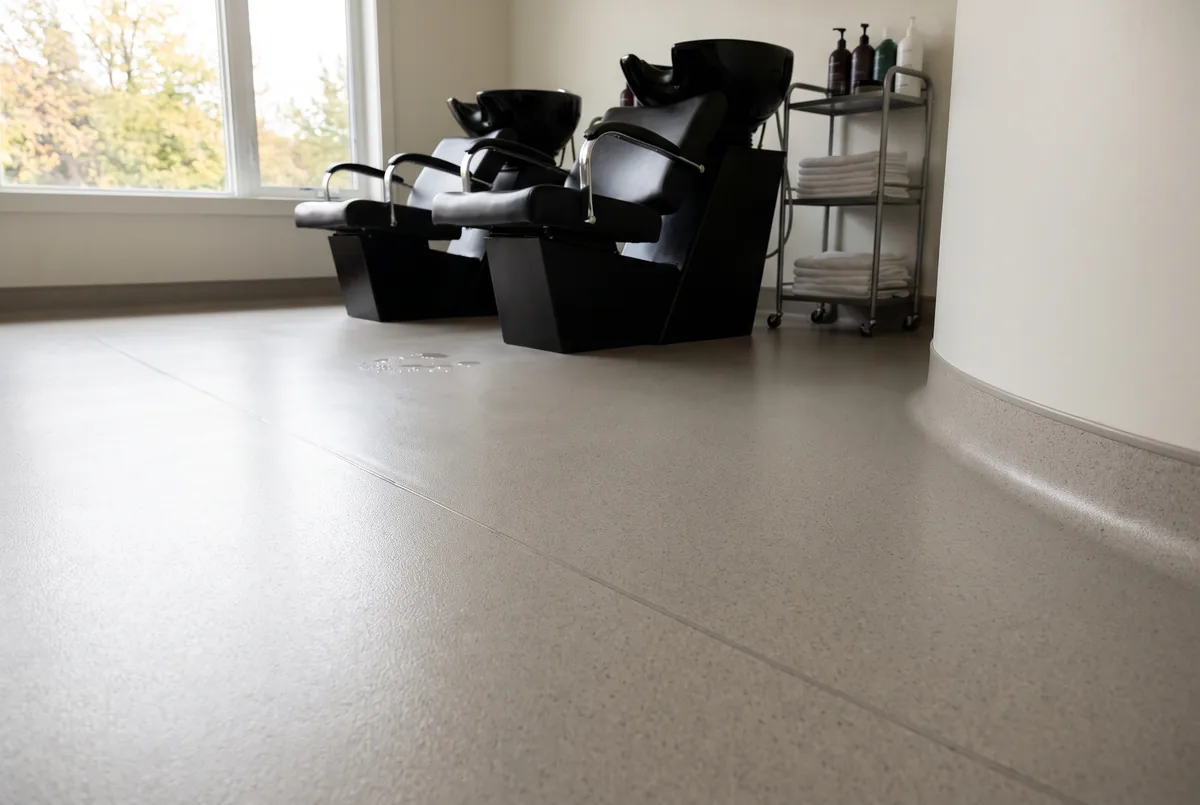
That is the real argument for fewer, tighter joints in the busy zones. Porcelain tile set with epoxy grout gives water and hair a hard, non-porous joint instead of a porous one, and glue-down commercial LVT keeps its seams tight instead of leaving the gaps a floating click floor can open. A tile cove base in a tiled wash zone, or a sealed perimeter with a rubber or vinyl wall base next to LVT, closes the base joint, and that joint is where wet-zone floors tend to let go first. Clinics face the same seam problem, as our guides to veterinary clinic floors in Madison and medical office exam rooms explain.
Best Flooring for Each Salon Zone
The best salon floor plan matches a material to each zone instead of forcing one product to do everything. A typical salon has five or six zones with genuinely different demands.
Zone |
What we usually specify |
Why it works |
|
Reception and retail |
Commercial LVT or LVP, glue-down |
Design freedom for the first impression, hard-wearing, handles rolling carts and salt-tracked entries |
|
Styling floor |
Commercial LVT with a verified dye-resistance result, glue-down |
Takes chair bases and rolling stools, seams stay tight, sweeps clean |
|
Color bar |
Porcelain tile with epoxy grout |
The single highest chemical-exposure spot in the building, and dense porcelain with epoxy grout gives dye little to soak into |
|
Shampoo and wash stations |
Porcelain tile with epoxy grout and a tile cove base, rated for wet slip resistance |
Waterproof tile body and non-porous grout joints, with the base joint closed against standing water |
|
Nail and pedicure |
Porcelain tile with epoxy grout |
Solvent exposure plus water, and the tile and grout clean without absorbing |
|
Treatment and spa rooms |
Porcelain tile or quiet-underfoot resilient |
Delivers the spa aesthetic where clients expect it, waterproof body |
|
Break room and back of house |
Commercial LVT |
Comfortable, quiet, and simple to maintain |
The rule the table points to: wherever color or water lands, choose porcelain tile with epoxy grout; everywhere else, glue-down commercial LVT with verified dye data.
A note on tile. Porcelain and ceramic are waterproof and they give you the spa look, but the grout is the variable. Cement grout is porous and needs ongoing sealing. Epoxy grout meeting ANSI A118.3 is chemical-resistant, water-cleanable, and non-porous, so it does not require sealing. In a color or pedicure zone, that difference decides whether the floor still looks clean in two years.
Salon Flooring for Stylists Who Stand All Day
The floor your stylists stand on all day affects how they feel at the end of a shift, so comfort belongs in the spec. The Bureau of Labor Statistics notes that physical stamina is important in this work because barbers, hairstylists, and cosmetologists are on their feet for most of their shift.
A NIOSH review of prolonged standing at work found consistent reports of low back pain, physical fatigue, muscle pain, and leg swelling, and named floor mats among the interventions in use. Resilient flooring gives underfoot that porcelain and polished concrete cannot. Wherever the design calls for tile, plan anti-fatigue mats at each chair into the layout from the start rather than adding them later.
Slip Resistance: The One Number to Ask For
Ask every product you are considering for its wet DCOF value tested to ANSI A326.3. That standard sets a wet dynamic coefficient of friction of 0.42 or greater for level interior spaces expected to be walked on when wet, which describes your shampoo area, your pedicure stations, and your entry on a snowy Tuesday.
The 2021 edition of the standard (ANSI A326.3-2021) also added a product use classification system, including an Interior Wet Plus category aimed at barefoot-prominent wet areas. That is the relevant one for spa wet rooms and pedicure zones where clients are not wearing shoes. The standard itself is careful to note that meeting 0.42 does not automatically make a material right for every project, so the specifier still has to weigh traffic, contaminants, and how the floor will actually be cleaned. Talk through your space with us, or call or text us at 608-221-5500.
Flooring to Avoid in a Hair Salon
Carpet, natural stone, hardwood, and laminate are the four floors we generally advise against in a working salon. Carpet is the clearest no: fine cut hair works into the pile and never fully comes out, and it holds chemical spills instead of releasing them. Natural stone such as marble, limestone, and travertine is calcareous, which means acids can dull or etch it, and impregnating sealers repel stains without preventing etching.
Hardwood does not tolerate the standing water at wash stations, and repeated chemical exposure attacks the finish. Laminate is not waterproof at the seams, so any water that reaches a joint swells the core, and that damage is permanent. If you want a wood look on the styling floor, wood-look commercial LVT delivers it without the water and chemistry risk. Keep in mind that LVP and vinyl cannot be sanded and refinished the way hardwood can, so the plan is replace rather than restore at end of life.
What Drives the Cost of Salon Flooring
The cost of salon flooring is driven less by the product than by the prep, the wet-zone detailing, and the schedule. The main value drivers:
- Subfloor prep: usually the biggest variable, especially leveling and patching an older storefront slab.
- Wet-zone detailing: epoxy grout, cove base, and drain detailing add skilled labor.
- Zoning: every material change adds a transition, and each one has to be detailed correctly or it becomes the failure point.
- Performance tier: entry-level commercial resilient and a premium wear layer behave very differently against dye.
- Scheduling: salons cannot simply close, so phased work, after-hours installation, and cure times all shape the plan, and we build that in up front.
Salon Flooring in Madison: Winter Salt and Older Slabs
Madison salons face two local problems: road salt at the front door from November into April, and decades-old slabs in converted storefronts. With high client turnover, a salon entry sees more wet footsteps per day than a typical office, and salt grit dulls a floor fast. A generous walk-off matting run inside the door, and a reception floor specified to handle it, does more for the life of your floor than any product upgrade. Our entryway salt guide covers the daily routine.
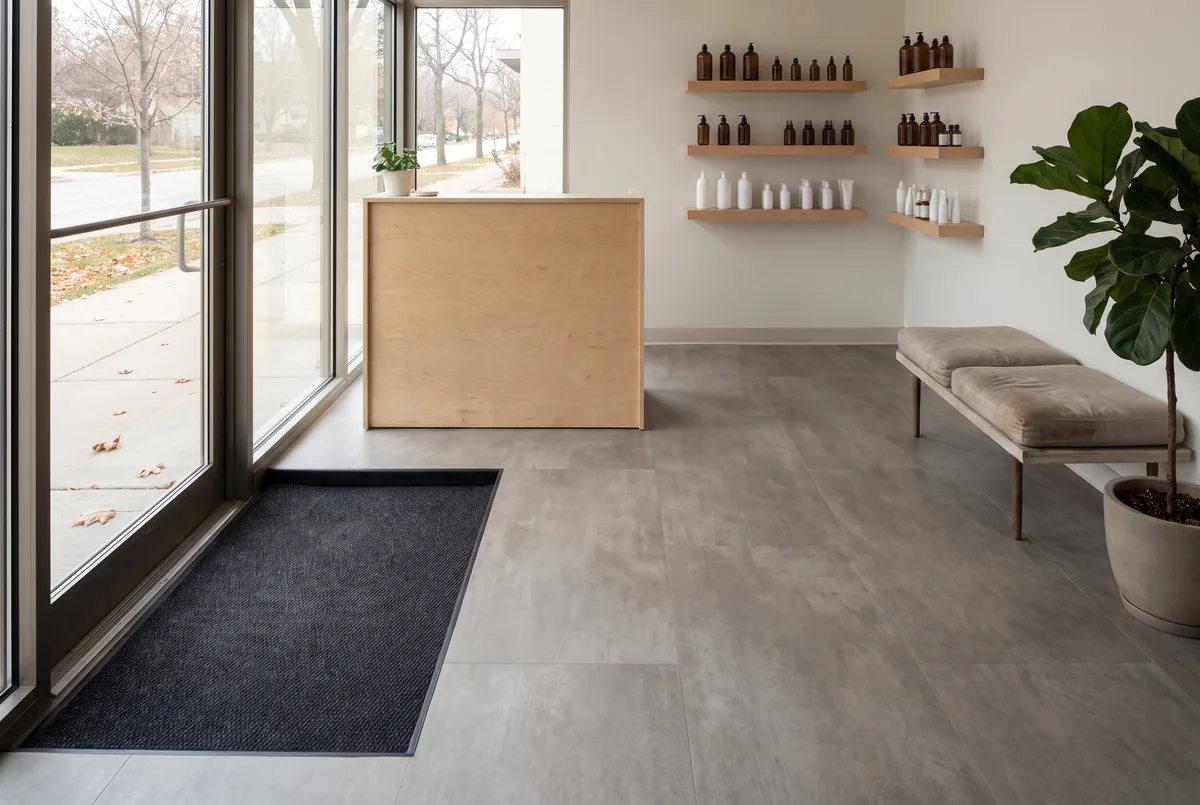
Plenty of Madison salons sit in converted older buildings near State Street, on the near east side, and in older storefronts along University Avenue in Middleton and Fish Hatchery Road in Fitchburg. Those slabs are often decades old, sometimes without a vapor retarder underneath, and slab moisture is a common reason a glue-down floor fails in a converted space. Plan a slab moisture test by a qualified testing firm before the adhesive is chosen, because the wrong adhesive over a wet slab can release (let go of the slab) far sooner than it should.
Newer retail space in Sun Prairie and on Madison’s west side is generally a cleaner starting point, with a more predictable slab and a level substrate. It is not automatically ready, though. New slabs can still be releasing moisture, and the same test applies. Wisconsin’s dry forced-air winters also swing indoor humidity hard, which is one more reason we steer salons away from wood and laminate and toward materials that ignore the seasons.
Sources: ASTM F925, U.S. Bureau of Labor Statistics, NIOSH, TCNA on ANSI A326.3.
Dane County Salon Flooring FAQs
What is the best flooring for a hair salon in Madison, WI?
For a Madison hair salon, the strongest specification is glue-down commercial LVT on the styling floor and reception with porcelain tile and epoxy grout at the color bar and shampoo stations. That combination gives you design flexibility where clients see it and a dense, chemical-resistant, waterproof surface where the risk actually is.
Can new salon flooring go over the old tile in a Madison storefront?
Sometimes. Glue-down commercial LVT can go over old tile that is flat and firmly bonded when the manufacturer’s instructions allow it, usually after the grout lines are skim coated (filled with a thin layer of patching compound) so they do not telegraph, or show through. Loose or cracked tile has to come up. Old resilient tile in an older building may need an asbestos test before anyone disturbs it, and our municipal building flooring guide explains why.
What is the best flooring for a barbershop?
Glue-down commercial LVT is the strongest all-around barbershop floor, because it handles rolling chair bases, sweeps clean, and keeps seams tight against short clippings. Barbershops usually see less hair color than a full-service salon, so the shampoo bowl is the main wet zone, and porcelain tile with epoxy grout there closes the one gap LVT leaves. Choose a low-texture surface, since deep embossing can hold fine clippings the way grout lines do.
How do you keep hair from getting into salon floor seams?
Reduce the number of seams and make the ones you have continuous. Glue-down commercial LVT installed with tight, properly rolled seams gives cut hair far less entry than click-lock or carpet, and porcelain tile with narrow epoxy grout joints keeps hair on the surface where a broom reaches it. Wide or light cement grout lines are the worst option, since hair settles into them and shows.
Is tile or vinyl better for a nail salon?
Porcelain tile is usually the better choice at the pedicure stations, but only with epoxy grout meeting ANSI A118.3, because cement grout is porous and will stain and absorb around pedicure stations. Glue-down commercial LVT works at manicure tables and reception when the manufacturer’s chemical resistance data covers acetone.
How Harmony Flooring Works
Every salon project starts with a conversation about how your space actually operates: where the color gets mixed, where the water lands, and how many chairs are turning on a Saturday. From there our process is Design · Measure · Install. We help you select products with the performance data to back them up, take precise field measurements and flag where the slab needs a moisture test, then coordinate installation through vetted installation partners, including the leveling, grout, wall base, and transition details that decide whether a salon floor lasts. We serve Madison, Dane County, and the surrounding communities, and we stay with the project through the final walkthrough. Covering Every Detail is how we work, because in a salon the details are the whole job. Browse our commercial flooring options for Madison businesses to see the product lines we specify.
If you are planning a salon, spa, or barbershop buildout or refresh in the Madison area, we would like to see your space and put a real specification in front of you. Schedule your free consultation and we will bring specifications to your space. Outfitting more than one type of space? Our office and retail flooring guide covers the rest.
Questions About Your Floors?
Call or text 608-221-5500Schedule a Free Consultation
Shop our floors: Hardwood · Vinyl · Carpet · Tile · Laminate
Showroom: 2125 S. Stoughton Rd, Madison, WI 53716
You Might Also Like
-

- Commercial Flooring
- Buying Guides
October 16, 2026
Municipal Building Flooring: A Wisconsin Buyer’s Guide
-
- Commercial Flooring
- Buying Guides
October 15, 2026
Apartment Turnover Flooring: A Madison Multifamily Guide
-