

- Commercial Flooring
Commercial and Industrial Epoxy Flooring: Wisconsin Guide
January 20, 2026
Reviewed by Kevin Sill, Co-owner, Harmony Flooring
Commercial epoxy flooring is a resin coating system, usually a primer, one or more epoxy body coats and a protective topcoat, bonded to a mechanically prepared concrete slab. It suits warehouses, shops, showrooms and dry plant floors best, while urethane cement (urethane concrete) is the better resin floor for hot washdown kitchens, breweries and food and dairy plants.
This guide compares the resin systems, the specs that decide whether a coating lasts, and the Wisconsin conditions that make or break one: cold slabs, road salt and wet washdowns. It also covers when a floor covering is the better answer. Harmony Flooring does not install epoxy or other resin coatings. A specialty epoxy contractor does that work, and Harmony Flooring can connect you with one. Harmony supplies the floor coverings for the rest of the building, listed on our commercial flooring page for Madison: carpet tile, LVT, rubber, and porcelain and quarry tile.
The Short Version
Pick the resin system by heat, chemicals and traffic, then let slab prep decide whether it lasts.
- Warehouses, shops and showrooms: 100% solids epoxy, with a flake or quartz broadcast where you need texture.
- Hot washdown, food and dairy areas: urethane cement with an integral cove base.
- Forklift lanes and impact zones: troweled epoxy mortar.
- Every system: shot blast or grind the slab to the specified profile and test it for moisture first.
- Offices, clinics, break rooms and stairs in the same building: a commercial floor covering is often the better fit.
Commercial and Industrial Flooring Systems Compared
Here is how the main resin systems compare with each other and with the floor coverings most facilities use in their finished spaces.
System |
Best for |
Heat and washdown |
Chemicals |
Watch for |
|
100% solids epoxy |
Warehouses, showrooms, corridors, light industrial |
Fine for routine mopping; not for hot washdown |
Good against many common chemicals |
Can amber in sunlight without a UV-stable topcoat |
|
Epoxy flake or quartz broadcast |
Break rooms, restrooms, locker rooms, shops |
Moderate |
Set by the topcoat |
More texture means more scrubbing |
|
Epoxy mortar (troweled) |
Loading areas, manufacturing, forklift lanes |
Moderate |
Good |
More labor and material |
|
Urethane cement |
Commercial kitchens, breweries, food and dairy plants |
Built for hot water and thermal shock |
Strong against many food acids and sanitizers |
Specialized install; check color stability |
|
Polished or sealed concrete |
Big retail, distribution, showrooms |
Not for washdown |
Varies by sealer |
Needs a sound slab; slick when wet |
|
Rubber and safety flooring |
Kitchens, stairs, locker rooms, wet areas |
Wet areas, per the maker |
Varies by product |
Seam sealing and the maker’s adhesive spec |
|
Commercial LVT |
Offices, clinics, break rooms, retail |
Damp mopping |
Varies by product |
Not for forklifts or hot washdown |
Quick verdict: 100% solids epoxy is the pick for most dry warehouses, shops and showrooms, while urethane cement wins wherever hot water and washdowns hit the floor.
What Epoxy Flooring Means in Commercial Buildings
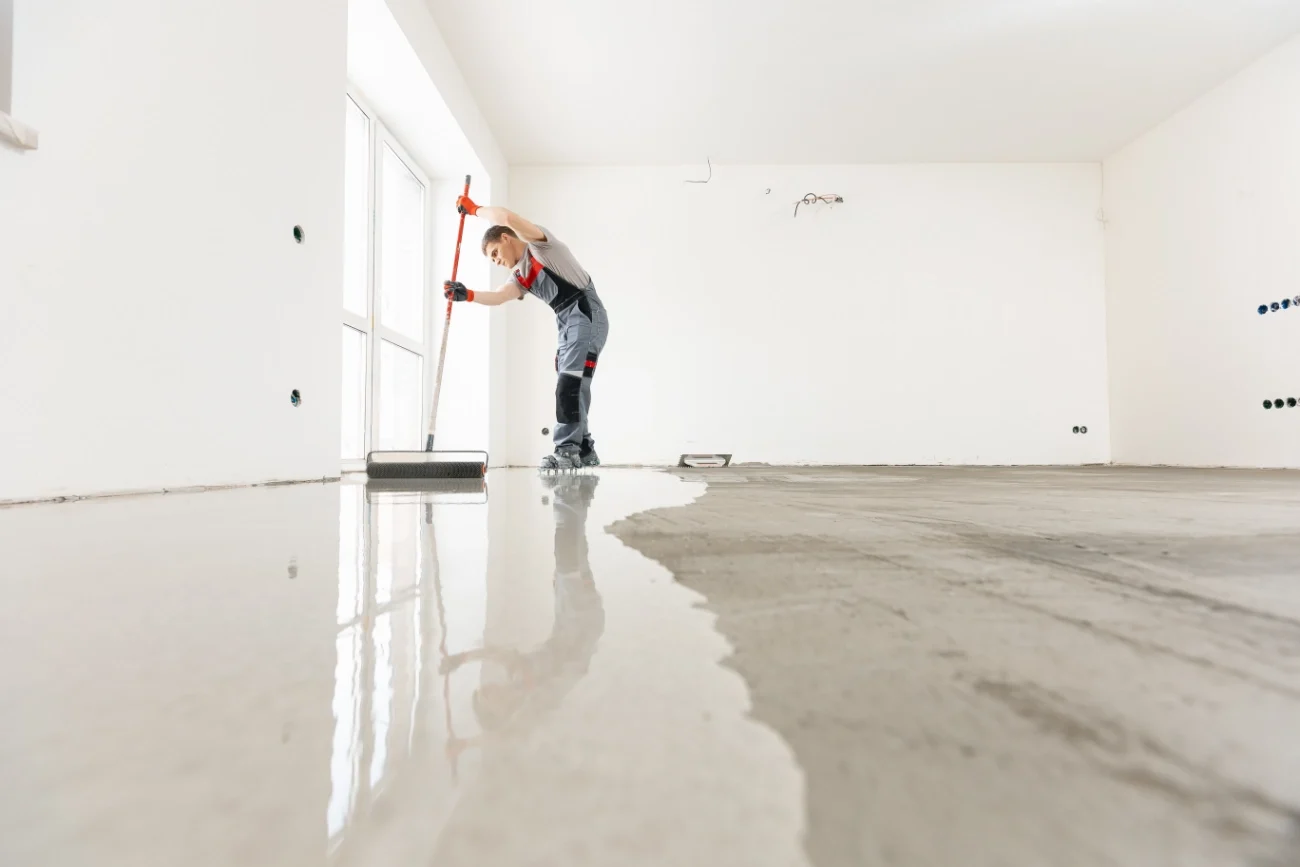
In commercial buildings, “epoxy flooring” means a seamless resinous coating built in layers over concrete, not a single paint coat. A typical system goes down in this order:
- Surface prep: shot blasting or diamond grinding to open the concrete.
- Primer: soaks in and anchors the system to the slab.
- Body coats: one or more epoxy coats that build thickness.
- Broadcast (optional): color flake or quartz for texture and look.
- Topcoat: often a urethane or polyaspartic that sets stain, UV and wear resistance.
Many commercial projects use 100% solids epoxy, which contains no water or solvent to evaporate, so the coat that goes down is close to the thickness that stays.
Commercial Epoxy System Types and Where Each Works Best
Each resin system is built for a different mix of traffic, water and heat.
High-build 100% solids epoxy
Best for: warehouses, showrooms, corridors, light industrial and retail back rooms. It builds a thick film and makes a good base for flake or quartz. Near big windows or bright vestibules, plan a UV-stable topcoat, because many epoxies amber or chalk in sunlight.
Epoxy flake systems
Best for: break rooms, lobbies, restrooms, corridors and shops. Flake hides dirt and scuffs and can be built with texture for traction. The topcoat decides how cleanable and stain resistant the floor is.
Quartz broadcast systems
Best for: locker rooms, restrooms and wet areas that need steady traction. Quartz gives consistent texture, but heavier texture takes longer to scrub, so pick the texture your cleaning staff can keep up with.
Epoxy mortar and troweled systems
Best for: loading areas, manufacturing floors and repair shops. These thick systems take impact and heavy equipment and can rebuild a damaged slab surface, at a higher investment in labor and material.
Urethane cement (urethane concrete)
Best for: commercial kitchens, dish rooms, breweries, food processing and laundry areas. It is not epoxy, but it belongs in the same conversation because it tolerates hot water, thermal shock and repeated washdowns better than standard epoxy systems. It costs more and takes a specialized crew, so it is usually saved for the harshest rooms.
Food Safe Epoxy Flooring in Wisconsin Food and Dairy Plants
No coating is food safe on its own. In food areas, the Wisconsin Food Code (the appendix to ATCP 75) requires floors that are smooth, durable and easily cleanable (section 6-201.11) and floor and wall junctures that are coved and closed or sealed (section 6-201.13 of the FDA Food Code), so the floor system has to meet those rules as installed.
That is why food, cheese and dairy plants lean toward seamless urethane cement or a resin system with an integral cove base. Milk, whey, hot water and the acids and sanitizers plants clean with are hard on floors, so ask the maker for a chemical resistance chart that lists your own sanitizers and cleaners, and confirm the details with your inspector before you finalize the spec.
Slip Resistance: How to Specify It
A good resin floor spec states how slip resistance will be measured, not just that the floor will be “non-slip.” Some resinous floor specs cite ASTM D2047; others call for a wet coefficient of friction test. Ask the coating maker which test their data comes from and whether it was run wet.
- Front of house: cleanable traction, not an aggressive grit that traps grime.
- Back of house and wet areas: more texture, matched to your cleaning equipment and sanitation routine.
Concrete Prep and Surface Profile
Prep decides whether an epoxy floor lasts. The coating needs a mechanically opened surface to bond to, and the industry scale for that is the Concrete Surface Profile from ICRI Guideline 310.2R, which runs from CSP 1 (nearly flat) to CSP 10 (very rough). The coating maker’s data sheet names the CSP range its system needs.
- Shot blasting or diamond grinding to reach the specified CSP.
- Crack and joint repair before the primer goes down.
- Moisture testing: ASTM F2170 (in-slab relative humidity) or ASTM F1869 (calcium chloride), with mitigation if the numbers call for it.
- Contamination removal: oils, silicones and old curing compounds block adhesion.
Skipping prep is how floors peel, bubble and fail early.
Wisconsin Conditions That Change the Spec
Southern Wisconsin adds three problems a national epoxy guide rarely covers: cold slabs, road salt and moisture coming up through older slabs.
- Cold cure: Every epoxy has a minimum air and slab temperature for curing, listed on its data sheet. In an unheated warehouse or loading dock between November and March, that can mean temporary heat or waiting for spring.
- Road salt and brine: Salt season runs November into April. Fleet garages, loading docks and entries see chloride de-icers every day, so check the chemical resistance chart for calcium and magnesium chloride, not just sodium chloride.
- Older slabs: Many older industrial and commercial buildings sit on slabs poured without a vapor retarder underneath. Moisture testing is not optional there.
- Entries: Grit is what wears coatings fastest, so plan walk-off matting at every door that sees winter traffic.
Performance Specs to Compare Bids
To compare bids or write a spec, ask for testable performance numbers on the maker’s data sheet.
- Adhesion: pull-off strength, often tested to ASTM D4541.
- Abrasion resistance: often reported as ASTM D4060 (Taber abrasion).
- Slip resistance: the test method and whether it was run wet.
- Chemical resistance: a chart that names your actual chemicals and exposure times.
- Return to service: hours until foot traffic, and until vehicles and full chemical exposure.
Installation Timeline and Downtime
Downtime for an epoxy floor depends on the system, the square footage and the slab condition. A typical commercial project runs in this order:
- Site evaluation: slab condition, moisture, traffic and cleaning routine.
- Mechanical prep: shot blast or grind to the specified profile.
- Base and body coats.
- Broadcast, if the system uses flake or quartz.
- Topcoat.
- Cure window before foot traffic, then vehicles and equipment, per the data sheet.
Faster-curing topcoats can shorten return to service, but the cure times on the data sheet, not the schedule, decide when the floor is ready.
Cleaning and Common Failure Points
Most commercial epoxy floors do best with dry dust mopping or auto-scrubbing to remove grit, a neutral cleaner suited to the topcoat, and no harsh degreasers unless the system is rated for them. When epoxy fails, it is usually for one of these reasons:
- Moisture vapor from the slab that was never tested or mitigated.
- Too little surface profile for the system.
- Contamination from oils, silicones or curing compounds.
- The wrong system for the room, such as standard epoxy in a hot washdown zone.
- No slip plan, so the texture does not match what the cleaning crew can maintain.
When a Commercial Floor Covering Is the Better Answer
A resin coating is not the best floor for every room in a facility. Offices, clinics, break rooms, restrooms, locker rooms and stairs often do better with a floor covering that is quieter, warmer and easier to replace in sections.
- Commercial kitchens: quarry tile, which takes grease, hot-water washdowns and daily scrubbing.
- Locker rooms, stairs and wet areas: rubber flooring rated by its maker for wet areas.
- Clinics and exam rooms: glue-down commercial LVT with a sealed perimeter, as our medical office flooring guide explains.
- Offices and break rooms: carpet tile or LVT.
- Entries and restrooms: commercial tile that stands up to salt and water.
Harmony Flooring sources these floor coverings for Madison-area facilities and bids them from your spec. Our commercial flooring options guide compares all eight common commercial floors side by side.
Industrial Flooring in Madison: Questions to Answer First
Before you price industrial flooring in Madison, answer six questions, because they decide the system more than any brochure does.
- What rolls on the floor: foot traffic, carts, pallet jacks or forklifts?
- What spills on it, and at what temperature?
- Is it washed down, and with hot water?
- How old is the slab, and has it been tested for moisture?
- Is the space heated year round?
- How long can each area be out of service?
With those answers, a specialty epoxy contractor can recommend a coating for the production floor, and Harmony Flooring can connect you with one. We plan the floor coverings for the offices, break rooms and restrooms in the same building.
Keep Reading
- Best Commercial Flooring Options for Offices and Retail
- Best Flooring for Restaurants and Cafés in Wisconsin
- Gym Flooring for Madison Fitness Studios: A Buyer’s Guide
- Commercial Flooring in Madison, WI: the commercial floors we source and bid
Planning Floors for a Wisconsin Facility
The right facility floor is the one matched to its heat, chemicals, traffic and slab, room by room. If your facility is within about 45 minutes of the Capitol and a build-out or renovation is coming, we can walk the building with you, bid the floor coverings for every space they fit, and connect you with a specialty epoxy contractor for the rooms that need a coating.
Want floors that are durable, safe and easy to maintain? Let’s talk. Harmony Flooring is Covering Every Detail.
Sources: Wisconsin DATCP: Food Code, FDA Food Code 2022, ASTM F2170 and ASTM F1869.
Commercial Epoxy Flooring Questions
Is epoxy or urethane concrete better for commercial flooring?
It depends on the room. Epoxy suits warehouses, showrooms and shops. Urethane concrete handles hot washdowns and thermal shock better, so it fits kitchens, breweries and food plants.
What is resinous flooring?
Resinous flooring is a seamless coating system bonded to concrete. It usually includes a primer, epoxy or urethane body coats and a protective topcoat. The result is a durable surface that’s easy to clean.
Is epoxy flooring a good fit for commercial kitchens?
Epoxy and urethane concrete can both create seamless floors that are easy to sanitize. Hot washdown areas usually do better with urethane concrete. Many kitchens also use quarry tile or rubber flooring, so match the floor to your heat, chemicals and cleaning routine.
How do you specify a resinous floor system for a commercial project?
Start with a site evaluation of the slab, moisture and traffic. Then call out testable specs: surface profile (ICRI CSP), moisture test method, adhesion, abrasion, slip resistance and a chemical resistance list. Write the prep into the spec, not just the coating.
How long does commercial epoxy flooring take to install?
It depends on the system, the size of the space and the slab condition. Prep, base coats and topcoat go down in stages, and each needs a cure window before traffic returns. In unheated Wisconsin spaces, cold slabs can stretch cure times.
Is epoxy flooring food safe?
No coating is food safe on its own. In Wisconsin food areas, the Food Code calls for easily cleanable floors and coved, sealed floor and wall junctures, so a seamless resin system with an integral cove, rated for your temperatures and sanitizers, is the usual answer. Confirm the details with your inspector.
What is the best industrial flooring for a Wisconsin warehouse?
For most dry warehouses, a 100% solids epoxy or troweled epoxy mortar in forklift lanes, over a properly prepared and moisture-tested slab, is the usual choice. In an unheated building, plan the install around the coating’s minimum cure temperature, and check its resistance to road salt brine.
Planning New Floors in the Madison Area?
Get a free in-home estimate. We measure, bring samples to your kitchen table and give you one written price. No obligation.
Call or text 608-221-5500Schedule a Free Visit
Shop our floors: Hardwood · Vinyl · Carpet · Tile · Laminate
Showroom: 2125 S. Stoughton Rd, Madison, WI 53716
You Might Also Like
-

-

-
- Commercial Flooring
- Floor Care and Cleaning
November 10, 2026
Commercial Entrance Matting and Floors for Wisconsin Winters

