

- Flooring Comparisons
- |
- Buying Guides
Wide Plank Flooring vs Narrow Plank for Madison Homes
November 9, 2026
Reviewed by Kevin Sill, Co-owner, Harmony Flooring
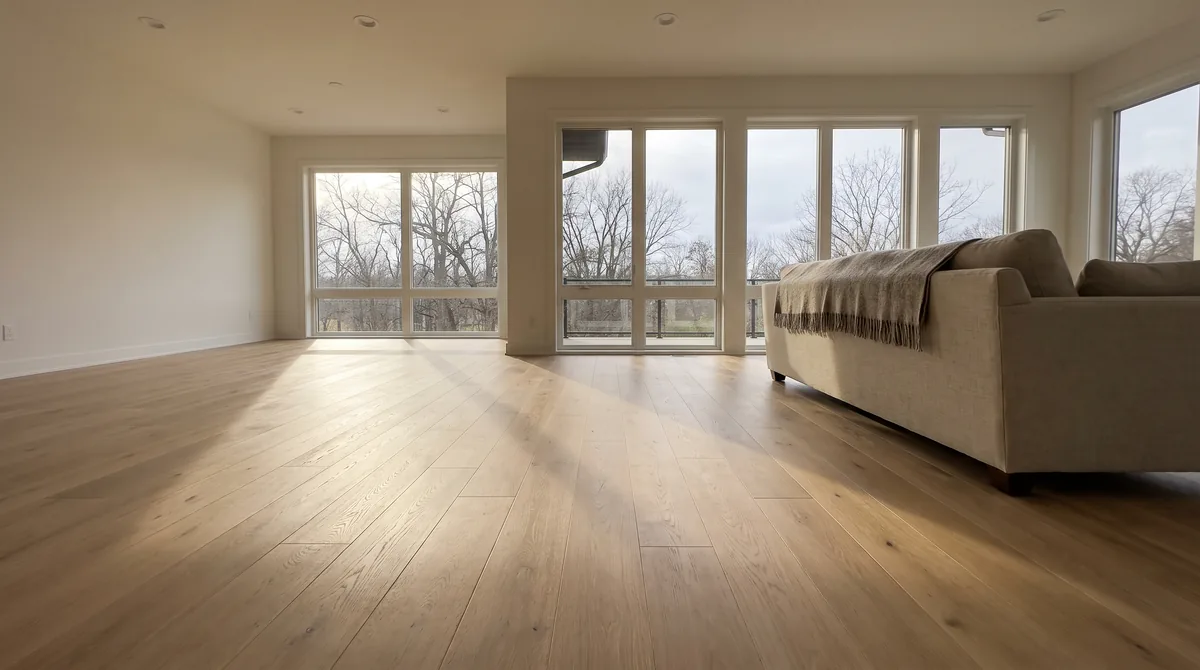
Neither width wins everywhere: wide plank flooring (6 inches and up) suits larger, brighter rooms and newer open plans, while narrow strip (usually 2 1/4 inches) suits smaller rooms and the older Madison homes built around it. In a Wisconsin winter, wide solid boards also show the biggest seasonal gaps, which is why wide floors here are usually engineered hardwood or vinyl plank.
The Short Version: Narrow strip reads traditional and busy, standard widths read neutral, wide planks read calm and modern, and extra wide reads rustic or high-end. Wide planks make rooms feel larger but can turn a narrow hallway into a bowling lane. In a Wisconsin heating season, engineered hardwood or luxury vinyl gives the wide look with smaller winter gaps; wide solid boards work but show more movement.
Wide Plank vs Narrow Plank Flooring: What Each Width Means
Narrow plank flooring is any board under 3 inches wide, and wide plank is any board 6 inches or wider. Everything in between is standard width. These are common industry descriptions, not fixed rules.
- Narrow strip (2 1/4 inch): the classic Madison bungalow and 1950s ranch floor. The many seams read traditional and busy.
- Standard (3 to 5 inch): the neutral middle. It suits almost any style.
- Wide (6 to 8 inch): fewer seams and more grain per board read calm and modern.
- Extra wide (9 inch plus): rustic in a knotty grade, high-end in a clean grade. It needs a big room.
Width |
Best room size |
Light |
Style it suits |
Winter movement in solid wood |
|
Narrow strip (2 1/4 inch) |
Small to medium rooms, older homes |
Handles dim rooms; the lines add texture |
Traditional, bungalow, ranch |
Smallest gap at each seam |
|
Standard (3 to 5 inch) |
Any room |
Works in any light |
Transitional, most homes |
Moderate |
|
Wide (6 to 8 inch) |
Medium to large rooms, open plans |
Best with good daylight |
Modern, Scandinavian, modern farmhouse |
Larger, more visible gaps |
|
Extra wide (9 inch plus) |
Large open rooms |
Best with strong daylight |
Rustic or high-end custom |
Largest; engineered strongly preferred |
For boards 6 inches or wider in a heated Wisconsin home, lean toward engineered hardwood or vinyl plank, and keep solid wood at standard width or narrower. A standard 3 to 5 inch board is the safe pick for most rooms. Wide planks suit large, bright open plans in engineered or vinyl, and narrow strip suits small rooms and older homes. Harmony Flooring helps Madison and Dane County homeowners weigh room, house, and climate together.
How Plank Width Changes the Way a Room Looks
Plank width changes how big a room looks and which way it seems to run. Wide planks mean fewer seams, so the floor reads as one quiet surface and a small room feels larger. Narrow strips add lines, which bring texture but can make a small room feel busy.
Direction matters as much as width: planks laid along a room’s long dimension stretch it.
Wide planks in a long, narrow hallway can look like a bowling lane. If that hall opens into the main floor, keep one width anyway, because a change at the hall looks like a patch.
Choosing Plank Width to Match Cabinets, Walls, and an Open Plan
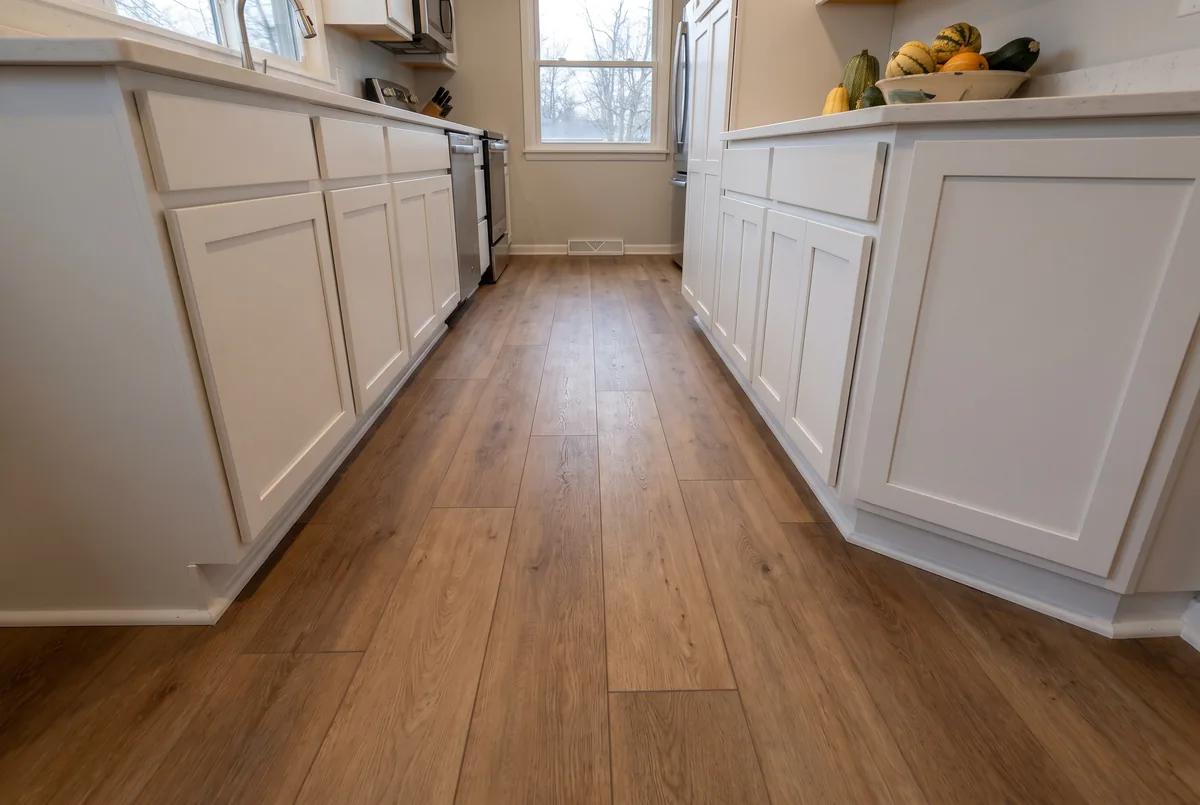
Choose width alongside your cabinets and walls, because width controls how much pattern the floor adds. A wide plank gives busy cabinets or bold walls a calm base, while a narrow strip pairs best with simple cabinet doors and quiet walls.
Our rule of thumb is one busy surface per room. Heavily grained oak cabinets over a high-contrast strip floor can feel crowded. A wide luxury vinyl plank in a soft oak tone under white shaker cabinets gives a clean, calm kitchen.
Wide boards also make color decisions bigger. Our guide to light vs dark flooring explains how tone changes a room. Our cabinet matching guide covers undertones and contrast.
For an open plan, run one width in one direction through the whole connected area, so the living room, kitchen, and dining area read as one space. Our open-concept flooring guide covers transitions and product choice.
Wide Plank vs Narrow Plank Flooring in a Wisconsin Winter
In a Wisconsin heating season, a wide solid board shows bigger winter gaps than a narrow one, because a wide board puts more of its shrinkage into each seam. Our winter gap guide explains why boards shrink and which gaps are normal.
Width changes the install spec too. NWFA installation guidelines require a closer moisture match between solid boards and the subfloor once boards reach 3 inches wide, and our acclimation guide gives the numbers.
That is why we usually steer homeowners who want wide planks toward engineered hardwood or wide plank LVP. Engineered hardwood has a real wood top layer over a layered core that restrains movement. Our engineered vs solid guide covers the tradeoffs. Our Madison hardwood guide compares local options.
Luxury vinyl does not take on moisture from the air the way wood does, so a wide vinyl plank keeps its look all winter. The hardwood flooring we carry in Madison shows the wood looks, and our vinyl plank flooring in Madison shows the vinyl looks.
One more catch: wide vinyl planks are usually longer too, and a long plank bridges dips instead of following them, so subfloor flatness matters more. Our installer guide covers the subfloor check.
Best Plank Width for Pets, Kids, and Resale
The best plank width for pets, kids, and resale is the one that suits the house, because finish and construction decide daily wear more than width does. A matte, wire-brushed (brushed to open the grain), or textured surface hides daily wear at any width; the one width-specific difference is repair, since a damaged wide board is a bigger piece to replace.
For resale, match the width to the house, not to this year’s showroom. Wide planks fit a new build, while in an older home a sound original strip floor, refinished, reads as restored rather than remodeled. Our refinish or replace guide covers how to tell whether an old floor can be saved.
Plank Widths in Older and Newer Dane County Homes
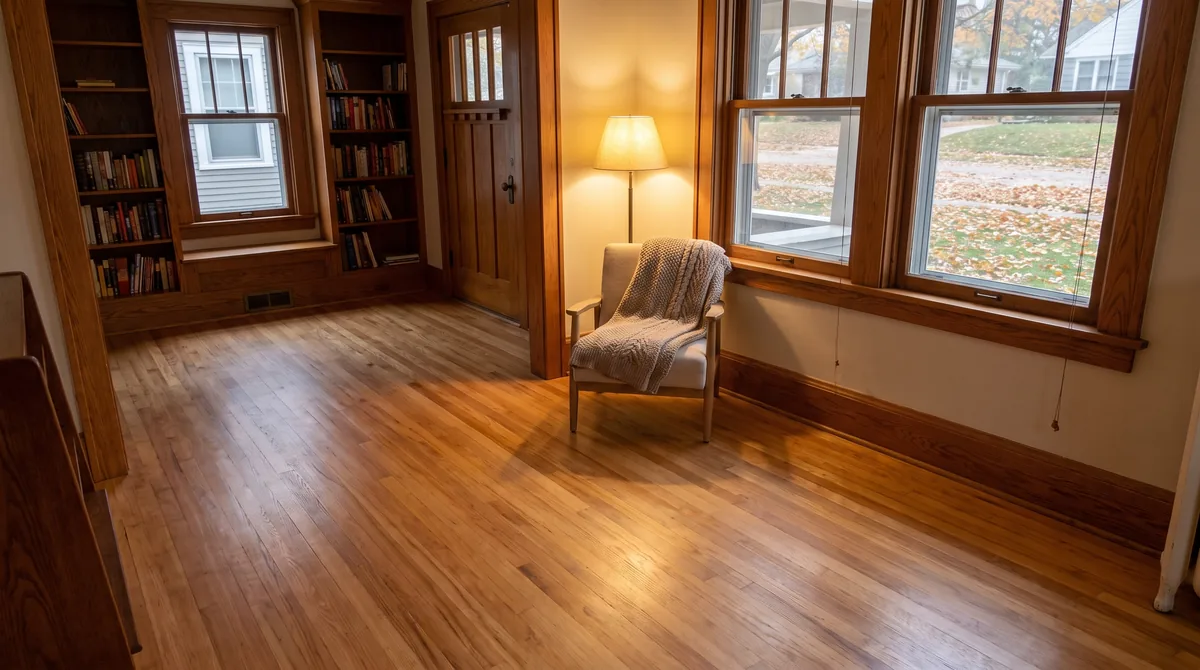
Plank width in Dane County follows the age of the house. Many Madison bungalows and 1950s ranches still have original 2 1/4 inch maple or oak strip, homes built in the 1990s and 2000s commonly have 3 1/4 inch oak, and many new builds use 7 inch or wider planks.
A 1920s bungalow living room with its original narrow maple strip running beside oak trim is worth keeping when the wood is sound. Refinishing usually suits the house better than a wide modern plank, and if you are not sure the old strip can be saved, Harmony can look at it and tell you. Our historic homes guide covers flooring choices for Madison’s older neighborhoods.
In McFarland, most established neighborhoods are ranches and split-levels built from the 1960s through the 1990s, and some still hide oak beneath old carpet. Remodels there often extend that oak into the next room, so matching its width matters. In rooms facing Lake Waubesa, low winter sun crosses the floor at a shallow angle (raking light) and shows every seam.
In Oregon, the village houses near downtown, some over a century old, often keep original wood floors over subfloors that are no longer flat, so a wide plank there starts with leveling. The open-concept homes built from the 2000s on often run 7 inch engineered oak or wide vinyl across the main floor.
Harmony Flooring serves Madison and all of Dane County, including McFarland and Oregon.
How to Compare Plank Widths Before You Choose
The best way to compare plank widths is to see two of them side by side in your own room and light, because showroom photos flatter wide planks with large, bright rooms.
Our room visualizer lets you try wood and vinyl looks in a photo of your room.
Then book a free in-home consultation, where we lay sample boards in two widths where the floor will go, in your own light. Talk through your options with us before you decide.
Sources: NWFA Installation Guidelines, NWFA types of wood floors, USDA Forest Products Laboratory Wood Handbook, chapter 4.
Plank Width FAQs for Madison Homeowners
Does wide plank flooring make a room look bigger?
Usually, yes. Fewer seams make the floor read as one calm surface, which helps a small or medium room feel larger. The exception is a long, narrow space, where wide boards can exaggerate the tunnel effect.
Should I put wide planks in a Madison bungalow?
Usually not, if the original strip floor is still sound. A 1920s Madison bungalow was built around 2 1/4 inch strip, and refinishing it keeps the house’s character. If the floor is beyond saving, a narrower standard width is a respectful middle ground.
Is wide plank flooring more expensive than narrow plank?
Usually, yes, within the same species and grade. Wide solid boards must come from larger, clearer logs, so they sit in a higher tier than strip. Engineered hardwood and vinyl plank narrow that gap.
Should new flooring match the plank width of the existing oak floor in my Dane County home?
Yes, when the new floor will touch the old one. A 3 1/4 inch oak floor looks patched if the next room switches to 7 inch planks at the doorway.
How Harmony Flooring Helps You Choose a Plank Width
The right width fits the age of your house, the size and light of the room, and how much winter movement you will accept. Harmony Flooring follows Design · Measure · Install: we help you choose the width and construction, measure the rooms and check the subfloor, and coordinate the install through vetted installation partners, Covering Every Detail.
Let us help you narrow it down. Schedule a free in-home consultation or call or text us at 608-221-5500.
Planning New Floors in the Madison Area?
Get a free in-home estimate. We measure, bring samples to your kitchen table and give you one written price. No obligation.
Call or text 608-221-5500Schedule a Free Visit
Shop our floors: Hardwood · Vinyl · Carpet · Tile · Laminate
Showroom: 2125 S. Stoughton Rd, Madison, WI 53716
You Might Also Like
-
- Floor Care and Cleaning
- Buying Guides
November 5, 2026
Protect Floors During the Holidays: A Wisconsin Guide
-
- Basements and Wisconsin Climate
- Buying Guides
October 30, 2026
Best Flooring for Wisconsin’s Climate: A Four-Season Guide
-
- Installation and Project Planning
- Buying Guides
October 26, 2026
8 Questions to Ask Before You Hire a Flooring Installer in Madison

