- Buying Guides
Open-Concept Flooring in Madison Homes: A Complete Guide
June 18, 2026
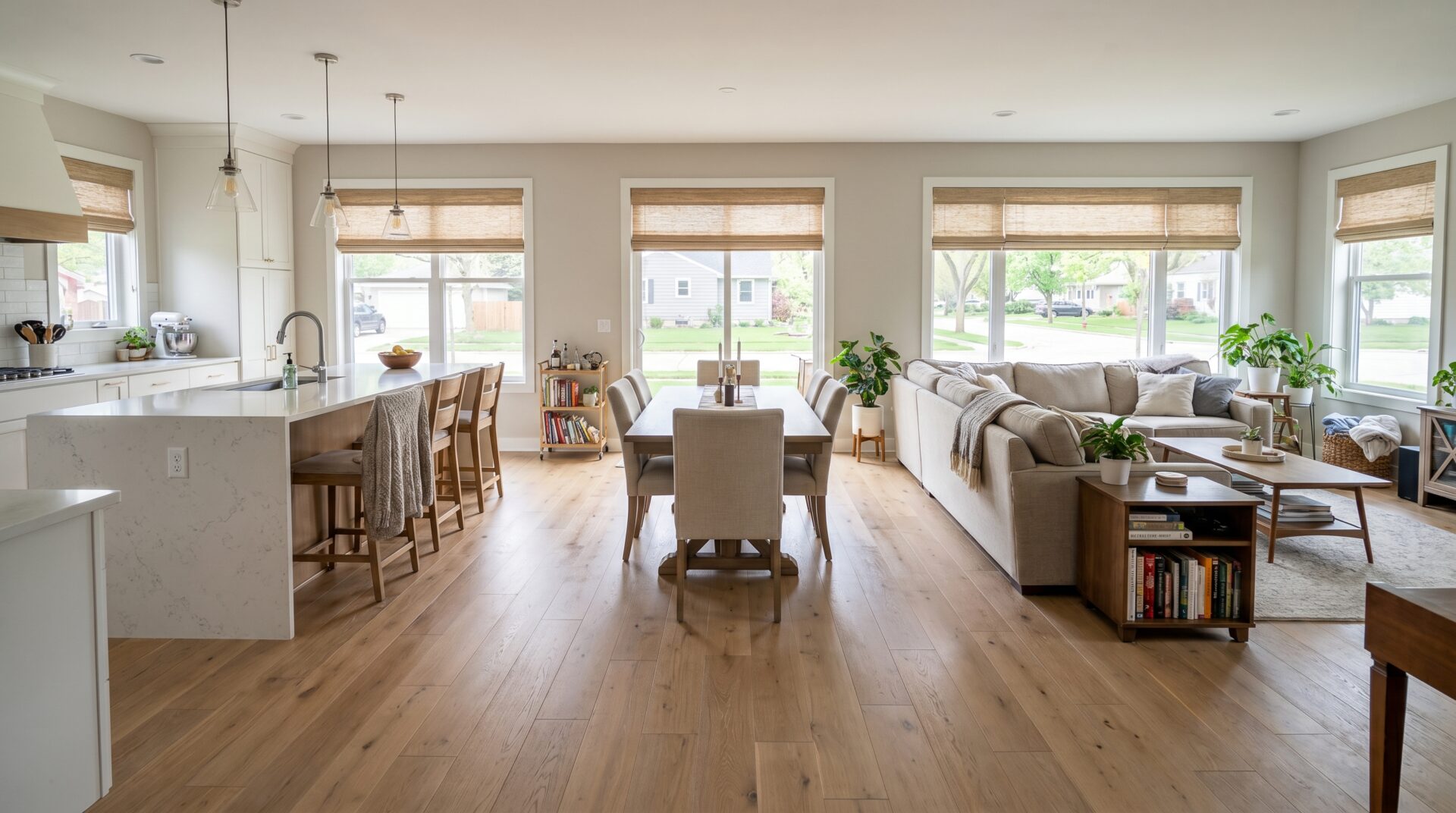
Open-concept main floors are now the standard layout in newer Madison-area homes and a frequent renovation goal in older ones. Walls come down, sightlines stretch from the kitchen through the dining area into the living room, and suddenly the flooring decision is bigger than it used to be. Where a single room used to live behind a doorway with its own floor, now you’re choosing one surface that has to handle cooking, eating, lounging, kids, pets, and the way the whole space photographs from the entry.
This guide walks through how to think about open-concept flooring in Madison homes. The two big choices, the products that work in each, where transitions actually belong if you go that route, and the Wisconsin climate factors that shape the decision. The goal is a main floor that flows the way you want it to, performs the way you need it to, and looks intentional whether you’re standing in the kitchen or walking through the front door.
The Short Version: Most Madison homeowners with an open-concept main floor either run one premium floor (typically wide-plank engineered hardwood, premium LVP, or large-format porcelain wood-look tile) across the entire space, or use two materials max with a clean architectural transition between them. The right choice depends on the home’s layout, how the rooms get used, and the look you’re after.
Key Takeaways
- One continuous floor across the main level is the most common look in modern open-concept design and the easiest path to a cohesive feel.
- Mixed materials work too, but only with intentional transitions and strong design discipline. Two materials max within view at any time.
- Wide-plank engineered hardwood, premium LVP, and large-format porcelain are the three products that hold up best across an open-plan main floor in a Wisconsin home.
- Transitions belong at architectural breaks (doorways, archways, room edges), not in the middle of an open sightline.
- Wisconsin humidity swings make engineered hardwood the safer call than solid for whole-floor open-plan installs in most newer homes.
The Two Big Decisions in Open-Concept Flooring
Every open-concept flooring conversation comes down to two real questions.
One floor or two? The biggest decision is whether you run the same floor across the whole main level, or use different materials for different zones (a wood-look in the living and dining areas, tile in the kitchen, something different in the mudroom). Both can work. Both can also fail. The choice depends on your layout, your willingness to commit to one product across very different uses, and the look you’re trying to achieve.
Continuous or zoned? Even within “one floor everywhere,” there’s a question of how that floor visually reads. A single product running the same direction edge-to-edge feels like one big space. A single product with a different layout in each zone (running direction shifts at the kitchen, for example) reads more like distinct rooms even though the material doesn’t change. These are the moves that make an open-plan floor feel either intentional or accidental.
Get those two decisions right and the rest of the project gets easier. Get them wrong and even the most beautiful product in the most expensive installation will feel slightly off.
Going All-In: One Floor Across the Whole Main Level
This is the dominant choice in modern open-concept design and what we recommend most often for newer Madison-area homes. The reasons are practical and aesthetic.
A single floor across the main level visually expands the space. Sightlines flow uninterrupted from the kitchen through the living room to the dining area, which is exactly what open-plan design is built to deliver. Continuity calms the eye, makes the home feel larger, and reads as an intentional design decision rather than a series of compromises.
The product has to be right, though. A whole-floor install asks one product to handle very different conditions in different zones. The kitchen has water risk, dropped objects, and constant traffic. The living room has furniture loads and rug interactions. The dining area sees chair scrape and food spills. The entry takes salt, slush, and tracked-in moisture from November through April. Not every product handles all of those equally well.
The three products that consistently work across a whole open-concept main level are:
- Wide-plank engineered hardwood. The most common premium choice. Beautiful, durable, handles humidity better than solid, and reads as cohesive across the whole space. Our engineered hardwood vs. solid hardwood guide covers when each fits.
- Premium luxury vinyl plank. Waterproof, scratch-resistant, comfortable underfoot, and now visually convincing enough that most clients can’t tell the difference from real wood. Our LVP guide for Madison homes walks through which products fit which spaces.
- Large-format porcelain wood-look tile. Less common but striking. Very scratch-resistant, fully waterproof, comfortable with radiant heat under it. The trade-off is hardness underfoot in a room where you stand a lot.
Whichever product you pick, go premium. A whole-floor install of an entry-level product is a false economy because the wear difference over a decade shows up everywhere at once. Better to scale down the square footage of the project than to scale down the product tier.
Mixing Materials with Intentional Transitions
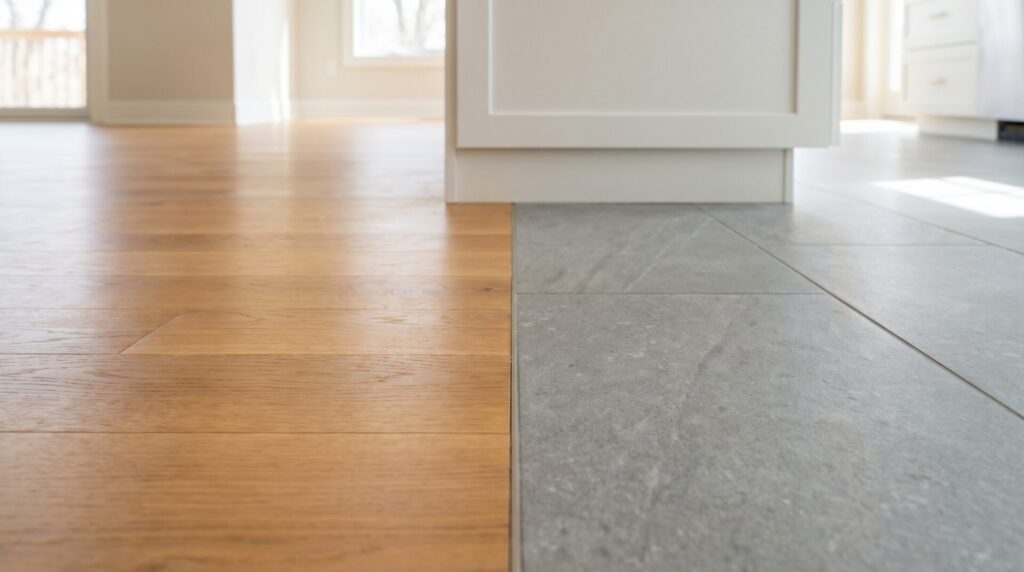
The other path is mixed flooring, intentionally zoned. Hardwood in the living and dining areas, tile in the kitchen, premium LVP in the mudroom and back hall. Done with discipline, this can read as deliberately designed rather than randomly assembled. Done casually, it reads as a series of compromises taped together.
A few rules separate the good version from the bad.
Two materials max within view at any time. When someone stands at one point in your open-plan main floor, they should see at most two flooring materials. Three or more competing in a single sightline always looks busy. If you want hardwood in the great room and tile in the kitchen, that’s fine. Adding a third material visible from either of those points starts to fragment the space.
Place transitions at architectural breaks. A flooring change should land at a real architectural edge, a doorway, an archway, the line where the kitchen island defines the cooking zone, the threshold of a hallway. Transitions in the middle of an open sightline always look arbitrary because they are.
Match scale and tone, not material. A wide-plank wood floor pairs well with large-format tile but reads choppy next to small-format mosaic. Warm-tone hardwood pairs well with warm-tone tile but fights cool gray porcelain. Match the visual weight and color temperature of the materials, even if the materials themselves are different.
Use threshold details intentionally. A clean, low-profile transition strip is itself a design element. So is a flush edge where the materials meet at the same height. Custom thresholds and flush transitions take more time and skill to install than standard pieces, and they also look much better.
Picking the Right Product for a Whole-Floor Install
If you’re going with one floor across the whole main level, the choice between engineered hardwood, premium LVP, and large-format porcelain comes down to a few honest questions.
How important is real wood to you? If the answer is “very,” engineered hardwood is the natural starting point. The look, feel, and patina of real wood are not fully replicable in any other product, even premium LVP that comes close visually.
How much standing water and moisture do you expect? Kitchens with active families, mudrooms attached to the main floor, and homes near Madison’s lakes all see more moisture than the average. Premium LVP or porcelain handle that better than even engineered hardwood. If your kitchen sees serious cooking and your floor plan flows directly from the entry into the main living space, the moisture argument tips toward LVP or tile.
Do you want comfort or durability as the priority? Tile is the most durable but the hardest underfoot. Hardwood is comfortable but more sensitive. Premium LVP sits in the middle, durable enough for most households, comfortable enough for long stretches in the kitchen. For homes where you stand and cook for hours regularly, LVP often wins on this dimension.
What’s underfoot in adjacent rooms? If you have hardwood elsewhere in the house, matching with hardwood on the main floor creates the strongest visual continuity. If you’re starting fresh, all three options are open. Engineered hardwood is the most flexible because it pairs naturally with both traditional and modern adjacent rooms.
Where Transitions Actually Belong (and Where They Don’t)
If you’re using more than one material, where the materials meet matters as much as which materials you choose.
The right transition points in an open-concept main floor:
- Where the kitchen ends. A defined kitchen zone, marked by an island or peninsula, gives you a natural place to transition between a kitchen-friendly floor (tile or porcelain) and a living-area floor (hardwood or LVP).
- At doorways and threshold edges. Where a hallway meets the open main level, where the mudroom enters the kitchen, where a powder room opens off the entry. Doorways are where flooring transitions look most natural.
- At architectural breaks. A change in ceiling height, a defined entry vestibule, a step up or down. Any architectural feature that visually divides the space gives you a logical place to change the floor.
The wrong transition points:
- In the middle of an open sightline. A flooring change that lands in the middle of the great room, with no architectural reason for it, always reads as arbitrary.
- Under the dining table. A transition under furniture is invisible until the furniture moves and then looks like a mistake.
- At rug edges. A transition that lines up with the edge of the area rug today is a transition in the wrong place tomorrow when the rug moves or gets replaced.
The simplest rule: if the transition wouldn’t be visible because of a permanent architectural feature, it’s probably in the wrong place.
If you’re trying to figure out where transitions belong in your specific layout, explore your options with us and we can walk through the floor plan with you.
Wisconsin Climate Considerations for Open-Concept Floors
A few specific things matter for open-concept flooring in Wisconsin homes.
Humidity swings stress whole-floor solid hardwood installs. When a single solid hardwood floor runs across an entire open main level, seasonal movement compounds. Gaps that open in February show up everywhere at once. Engineered hardwood is dimensionally stable across the wet-summer, dry-winter cycle and is the safer call for whole-floor installs in newer Madison-area homes, particularly in the tighter, well-insulated builds in Sun Prairie and Middleton.
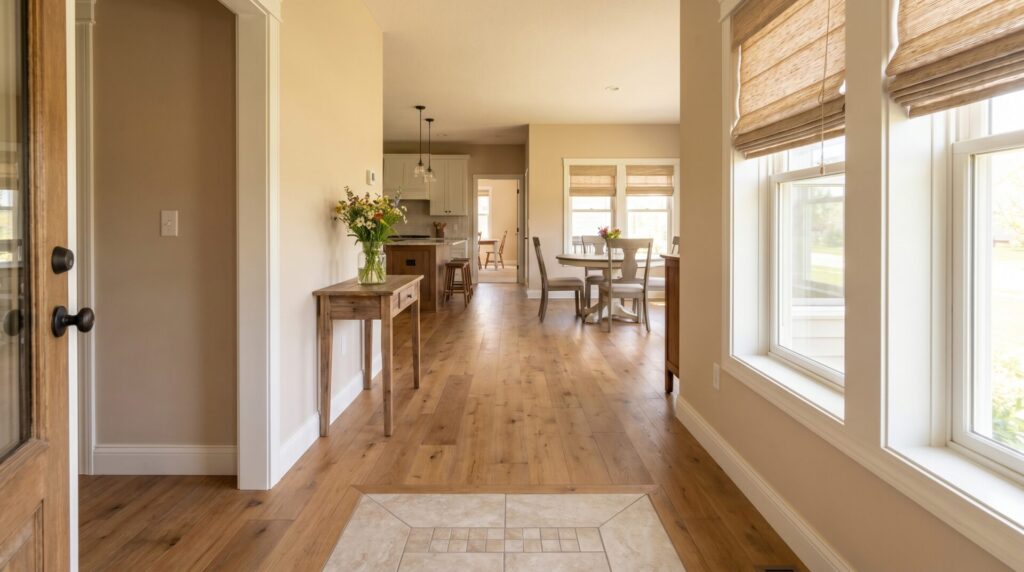
Salt and slush from November through April hit the entry first. If your open-plan main floor runs directly from the front entry or garage door into the living space, the entry zone takes the worst of Wisconsin winter conditions. A waterproof product (premium LVP or porcelain) at the entry, transitioning to your main material a few feet in, can solve the worst-case scenario without compromising the look of the rest of the floor. A walk-off rug helps, but it’s not a substitute for product choice.
Forced-air heat creates dry winter conditions. If you’re going with solid hardwood, plan for whole-house humidification. Without it, a wide-plank solid hardwood floor across an open main level will move noticeably with the seasons. Engineered hardwood handles this without complaint.
Radiant heat is becoming more common in main-floor renovations. If you’re building or renovating with radiant floor heat under the open-plan area, your product choices narrow. Tile, engineered hardwood rated for radiant, and certain premium LVP products work. Solid hardwood does not.
What to Expect from the Process
A whole-floor open-concept project is a meaningful undertaking. A few things worth knowing before you start.
Prep matters more in open-plan installs than in single-room jobs. A floor that runs across multiple zones has to land flat across the whole area, not just within each room. Subfloor flatness across long planes is critical, especially for wide-plank or large-format products. We check this with a long straightedge during the measure visit and tell you straight what prep work is needed.
Plan to be out of the main floor for several days. A typical open-plan main floor installation runs three to five days for a straightforward floor, longer for more complex products like patterned hardwood or large-format porcelain. The space is unusable during the install and for a day or two of cure time after.
Furniture moves matter. Open-plan installs often require moving everything in the great room, dining area, and kitchen at the same time. A clear plan for furniture (storage in another room, in the garage, or with a moving service) is part of the project planning, not an afterthought.
Order materials with overage. A whole-floor install needs more material than the square footage suggests, typically 10-15% extra to account for cuts, pattern matching, and future repairs. Running short mid-project on a discontinued lot is the worst outcome of a poorly-planned order.
Keep Reading
- How to Choose Flooring That Matches Your Cabinet and Wall Colors
- The Best Type of Flooring for Every Room in Your Home
- Vinyl Flooring in Madison, WI: waterproof plank styles and brands
Frequently Asked Questions About Open-Concept Flooring
Should I use one flooring or different materials in an open floor plan?
For most open floor plans, one continuous floor across the main level gives the cleanest look. Mixing materials can work too if each change lands at a doorway or other architectural break.
What’s the best flooring for an open-concept main floor?
Wide-plank engineered hardwood, premium luxury vinyl plank and large-format wood-look porcelain tile hold up best. The right pick depends on how much real wood matters to you. It also depends on how much moisture the floor will see. You can compare the five floors side by side.
Can I have hardwood in the living room and tile in the kitchen?
Yes. Put the change at a natural break, like the edge of the kitchen island. Match the scale and color tone of the two floors. Keep it to two materials in view at once.
Is engineered hardwood better than solid for an open floor plan?
In most Wisconsin homes, yes. Engineered hardwood handles seasonal humidity swings better, and that matters more across a big continuous floor. Solid hardwood still works with whole-house humidity control.
How long does an open-concept floor take?
A straightforward main floor usually takes three to five days. Complex products or a lot of prep can take longer. You’ll get dates before material is ordered.
Choosing the Open-Concept Flooring Approach for Your Home
The open-plan main floor is one of the rooms where flooring choices matter most because the floor is doing more visual work than in any other space in the house. Get it right and the home feels expansive, cohesive, and intentional. Get it wrong and even great furniture and lighting can’t fully fix it.
The honest take: most Madison homeowners with an open-concept main floor are best served by one continuous premium floor (engineered hardwood, premium LVP, or large-format porcelain) running across the whole space. Mixed flooring works for homeowners with strong design discipline and a clear plan for transitions, but it’s the harder path. Either way, the product tier and installation quality matter more in an open-plan space than they do in a series of separate rooms.
If you’re starting a flooring project on an open-concept main floor and want a real conversation about what fits your house, start the conversation with our team at Harmony Flooring. We’ll look at your specific layout, walk through the products that make sense for your conditions, and help you design a floor that reads as intentional from the moment someone walks in.
Questions About Your Floors?
Call or text 608-221-5500Schedule a Free Consultation
Shop our floors: Hardwood · Vinyl · Carpet · Tile · Laminate
Showroom: 2125 S. Stoughton Rd, Madison, WI 53716
- engineered hardwood
- flooring transitions
- LVP
- Madison flooring
- open floor plan
- open-concept
- porcelain tile
- wide-plank hardwood