

- Basements and Wisconsin Climate
- |
- Buying Guides
Best Flooring for Wisconsin’s Climate: A Four-Season Guide
October 30, 2026
Reviewed by Kevin Sill, Co-owner, Harmony Flooring
The best flooring for Wisconsin’s climate is not one floor: it is the right floor in each room, chosen for that room’s hardest season. A floor here lives through five conditions in one year: dry furnace air, a sticky July, salt and slush at the door, a cool concrete basement, and in some homes heat rising through the floor itself. No single product wins all five, though porcelain tile and rigid core vinyl plank come closest.
Across Madison and Dane County, the same pattern shows up every year: the floor that fails is rarely a bad product. It is a good product in a room whose season it was never chosen for. The advice below is written for Wisconsin houses, and it holds across the Upper Midwest too, from Minnesota and Michigan to Iowa and northern Illinois.
The Short Version: Put porcelain tile or rigid core luxury vinyl plank (LVP) at the doors and in the basement, engineered hardwood or LVP in living spaces, carpet or LVP in bedrooms, and tile over radiant heat. For any floor that contains wood, hold indoor humidity in the NWFA range, 30 to 50 percent RH, 60 to 80 degrees F, and change it slowly.
Flooring for Wisconsin’s Climate: The Five Forces Your Floor Lives With
Flooring for Wisconsin’s climate is flooring chosen to handle five seasonal forces: dry heating-season air, humid summers, road salt and freeze-thaw at the doors, ground moisture in basements and slabs, and radiant or forced-air heat. Each force hits a different room, and each floor type answers it differently.
- Dry heating-season air, October into April. Cold outdoor air holds little moisture, and once the furnace warms it, indoor relative humidity (RH, how much moisture the air holds compared with its maximum at that temperature) drops hard. Wood and wood-based floors give up moisture and shrink.
- Humid summers. The same house swings the other way from late spring into September. Wood takes moisture back on and swells, and without steady air conditioning, boards can cup (edges higher than the centers). Our summer cupping guide explains what that looks like and why it happens.
- Salt, slush and freeze-thaw at the door, November into April. Road salt and sand are abrasive grit, and meltwater carries them onto the first few steps inside. Days that thaw and refreeze keep that entry floor wet, then dry, then wet again for weeks.
- Basements, slabs and ground moisture. Concrete is porous, so moisture vapor moves up through a slab even when the surface looks dry, and snowmelt and spring rain soak the soil around the foundation. Below-grade rooms also stay cooler than the floors above them.
- Radiant and forced-air heat. Forced air dries the whole house and hits the boards nearest each register hardest. Radiant heat warms the floor surface directly, which suits some materials and stresses others.
Winter-friendly flooring is only half the job in a four-season state, because the same floor has to handle July too. Our winter flooring guide covers the cold-month picks in more depth.
How Each Floor Type Handles a Cold, Four-Season Climate
Porcelain tile and rigid core LVP (vinyl plank with a stiff composite core, often stone-based) handle the widest range of Wisconsin conditions. Engineered hardwood handles the dry and humid seasons better than solid, while solid hardwood, laminate and carpet each have a force or two they should be kept away from. Here is the whole picture in one table.
Floor type |
Dry heating season |
Humid summer |
Salt and slush at the door |
Basement or slab |
Radiant heat |
|
Solid hardwood |
Shrinks, seasonal gaps open |
Swells, cupping risk without AC |
Grit scratches, standing water stains |
Not below grade (below ground level), per the NWFA |
Usually skipped; engineered is safer |
|
Engineered hardwood |
Moves less than solid, fine gaps possible |
More stable, still needs AC |
Same finish wear as solid |
Possible over a dry, tested slab if the maker allows |
Good when the maker rates it |
|
Rigid core LVP |
Barely moved by humidity |
Barely moved by humidity |
Waterproof surface; grit dulls the wear layer |
A top pick over a dry slab |
Good when rated; respect the maker’s surface limit |
|
Laminate |
Wood-fiber core moves some |
Edges can swell if water gets in |
Not waterproof at seams; poor at the door |
Risky; water-resistant lines over a dry slab only |
Some lines rated; check the spec |
|
Porcelain or ceramic tile |
Unaffected |
Unaffected |
The best door floor; rinse salt film off the grout |
Excellent |
The best partner |
|
Carpet |
Comfortable; more static in dry air |
Can hold dampness in a damp room |
Holds salt and meltwater; skip it at doors |
Only in a dry room with a moisture-tolerant pad |
Thick pad blocks the heat |
Match each room to the force that dominates it, instead of choosing one floor for the whole house and hoping.
Porcelain earns its place at the door because ANSI A137.1, the American standard for ceramic tile, defines porcelain as tile that absorbs 0.5 percent water or less. Engineered hardwood earns its place in living spaces because its cross-layered core restrains the wood on top, so it moves less across the same humidity swing. See the hardwood we carry in Madison.
Laminate sits in between: a wood-fiber core under a tough wear surface, a fine fit for dry living spaces and a poor one at a salty door. Laminate flooring in Madison, WI.
Why Vinyl Plank Can Buckle in Strong Winter Sun
Waterproof is not the same as weatherproof: rigid core vinyl barely reacts to humidity, but it still expands with heat, and a floating floor with no room to grow can peak (joints lifting into a ridge) or buckle. That surprises people, and in Wisconsin the place it gets tested is rarely the basement.
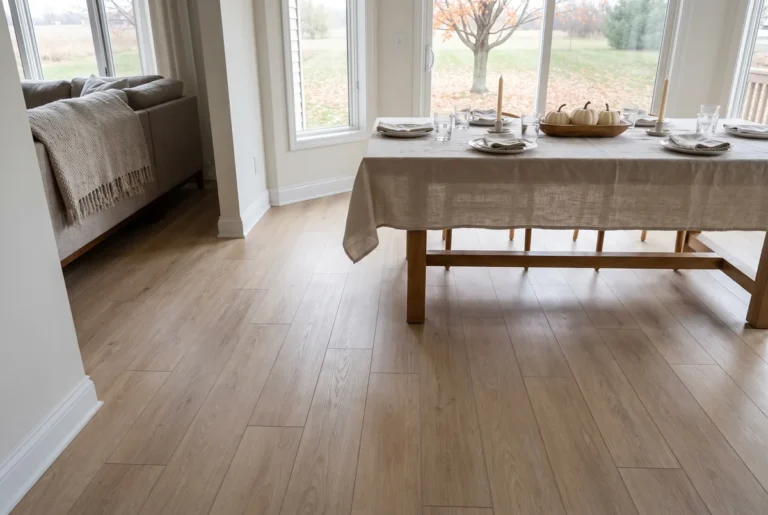
The tougher spot is a sunroom or a run of floor under a big south-facing window. Winter sun sits low, so it reaches deeper into the room than summer sun does, and on a bright January afternoon it can heat a strip of wide oak-look planks well above the room air. A floating floor (one that clicks together instead of being glued down) needs its perimeter expansion gap, the small space left at the walls, to absorb that movement. Manufacturers publish temperature limits for their vinyl, and some call for window coverings in strong direct sun, so the spec sheet for the exact line decides whether it belongs in a sunny room. In the sunniest rooms, a glue-down vinyl rated for the space is often the steadier choice. Browse vinyl plank flooring in Madison.
An unheated three-season porch tests vinyl from the other side. The COREtec Stone instructions call for keeping the room between 55 and 85 degrees F after installation, so check the spec of any vinyl you consider for a porch that sits below freezing in January. Frost-resistant porcelain tile is the usual pick there.
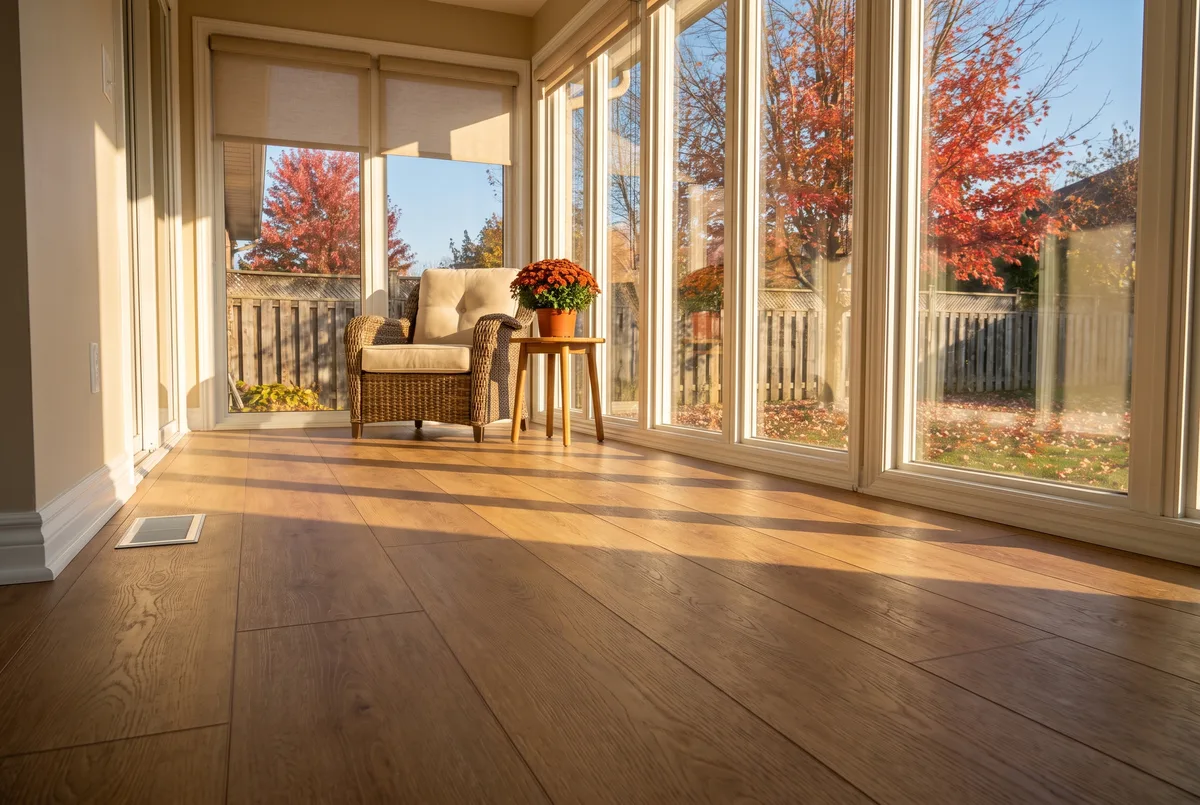
Best Flooring for Each Room in a Wisconsin House
The best flooring for a Wisconsin house changes room by room: tile or LVP at the doors and below grade, engineered hardwood or LVP in the main living space, and carpet or a warm hard surface in bedrooms. Here is how we match each room to its hardest season.
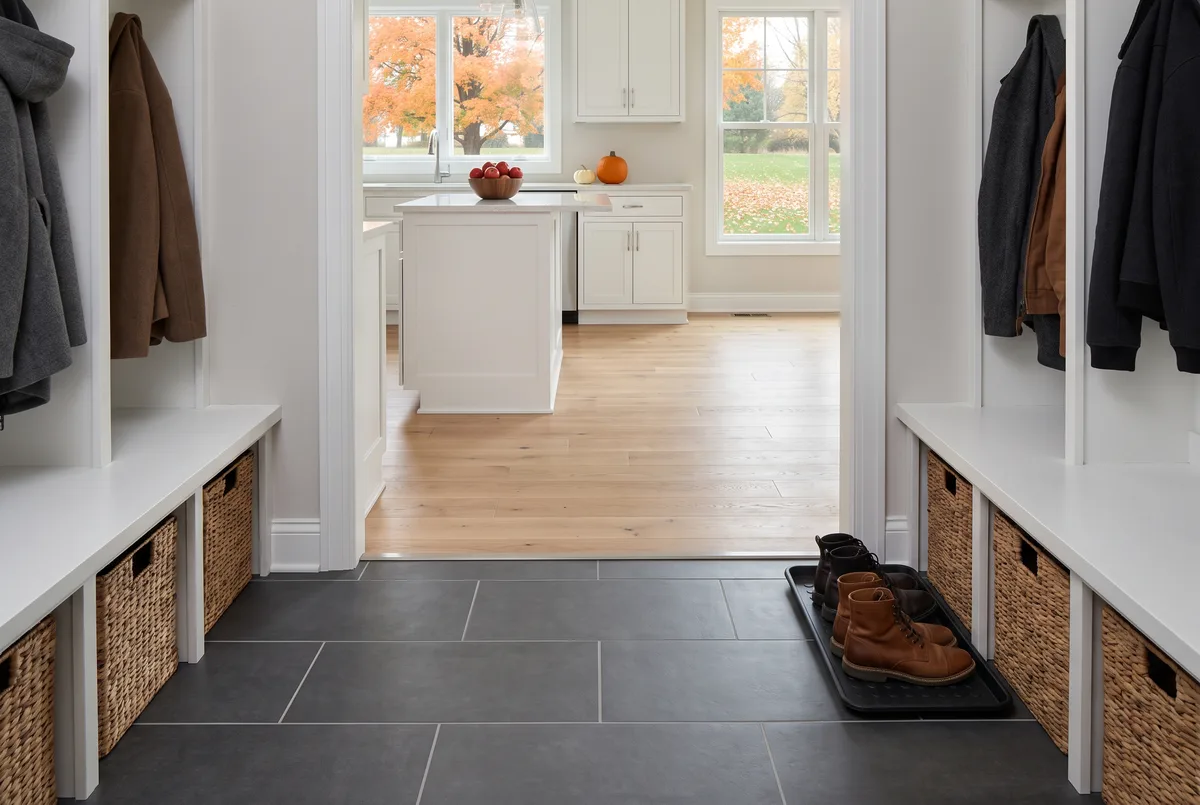
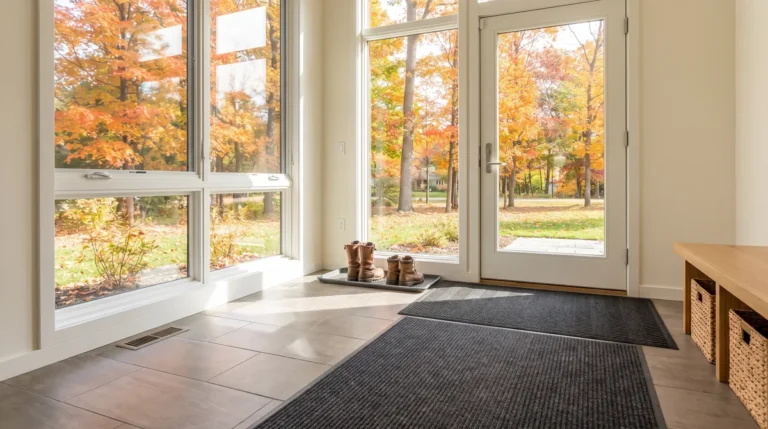
- Entry and mudroom: matte porcelain tile or LVP with a thick wear layer (the clear top layer that protects the printed surface), because salt season runs November into April. Our mudroom and entryway guide ranks the options.
- Kitchen: LVP or porcelain, because both resist water at the surface and a spill wipes up. A slow dishwasher or fridge leak still needs to be found fast, since water can travel under any floor. Engineered hardwood works in an open plan when spills get wiped quickly, since wood is not waterproof.
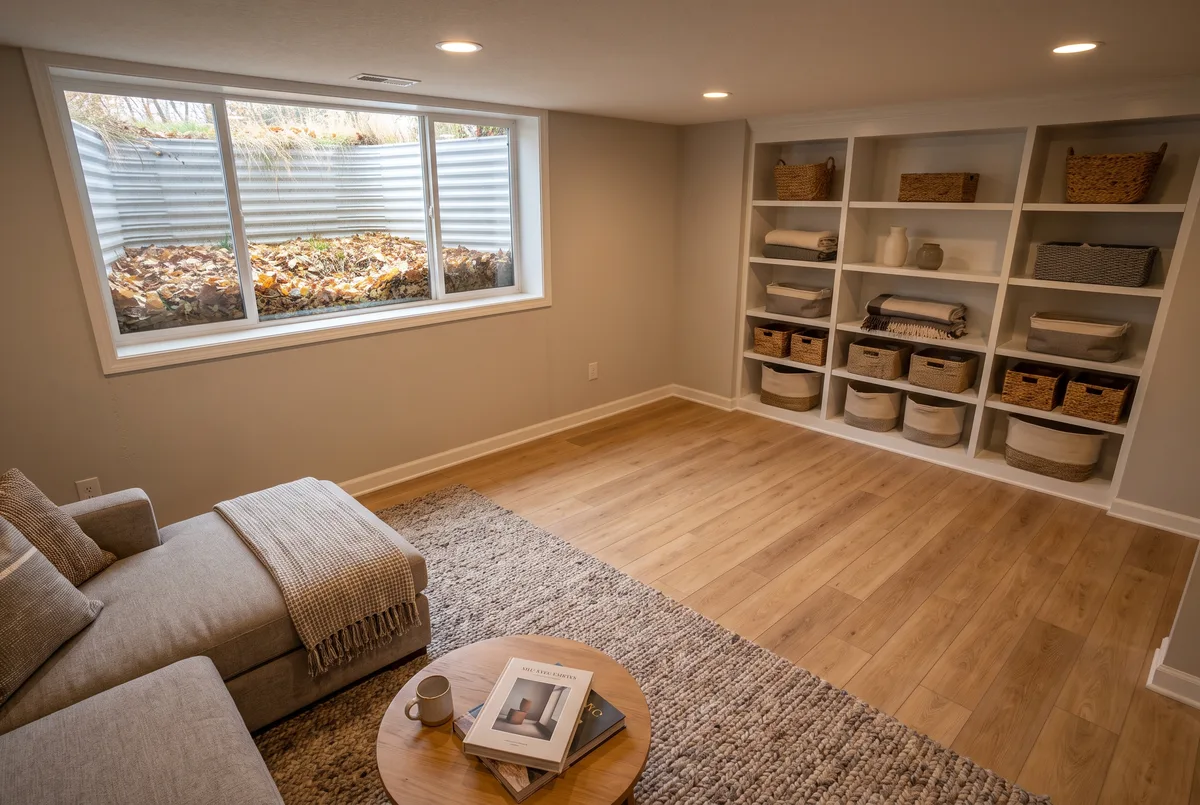
- Basement: rigid core LVP or porcelain over a slab that has been moisture tested, for example with the ASTM F2170 test, which reads humidity from probes set into the concrete. Carpet only in a lower level that stays dry, and never solid hardwood. Our basement moisture guide walks through finding the source first.
- Main living areas: engineered hardwood, solid hardwood in narrower widths with steady humidity control, or LVP. Our local hardwood guide covers species and widths.
- Bedrooms: carpet for warmth and quiet, or engineered hardwood or LVP with an area rug. Our guide to comfortable flooring compares warmth underfoot by material.
- Bathrooms: porcelain tile, often over electric radiant heat, or LVP, which feels warmer underfoot than bare tile. Tile for Madison baths and entries.
- Over radiant heat: tile first, then engineered hardwood and LVP rated for radiant use by the maker. Our radiant heat guide matches floors to each system.
Want to see the room-by-room plan before you commit? Upload a photo of each room to our room visualizer, then bring the looks you like to your free in-home visit.
Prefer one floor across the whole main level? Our one-floor guide weighs that choice for Wisconsin homes.
For bedrooms and dry lower levels, browse carpet in Madison.
Want a second set of eyes on which floor fits which room? Talk through your house room by room with us.
Questions to Ask Before Choosing Flooring for a Cold Climate
The right questions before you choose flooring for a cold climate are about the room’s conditions, not the product’s brochure. Answer these five before any sample comes home:
- Which door does the household actually use from November into April?
- Is the room above, on, or below grade, and has the slab been moisture tested?
- Does the room get strong winter sun through a south or west window?
- What heats it: forced air, radiators, or radiant heat in the floor?
- Can the house hold 30 to 50 percent RH in January, or does it run drier?
The answers usually narrow a room to two floor types before style even comes up.
Indoor Humidity Targets for Floors in Winter and Summer
The National Wood Flooring Association’s target for any room with a wood floor is 30 to 50 percent RH, 60 to 80 degrees F, all year. In a Wisconsin house, that means adding moisture through the heating season and removing it in summer, with changes made gradually.
That target matters for solid hardwood, engineered hardwood and laminate, because all three contain wood. Tile and rigid core vinyl barely react to humidity, though people do: dry winter air is also what makes static shocks and dry skin more common. Our indoor humidity guide covers where to put the meter and how to set the humidifier.
Expect some movement anyway. Thin, even gaps between hardwood boards in January that close by early summer are seasonal, not a defect. Our winter gap guide shows which gaps are normal and which are not.
Wisconsin Floor Care Calendar, Month by Month
A Wisconsin floor care calendar follows the heating season, the salt season and the summer humidity: start humidifying and matting in October, protect entries through winter, clean up and check the basement in April, and control moisture all summer.
When |
What the climate is doing |
What to do for your floors |
|
October |
Furnace starts, indoor air dries quickly |
Start the humidifier as the heat comes on; set mats at every winter door |
|
November to March |
Dry heat plus salt season |
Hold 30 to 50 percent RH; sweep entries daily; wipe meltwater right away; expect thin seasonal gaps |
|
April |
Thaw, last salt, wet ground |
Deep clean entries and wash mats; look for damp spots on the basement floor; ease the humidifier down as the heat shuts off |
|
May to September |
Humid air, strong sun |
Run AC steadily; dehumidify the lower level; close blinds on bright south windows; watch for cupping |
The rule the calendar points to: act at each change of season, not after the damage shows.
Three things to do now, while the furnace is just settling in:
- Set the humidifier now, with a hygrometer (a small humidity meter) in the main living space, before the dry air has a head start.
- Put a coarse mat outside and a soaking mat just inside each door you use all winter, before the first salt run.
- Move boot trays and wet gear off wood and laminate and onto tile or a rubber-backed mat near the door.
Our salt and ice melt guide walks through the daily entry routine.
How Wisconsin’s Climate Shows Up in Dane County Homes
In Dane County, the five forces land in different rooms depending on the age of the house and how close it sits to water. A 1920s Madison bungalow with radiators, a newer Verona two-story with a finished basement, and a McFarland home near Lake Waubesa face the same weather, but each one needs a different floor plan.
In Verona’s newer subdivisions, ground moisture is the force to plan around, because finishing the basement comes up often there. Each of those lower levels sits on a slab, so the slab should be moisture tested by a testing firm or the general contractor before any sample comes out, and rigid core LVP in a warm oak look is a frequent finish once it passes. A house that is still brand new adds one more step: fresh concrete and drywall give off moisture as they dry, so flooring waits until the house is closed in and the heat is running. Our acclimation guide explains why.
In McFarland, the water itself is the force. Lake Waubesa and the Yahara River sit close to a lot of the village’s homes, and the lakeside streets carry sand and wet shoes into the mudroom and dampness into the lower level. That steers mudrooms and lower levels toward porcelain tile or rigid core LVP. Real wood still suits the main floor, but in a house that sits low, engineered hardwood is the steadier pick than solid.
Harmony Flooring serves Madison and all of Dane County, Verona and McFarland included.
When to Call a Flooring Professional About Seasonal Damage
Seasonal movement that comes and goes is normal; damage that stays after the season changes is not, and that is the point to have a professional look. Watch for these:
- Gaps in hardwood that are still open in July or August
- Cupped or crowned boards (centers higher than the edges) that do not settle as the season turns
- Swollen laminate seams or soft spots near a door or sink
- A musty smell, dark staining, or dampness under basement flooring
- A white haze or worn path at the entry that survives proper cleaning
- Cracked grout or loose tile at the door after a freeze-thaw stretch
Each of these needs a diagnosis before anyone picks a fix. Harmony Flooring can look at it and tell you what it needs, whether that is steadier humidity, a moisture source to track down, or a new floor better matched to the room.
Sources: NWFA problem prevention, ANSI on A137.1 porcelain tile, ASTM F2170, COREtec Stone installation instructions.
Wisconsin Climate Flooring FAQs
Will a flooring warranty cover gaps or cupping from Wisconsin’s climate?
Usually not, if the house was kept outside the conditions the maker requires. Hardwood and laminate warranties typically list a humidity and temperature range for the home and treat gaps, cupping or swelling from conditions outside it as a care issue, not a product defect. Keep the maker’s care guide, run a hygrometer, and hold the house in range, so a real defect is easy to tell apart from a dry January.
Is engineered hardwood or LVP better for Wisconsin’s climate?
It depends on the room’s hardest force. Engineered hardwood is the better choice where you want real wood in a main living space with humidity control, because its layered core moves less than solid wood. Rigid core LVP is the better choice anywhere water, salt or a basement slab is involved, because it is waterproof at the surface and barely reacts to humidity. The two often share one house.
Is the best flooring for Midwest homes the same in Minnesota, Michigan and Iowa?
Largely, yes. Minnesota, Michigan, Iowa and northern Illinois share Wisconsin’s dry heated winters, humid summers, salted roads and basements, so the same room-by-room logic applies. That is why the best flooring for cold climates is a room-by-room answer wherever you live. What changes is degree: where winters run longer and colder, as in much of Minnesota, the humidifier season and the salt season run longer too.
Can we turn the heat down in a Madison home while we’re away for the winter?
Yes, within limits. The NWFA range for wood floors starts at 60 degrees F, so a long stretch below that moves a wood floor outside its recommended range, and laminate and vinyl makers publish their own temperature limits. Set the thermostat no lower than your floor’s maker allows, and if you have a whole-home humidifier, leave it on a modest setting rather than off.
Will flooring that worked in a warmer state hold up in a Wisconsin home?
Mostly, but not room for room. Families moving to the Madison area from a milder climate often find their old choices need adjusting: wide solid hardwood shows bigger seasonal gaps, laminate and carpet struggle at a salted entry, and a basement slab adds ground moisture that a house without a basement never had. Plan each room around its Wisconsin season before you reorder the floor you loved.
How Harmony Flooring Works
A floor in a Wisconsin house is judged after its first January and its first July, not on install day, and the right choice is the one that still looks right after both. That is the whole reason to plan room by room.
Every Harmony Flooring project follows Design · Measure · Install. We start by matching each room to its hardest season, then measure, check the subfloor, confirm any slab has been moisture tested by a testing firm or your general contractor, and schedule the install with the trusted local installers we coordinate across Dane County. See how Madison flooring installation works. Covering Every Detail is how we approach every room in the house.
To plan floors for all four seasons, schedule your free in-home consultation or call or text us at 608-221-5500.
Planning New Floors in the Madison Area?
Get a free in-home estimate. We measure, bring samples to your kitchen table and give you one written price. No obligation.
Call or text 608-221-5500Schedule a Free Consultation
Shop our floors: Hardwood · Vinyl · Carpet · Tile · Laminate
Showroom: 2125 S. Stoughton Rd, Madison, WI 53716
You Might Also Like
-
- Installation and Project Planning
- Buying Guides
October 26, 2026
8 Questions to Ask Before You Hire a Flooring Installer in Madison
-
- Installation and Project Planning
- Buying Guides
October 21, 2026
New Floors Before the Holidays in Madison: What’s Realistic
-
- Floor Care and Cleaning
- Buying Guides
October 19, 2026
Protect Entryway Floors From Salt and Ice Melt in Wisconsin

