

- Commercial Flooring
Commercial Flooring Over the Holidays: A Madison Plan
November 2, 2026
Reviewed by Kevin Sill, Co-owner, Harmony Flooring
For a Madison business that slows down over the holidays, the easiest time to install commercial flooring is the week between Christmas and New Year, and that means ordering before Thanksgiving. Most projects get planned in the wrong order: someone picks a sample and collects a bid, and only then asks when the floor can go in, whether the slab is dry, and how a damaged section gets fixed.
This guide is for business owners, facilities managers, property managers, and general contractors planning a floor replacement in Madison and across Dane County this winter.
The Short Version: This year the holiday install window runs Monday, December 28 through Thursday, December 31, so the order goes in before Thanksgiving on November 26. A commercial floor here has to survive heavy traffic, winter salt and slush, slab moisture, and your cleaning chemistry, and it has to be repairable in pieces. Choose by zone, not by building.
What Makes a Commercial Floor Last in a Madison Business
A commercial floor lasts in a Madison business when it is chosen for its duty cycle: years of foot and cart traffic, a long season of salt and slush at the door, and daily cleaning chemicals, while staying repairable one section at a time. Every product and every bid should be judged against that sentence.
Duty cycle means how many people cross a spot each day, what rolls over it, what gets spilled on it, and how often it gets scrubbed. The same product can suit a dental reception area and fail at a salon color bar.
Harmony Flooring starts every commercial job with that duty cycle. We design and measure, then coordinate the install through vetted installation partners. See the commercial flooring lines we carry in Madison.
Scheduling Commercial Flooring Over the Holiday Slowdown in Madison
Scheduling commercial flooring over the holiday slowdown works because traffic in Madison offices and many other businesses is at its lowest between Christmas and New Year, and buildings sit partly empty. The catch is lead time: to install that week, the order usually has to be placed before Thanksgiving.
The timing is tighter than it looks. Commercial products are often ordered to the job rather than pulled from a shelf, and specialty colors, commercial LVT, and large carpet tile runs can take weeks to arrive. Suppliers and freight slow down over the holidays too. Confirm the lead time on your exact product before you count on a date.
Retail runs the other way, and schools have their own summer window. The holiday season is the busiest stretch of the year for many stores, so plan a retail install for January, when traffic drops and the sales floor can be done in sections.
Not every business can close, even for a week. Phasing the work zone by zone and scheduling after hours keep the doors open. Our no-shutdown installation guide explains how that works.
Do this in November:
- Choose the product and place the order before Thanksgiving. That protects your Christmas-week slot.
- Book the measure now, and line up the slab moisture test. A testing firm or your general contractor runs it, and ASTM F2170 probes have to sit in the slab before a reading counts, so the test cannot wait for install week. In an older building, add an asbestos inspection of the old tile and adhesive, because removal cannot be scheduled until results are in. Harmony Flooring requires that test first and refers any removal to a certified abatement company.
- Write the phasing plan and tell your people. Staff, tenants, and patients should know which zones close and when.
Five Decisions to Make Before You Order Commercial Flooring
Before a Madison business orders commercial flooring, five decisions should be made in order: traffic, moisture, cleaning, sound, and repair.
- Traffic class. Map where people and carts actually go: the entry, the main aisle, the path to the restrooms. A floor rated for a private office will not last in a checkout lane.
- Moisture and the slab. Concrete holds moisture you cannot see. Have a testing firm or the general contractor test the slab before any glue-down product is chosen, because a damp slab can make adhesive let go, and no wear layer fixes that. The floor maker’s moisture limit decides.
- Cleaning chemistry. Match the floor to how your building is cleaned. Auto-scrubbers, disinfectants, and floor strippers suit some surfaces and damage others.
- Acoustics. Hard surfaces carry footfall and chair noise. Carpet tile quiets open offices, and hard floors on upper stories may need an acoustic underlayment.
- Repairability. Ask how one damaged section gets replaced. Carpet tile, glue-down LVT, and porcelain tile can be repaired in pieces. Some floors cannot.
That last decision hides the biggest surprise on a commercial bid. The lowest-looking number is often a product that cannot be repaired in pieces. Broadloom carpet (wall-to-wall roll carpet) gets patched with a visible seam. A click-together floating floor has to be unlocked row by row back to the wall. A coating may need a whole room recoated to hide one gouge.
Over the life of the floor, one dragged cabinet or one burst pipe can erase the gap between two bids. Ask every bidder how a single-section repair works, and ask for attic stock (spare matching material from the same dye lot, meaning the same production run, kept on site) from the original order.
Commercial Flooring Options Compared by Zone and Repairability
Commercial LVT, carpet tile, porcelain and quarry tile, and rubber cover most zones in a typical Madison commercial space, and polished concrete or epoxy comes in through a specialty contractor where a room needs it. Each one wins in some zones and struggles in others. The table shows where each fits and what to check before you sign.
Commercial flooring option |
Best for |
Repair one damaged section? |
Watch out for |
|
Commercial LVT or LVP, glue-down |
Offices, retail sales floors, waiting rooms, break rooms, exam rooms, clinic corridors |
Yes, plank by plank from attic stock |
Wear layer is commonly specified at 20 mil, and heavier-traffic lines go thicker; confirm on the spec sheet. Needs a flat, dry slab. |
|
Quarry tile (dense, unglazed clay tile) |
Commercial kitchens, dish rooms, back-of-house wet zones |
Yes, tile by tile, if spare tile from the same lot is kept |
Grout needs regular scrubbing. Hard and loud underfoot. |
|
Carpet tile |
Open offices, conference rooms, classrooms, corridors |
Yes, tile by tile |
Keep it out of wet zones. Look for CRI Green Label Plus certification. |
|
Porcelain tile |
Entries, restrooms, restaurant dining rooms |
Yes, tile by tile, if spare tile from the same lot is kept |
Ask for an ANSI A326.3 wet DCOF of 0.42 or higher. Grout type matters. |
|
Rubber |
Gyms, stairs, locker rooms, standing work areas |
Tiles yes; rolled rubber is patched |
Some products carry an odor at first. Cleaning products must match the rubber. |
|
Polished concrete or epoxy, through a specialty contractor |
Warehouses, showrooms, back of house |
Patched, and repairs tend to show |
Only as good as the slab prep. It is hard underfoot. |
In any zone where damage is likely, choose a floor that repairs in pieces and order attic stock with it. Glue-down commercial LVT is the common pick for offices, sales floors and waiting rooms. Porcelain or quarry tile suits restrooms, kitchens and other wet zones. Carpet tile fits where quiet matters most. A room that needs a seamless welded or poured floor goes to a specialty contractor.
Two standards come up on almost every commercial job. ASTM F2170 is the slab moisture test that places relative humidity probes inside the concrete, and flooring and adhesive manufacturers state the maximum reading their warranty allows. ANSI A326.3, published through the Tile Council of North America (TCNA), sets a wet DCOF (dynamic coefficient of friction, a measure of slip resistance) of 0.42 or higher for level interior floors expected to be walked on when wet.
CRI Green Label Plus is the Carpet and Rug Institute’s indoor air quality certification for low-emission carpet and adhesives, and many office and school specs call for it. Wear layer, the clear top film on vinyl, is measured in mil (thousandths of an inch), and the right number depends on traffic and the manufacturer’s commercial warranty. Not sure which row fits your building? Get expert guidance before you decide.
Which Guide to Read for Your Type of Business
Each type of commercial space has one dominant risk, and the right floor answers that risk first. Use this list to find your starting point, then read the guide written for your space.
- Offices and retail. Carpet tile for quiet, LVT for busy paths and the front door. Our offices and retail guide covers both.
- Restaurants and cafes. Grease, spills, and slip resistance drive every choice.
- Medical and dental offices. Cleanability and low-seam surfaces come first.
- Veterinary clinics. Urine, wet cleaning, and claws call for their own spec.
- Childcare centers. Sanitation, crawling infants, and new walkers shape each room.
- Schools and campuses. Classroom acoustics and short summer install windows lead the plan.
- Gyms and fitness studios. Dropped weights and impact noise need rubber in the right zones.
- Senior living. Fall risk, walkers, and wheelchairs set the standard.
- Salons and spas. Hair color and constant water at the bowls are the real threats.
- Multifamily. Turnover speed and plank-level repair decide the spec.
- Municipal and public buildings. Public bids, accessible transitions, and attic stock belong in the spec.
Wisconsin Winters, Old Slabs, and New Construction
Wisconsin winters change how commercial flooring has to be installed in Madison, not just which product you pick. Cold buildings, salt at the door, and damp slabs are the three conditions we plan around most.
Resilient flooring and its adhesives need the space held within the manufacturer’s stated temperature range before, during, and after installation. A vacant suite with the heat turned down for winter is a common snag, so the heat has to come on days ahead, and some products need time to acclimate in the room.
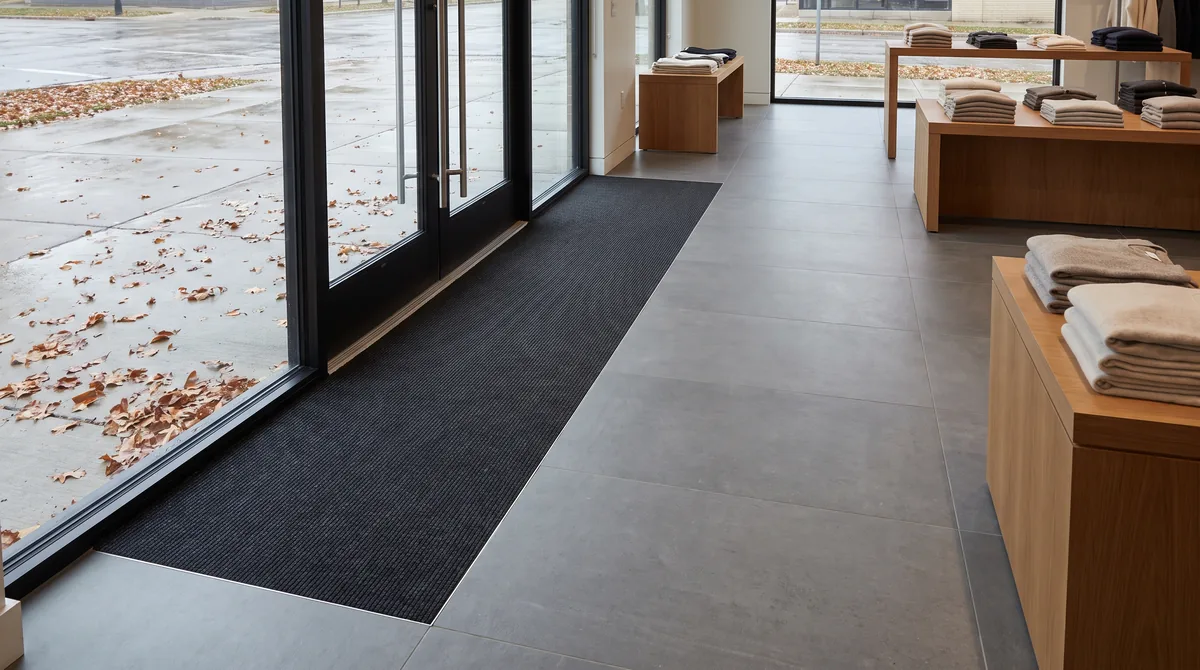
From November into April, salt and slush ride in on every pair of boots. A long run of walk-off matting inside the entry, plus a hard, slip-resistant surface in the vestibule, protects everything beyond it.
Slab moisture is the third condition. Some older commercial buildings here sit on slabs poured without a vapor retarder (a plastic sheet under the concrete that blocks ground moisture), and nobody can tell which by looking, which is why a testing firm or the general contractor tests the slab before an adhesive is chosen.
Middleton’s commercial work is mostly renovation of established offices and clinics, where old flooring, adhesive residue, and an aging slab decide the prep. See flooring installation in Middleton, WI for that work.
Sun Prairie is growing fast, with new retail and childcare space on newer slabs. Those still need testing, because fresh concrete can take months to dry. For local service, see flooring installation in Sun Prairie, WI.
Harmony Flooring serves businesses in Madison and throughout Dane County, including Middleton and Sun Prairie.
What to Ask Before You Sign a Commercial Flooring Bid
The right bid for a Madison business rests on a slab moisture test from a testing firm or the general contractor, and comes with a written phasing plan, current insurance, and one accountable contact. Price matters, but those four things decide whether the job finishes on time and holds up.
- Permits. Ask whether your project needs a building permit and who will pull it. Your municipality sets that requirement.
- Insurance. Ask for a certificate of insurance (COI) with current dates, naming your business or landlord if your lease requires it.
- A written phasing plan. Zones, dates, work hours, cure times, and when each area reopens.
- One accountable contact. One person who answers for the schedule, the installers, and the punch list (the last round of fixes before sign-off).
Sources: ASTM F2170, TCNA DCOF and ANSI A326.3 FAQ, CRI Green Label Plus, COREtec Stone installation instructions.
Commercial Flooring FAQs for Madison and Dane County Businesses
Can commercial flooring be installed in a Madison building in winter?
Yes, as long as the space is heated. Resilient flooring and adhesive makers state a temperature range the room has to hold before, during, and after installation, so a vacant suite with the heat turned down needs to be warmed days ahead. The slab still needs its moisture test, and walk-off matting should go in with the new floor.
How soon can a Madison office reopen after new flooring goes in?
It depends on the product and its adhesive. Carpet tile can often take foot traffic right away, while glue-down LVT and glued-down rubber follow the adhesive maker’s cure times before furniture and rolling loads return, and porcelain tile waits on mortar and grout. Put each zone’s reopen time in the phasing plan so staff know when to come back after New Year.
Does an older Madison building need a slab moisture test before new flooring?
Yes. Some older Madison commercial slabs were poured without a vapor retarder, and a damp slab can make glue-down flooring release. A testing firm or the general contractor runs an ASTM F2170 test, which measures the relative humidity inside the slab so the flooring and adhesive can be matched to it.
What is the most repairable commercial flooring?
Carpet tile, glue-down LVT, and porcelain tile are the most repairable, because one damaged tile or plank can be lifted and replaced on its own. Keep attic stock from the original order so the replacement matches in color and dye lot.
What makes commercial flooring different from residential flooring?
Commercial flooring is built for heavier traffic, rolling loads, and daily commercial cleaning, with thicker wear layers, commercial warranties, and specs that name slip-resistance and emissions standards, such as ANSI A326.3 for tile. It is also installed around a business schedule, often in phases or after hours.
How Harmony Flooring Works
Every commercial project Harmony Flooring takes on in Madison and Dane County follows Design · Measure · Install. Design means we help you choose the right floor for each zone, working from your spec or from scratch. Measure means we walk the space, measure it, and check the subfloor so the bid rests on facts. Install means Harmony schedules the work and coordinates vetted installation partners zone by zone around your hours, with one point of contact from walkthrough to punch list, Covering Every Detail.
If the holiday week is your window, November is when it gets decided. Let us help you narrow it down: schedule a walkthrough or call or text us at 608-221-5500.
Planning New Floors in the Madison Area?
Get a free in-home estimate. We measure, bring samples to your kitchen table and give you one written price. No obligation.
Call or text 608-221-5500Schedule a Free Consultation
Shop our floors: Hardwood · Vinyl · Carpet · Tile · Laminate
Showroom: 2125 S. Stoughton Rd, Madison, WI 53716
You Might Also Like
-
-

- Commercial Flooring
- Buying Guides
October 16, 2026
Municipal Building Flooring: A Wisconsin Buyer’s Guide
-
- Commercial Flooring
- Buying Guides
October 15, 2026
Apartment Turnover Flooring: A Madison Multifamily Guide

