- Tile
Are Heated Tile Floors Worth It in a Wisconsin Bathroom?
February 24, 2026
Reviewed by Kevin Sill, Co-owner, Harmony Flooring
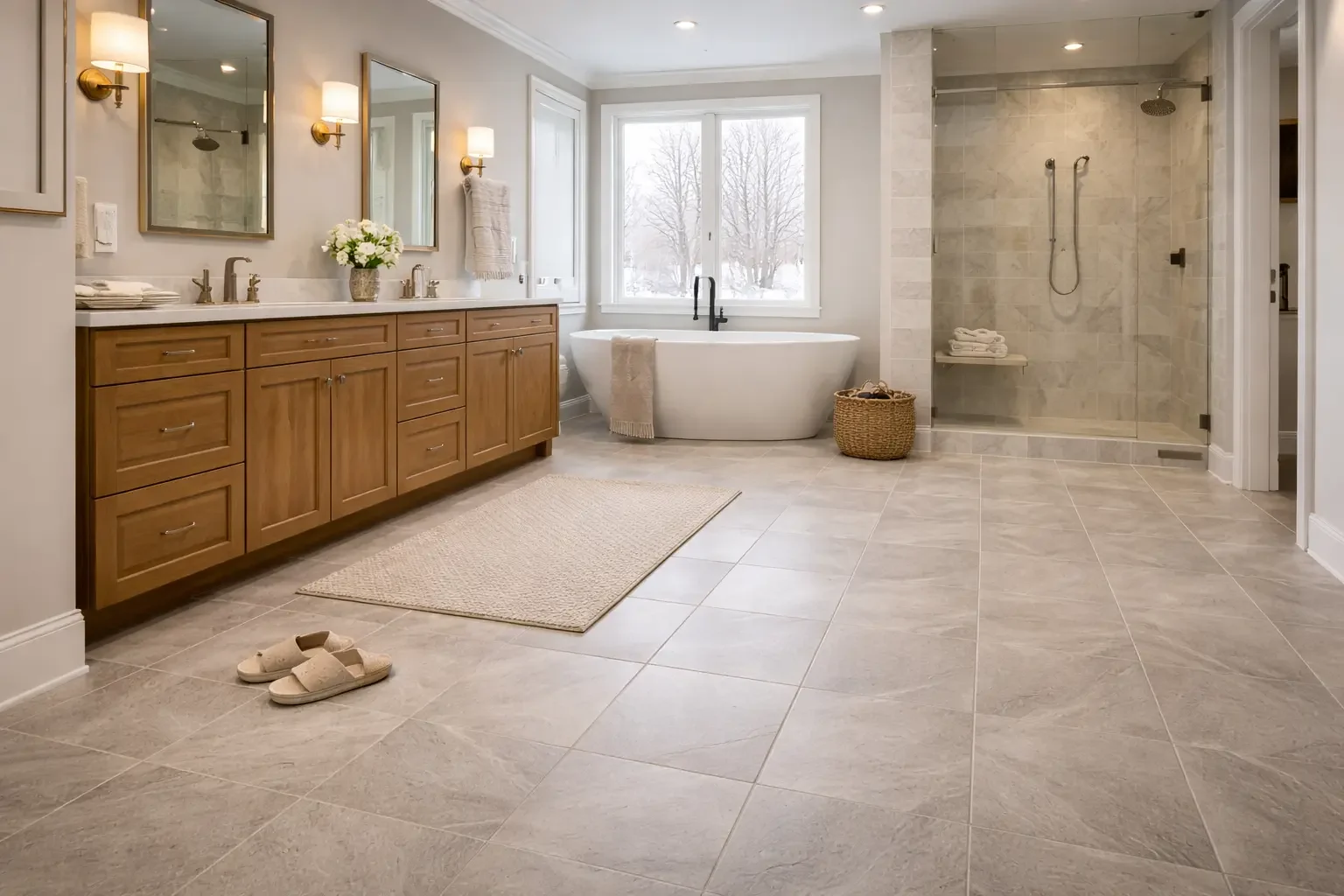
A heated tile floor is worth it in most Wisconsin bathrooms that are getting new tile anyway. Electric heat under the tile makes a cold bathroom floor the warmest surface in the house. It does its best work from October into April. The call gets harder when your current tile is staying put, because the heat has to go under the tile.
Madison’s normal January low is 11.8 degrees F, according to the Wisconsin State Climatology Office. Bare tile pulls warmth out of bare feet, so a tiled bathroom over a basement slab or a crawlspace feels that cold first. Set a heating cable in the mortar under the same tile and it works the other way. The tile spreads the warmth evenly and holds it.
Porcelain is the tile we’d put over a heated bathroom floor in most homes. You can stand on samples of the porcelain and ceramic tile in Madison that we carry before you decide. Here’s when the upgrade pays off and how to plan it.
When a Heated Tile Floor Is Worth It
Picture the bathroom you use at 6 a.m. in January. If that floor is tile and it’s coming out for a remodel, heat is the easiest yes in the whole project. The mat or cable goes down in the same mortar bed the new tile needs.
It pays off most when:
- The old floor is coming out anyway, so nothing extra gets torn up.
- You use the room every day, like a primary bath or the kids’ bath.
- The floor sits over a cold slab or crawlspace.
- You stand there for a while, at a kitchen sink or by the back door in salt season.
It’s a weaker fit when:
- The tile you have is sound. Adding heat means tearing it out.
- It’s a guest bath that sits empty most of the week.
- Rugs or cabinets would cover most of the floor.
- You want heat for the whole house. That’s usually a hydronic project with warm water in tubing, which our guide to heated floor options covers.
A heated floor is a comfort upgrade. Your furnace still heats the house. The floor just stops being the cold part of it.
Types of Electric Floor Heat Under Tile
There are two families of heated floors: electric and hydronic. If you’re still choosing between them, our types of heated floors guide compares the two and the best flooring over each. Under the tile in a single room, electric is the common choice. It comes in three forms.
| Electric system | How it goes down | Best fit | Watch for |
|---|---|---|---|
| Heating mat | Cable comes pre-spaced on a mesh roll that’s set in thinset mortar | Square or rectangular rooms with open floor | Mats come in set sizes, so odd corners can stay cold |
| Loose cable | Cable is spaced by hand on strips or clips, then covered in mortar | Rooms with angles or curves | Slower layout; spacing has to stay even |
| Cable in an uncoupling membrane | Cable snaps into a studded membrane bonded to the subfloor, and the tile is set over it | Remodels where crack protection and an even layout both matter | Membrane and cable work as one system; follow that maker’s spacing and tile rules |
A mat or a membrane system is the simpler path for most bathroom remodels. Schluter’s DITRA-HEAT cables snap into the membrane’s studs with no clips, and Schluter says no self-leveler is needed to cover them. The same membrane also helps protect the tile from cracking as the subfloor moves. Loose cable earns its place in an odd-shaped room where a mat would leave cold gaps.
Best Tile for a Heated Floor
Two inches square is the smallest tile Schluter lists for its heated membrane, and smaller mosaics need the maker’s sign-off. Past that, most floor tile works over electric heat. The tile industry’s guide to tile and radiant heat points out that ceramic tile conducts heat well and isn’t affected by moisture or heat.
- Porcelain. Dense and unaffected by water, it’s our pick for heated bathroom floors and entries. Wood-look porcelain planks put a wood look over the heat. Long planks and large tiles need a very flat floor, and the installers we coordinate handle that leveling before any tile goes down.
- Ceramic. A little softer than porcelain and a good value for a bathroom floor. It works over a mat or membrane too.
- Natural stone. Marble and travertine work over floor heat too. A thick stone tile takes longer to warm up. Stone is porous, so it needs a sealer at install and fresh coats over the years.
Curious how a porcelain look reads in your own bathroom? Try it on a photo in our room visualizer before the free in-home visit.
Heated Bathroom Floors in Wisconsin Homes
The most common planning mistake is assuming the whole bathroom floor gets heat. It doesn’t. Schluter tells buyers not to order cable the same size as the area being tiled. Its layout rules keep cable away from fixed cabinets and drains. The warm zone is where you stand. Think in front of the vanity and outside the shower.
Three kinds of Wisconsin bathrooms feel the cold most. One is a basement bath on a concrete slab. Another is a slab-on-grade bath in a ranch or an addition. The third sits over a crawlspace or an attached garage. On concrete, part of the heat goes down instead of up. Schluter notes that closer cable spacing may be wanted over uninsulated concrete on or below grade. Some heating makers also sell an insulating underlayment for slabs. Ask about both before the cable is ordered.
A basement slab also needs a moisture check before any floor goes over it. The installers we coordinate don’t test slabs. A testing firm or your general contractor does that, and our basement flooring guide for Madison explains what the results mean for tile. For the rest of the room, our bathroom flooring guide for Madison homes compares tile with vinyl plank.
Heated Kitchen Floors and Entries
Salt season runs November into April here. The back entry takes the worst of it, with slush and grit on every boot. Porcelain shrugs off water and salt. A heated floor under it helps those puddles dry sooner and makes the entry nicer to stand on in socks. Grit is still the enemy, so keep a mat at the door and sweep often. Our mudroom and entry flooring guide covers the rest of that room.
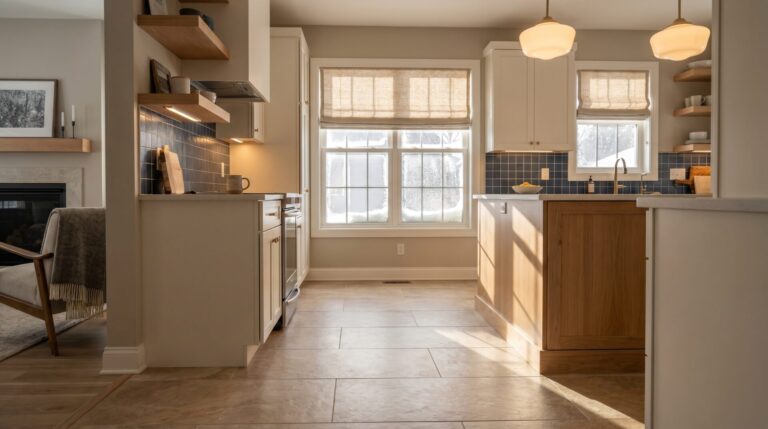
In a kitchen, the heat goes in the open floor where you stand, in front of the sink and range and along the island. Cable doesn’t run under cabinets or an island, so map the heated area after the cabinet layout is final. Our kitchen flooring guide for Madison homes weighs tile against vinyl and wood for the whole room.
Who Installs a Heated Tile Floor
A heated tile floor is two jobs stacked together. The heating mat or cable is installed per the manufacturer’s instructions by the right trade, and an electrician connects it to its thermostat and circuit. Harmony Flooring designs and measures the tile floor and coordinates the tile installation on top. We don’t wire or install heating systems.
Settle these before the tile goes down:
- Decide on heat at the design stage, before tile is ordered. The mat or membrane raises the floor a little, so plan the transition at the doorway, especially next to hallway hardwood.
- Map the heated area around fixtures and cabinets.
- Have an electrician confirm the circuit and voltage. Schluter’s cables come in 120 and 240 volt versions, and Schluter tells buyers to consult a qualified electrician before ordering.
- Choose the thermostat and where its floor sensor goes. Schluter ships two floor temperature sensors with its cables, and they can go in at the same time as the cable.
- Test the cable before, during and after installation. Schluter strongly recommends a megohmmeter test because tiny breaks in the cable insulation can trip the required GFCI protection later.
- Let the mortar cure before the heat comes on. The heating maker’s instructions give the wait.
The installers we coordinate handle subfloor leveling, tear-out and haul-away of the old floor on install day. Moving furniture can be part of the labor too, if you want it. See how flooring installation in Madison works with us.
Running a Heated Floor Through a Wisconsin Winter
Heating season here runs October into April, and that’s when the floor earns its place. A thermostat with a floor sensor holds the tile at the temperature you pick. Program it to warm the floor before your morning routine and drop back while the house is empty.
Three things set how much power the floor uses. One is the size of the heated area. Another is how many hours it runs. The last is how much heat escapes into the slab or crawlspace below, which is why insulation matters on concrete. A floor on a schedule runs only when someone’s there to feel it.
Sources: Wisconsin State Climatology Office: Madison Climate Data, Why Tile (TCNA): Ceramic Tile Meets Radiant Heat, Schluter-Systems: DITRA-HEAT-E-HK heating cables and Schluter-Systems: Megohmmeter testing for DITRA-HEAT cables.
Heated Tile Floor Questions
Can radiant floor heating be installed in bathrooms and kitchens?
Yes. Bathrooms and kitchens are the most common rooms for electric floor heat under tile. The mat or cable goes under the new tile, installed per the manufacturer’s instructions, and an electrician connects it to its own thermostat. The easiest time to add it is during a remodel, when the old floor is coming up anyway.
Can you add heated floors to an existing tile floor?
Not without taking the tile up. Electric floor heat goes directly beneath the tile, so the old tile and its setting bed come out before the heating mat goes down. That’s why heat is usually added when a bathroom or kitchen floor is being replaced anyway.
Does a heated tile floor need its own circuit?
Sometimes. It depends on the size of the heated area, the cable’s voltage and what else is on the circuit. Electric floor heat comes in 120 and 240 volt versions and needs GFCI protection, so have an electrician check the circuit before the cable is ordered.
Can you heat a tile floor in a basement?
Yes. Tile on a basement slab can be heated, and it takes the chill out of a lower level in winter. Bare concrete pulls heat downward, so ask the heating maker about an insulating underlayment or closer cable spacing. The slab also needs a moisture check first from a testing firm or your general contractor.
How long do heated tile floors last?
An electric heating cable set in mortar under tile has no moving parts, so there’s little to wear out once it’s tested and covered. The thermostat is the part you can reach and replace. Check the maker’s warranty on both, and keep the cable test readings from installation, since some makers tie the warranty to them.
Keep Reading
- Tile Flooring for Madison Homes: The Complete Guide
- Flooring That Stays Comfortable Year Round in Wisconsin Homes
- Tile Flooring in Madison, WI: porcelain, ceramic and stone-look options
See Heated Tile Options in Our Madison Showroom
Bring a photo of the room to our showroom on South Stoughton Road, and we’ll show you porcelain and ceramic that suit a heated floor. Every project runs on Design · Measure · Install. We help you pick the tile and measure the room, then coordinate the tile installation over the heating system. From the first sample to the final walkthrough, we’re focused on Covering Every Detail.
Ready to plan yours? Schedule a free consultation or call or text us at 608-221-5500.
Planning New Floors in the Madison Area?
Get a free in-home estimate. We measure, bring samples to your kitchen table and give you one written price. No obligation.
Call or text 608-221-5500Schedule a Free Visit
Shop our floors: Hardwood · Vinyl · Carpet · Tile · Laminate
Showroom: 2125 S. Stoughton Rd, Madison, WI 53716