

Assisted Living and Healthcare Flooring in Madison
Floors for senior living, memory care, skilled nursing and clinics across Madison and Dane County. We help you choose the right floor for each space. Then we plan the work around the people who live and work there.
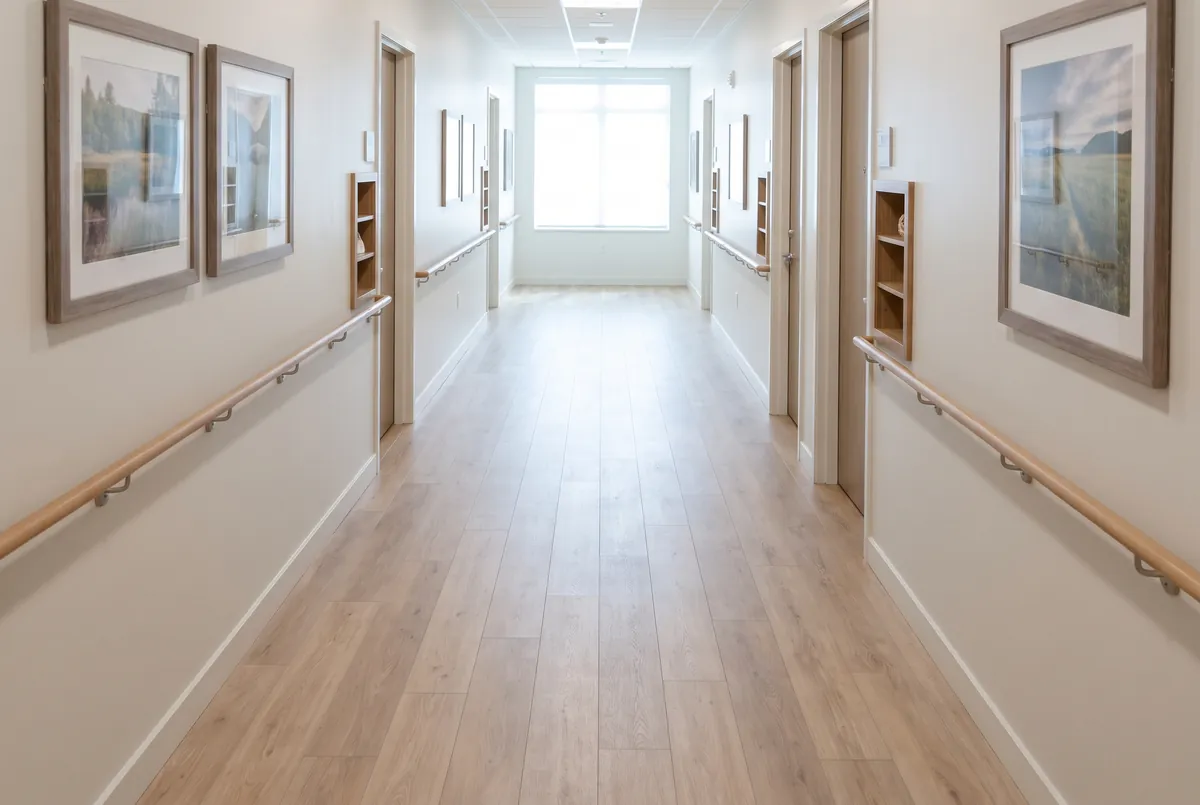
- Who we work with: Assisted living, memory care, skilled nursing, independent living, clinics, and medical and dental offices.
- Floors we source: Sheet vinyl, LVT, carpet tile, hybrid resilient, rubber and commercial tile.
- How the work runs: Room by room or wing by wing, planned with your staff.
- Where: Madison and towns within about 45 minutes of the Capitol.
What a Care Floor Has to Do
A floor in assisted living takes walkers, med carts and mop buckets every hour of the day. It has to be safe for someone who’s unsteady. It has to clean up fast after an accident. In memory care it can’t confuse anyone. Here’s what we look at first.
Steady Footing
Falls are the big worry. The CDC says more than one in four adults 65 and older fall each year. A floor can’t stop every fall. It can remove the easy causes, like slick spots, curled edges and raised strips. Ask for the maker’s slip test data on any hard floor. More grip isn’t always better, though. A resident who shuffles can catch a toe.
Easy Rolling
Walkers, wheelchairs, med carts and lifts cross these floors all day. The ADA floor guide caps carpet pile at 1/2 inch and wants carpet held down tight. Glue-down carpet tile and resilient floors keep the push light. A thick, soft pad makes it harder.
Fast Cleanup
Spills and accidents happen every day. Heat-welded sheet vinyl has no open seams for fluids to settle in. It can also run up the wall as a coved base. Carpet with a moisture barrier backing keeps spills on top, where staff can reach them. Check each floor’s care guide against the disinfectants you already use.
Calm for Memory Care
Someone living with dementia may read a dark patch as a hole. Glare can look like a wet spot. Bold borders can read as a step. So we lean toward matte finishes and one steady tone from room to hall. We keep transitions low and close in color.
Quieter Halls
Hard floors carry cart noise and footsteps down a corridor. Carpet tile soaks up a lot of it. Hybrid resilient floors sit in between. They look and feel like a textile. They clean up more easily than carpet.
Winter at the Door
Madison entries take salt and slush from November into April. That grit gets tracked deep into the building. A long run of walk-off carpet tile at the door catches most of it. We cover that in our guide to entrance walk-off flooring.
Which Floor Goes Where
Most buildings use three or four floors, not one. Here’s where each tends to fit in senior living and healthcare.
| Space | Floors That Tend to Work | What We Watch For |
|---|---|---|
| Corridors | LVT, carpet tile or hybrid resilient | Rolling carts, noise, one steady tone end to end |
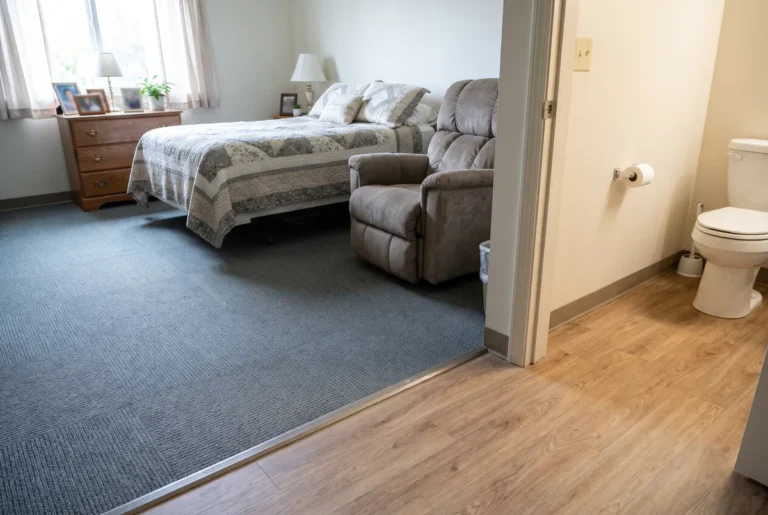
| Resident rooms | Carpet tile or wood-look LVT | A homey look and a low edge at the bathroom door |
| Memory care | Matte LVT or hybrid resilient in one tone | No dark spots, busy patterns or shiny strips |
| Bathrooms and showers | Slip-resistant sheet vinyl or textured tile | Wet footing, sealed seams, a coved base |
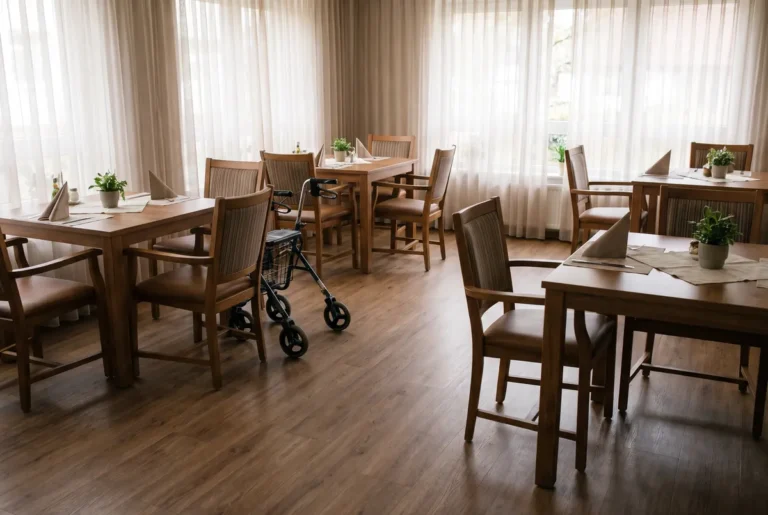
| Dining and common rooms | LVT or hybrid resilient | Food spills, sliding chairs, daily mopping |
| Entries | Walk-off carpet tile, then tile or LVT | Salt, slush and grit in winter |
| Therapy and fitness rooms | Rubber flooring | Footing, a little give, equipment weight |
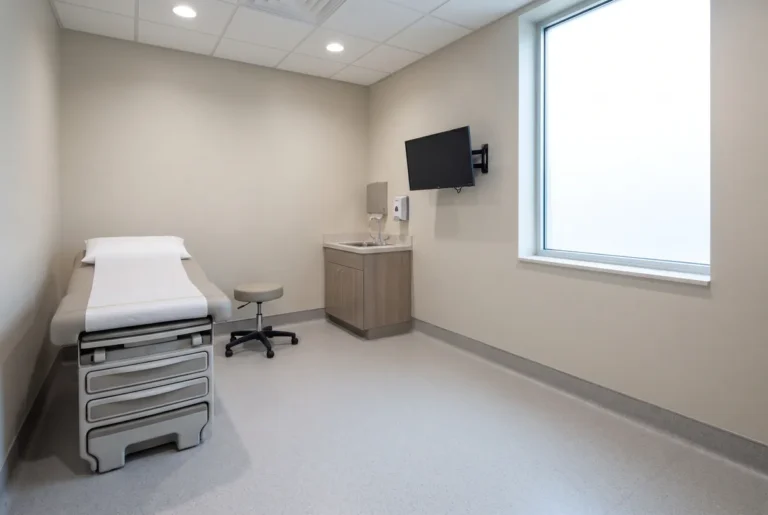
| Exam and procedure rooms | Heat-welded sheet vinyl | Tight seams, coved base, rolling stools |
| Waiting rooms and offices | Carpet tile or LVT | Noise, steady traffic, easy tile swaps |
| Dental operatories | Sheet vinyl or LVT | Chair bases, rolling carts, strong cleaners |
Your designer or state rules may already set some of this. Send us the spec. We’ll bid it as written. No spec yet? We’ll walk the building with you and put a plan on paper.
Working Around Residents and Patients
This is where care projects go well or go badly. People live here. Staff can’t stop working. So the plan matters as much as the floor itself.
- Walk the building together. We walk it with your administrator or maintenance lead. We look at the floor underneath, the doorways and the busiest paths.
- Plan the order of work. We map the job by room, wing or floor. Your team decides when residents move and which halls stay open. Tell us which hours and areas must stay quiet. We build the schedule around them.
- Choose low-emission products. Ask for FloorScore on hard floors and CRI Green Label Plus on carpet and adhesives. Both test for indoor emissions. A plain “low VOC” label tells you much less.
- Keep transitions flush. The ADA allows a 1/4 inch edge, or 1/2 inch with a bevel. We plan for flush transitions wherever two floors meet. The trusted local installers we coordinate build to that plan.
- Walk it again at the end. Your coordinator walks the finished space with you. The punch list stays open until every item is closed out.
How long will it take? It depends on the floor, the rooms and the prep work. Your consultant gives you install dates before anything is ordered.
Concrete slabs, new or old, may need moisture testing before a new floor goes down. A testing firm or your general contractor handles that part.
Clinics, Dental and Medical Offices
Clinics run on a different rhythm. Patients come and go all day. Most offices want to stay open while the floor gets done. We phase the work around your hours, often one room at a time.
Exam rooms usually get sheet vinyl with welded seams. Waiting rooms and offices often get carpet tile or LVT. Our medical office flooring guide goes room by room. Vet clinics have their own needs. We cover them in our veterinary clinic flooring guide.
Commercial Lines We Source
We carry J+J Flooring, Patcraft, Shaw Contract and Mannington Commercial.
- Mannington Commercial makes healthcare sheet vinyl, rubber and LVT. Its Seam+Advantage system welds its sheet vinyl to compatible Mannington carpet. That leaves no transition strip at all.
- J+J Flooring makes carpet for senior living and Kinetex, a hybrid floor. It has a textile look and is built to clean up more easily than carpet.
- Patcraft and Shaw Contract make carpet tile and LVT lines built for healthcare and senior living.
You can see them at our Madison showroom. A second room there holds our commercial lines. Already have a spec? We’ll match it. We can also suggest an equal if a product is hard to get.
Why Facilities Call Harmony
- One point of contact. One coordinator from the first walkthrough to the punch list. You don’t chase three people for answers.
- Local since 2009. We’re at 2125 S. Stoughton Rd on Madison’s east side. When a punch list item comes up, we’re close.
- Specs or no specs. We work from an architect’s plan or help you build one from scratch.
- Every building type. We also plan floors for apartments, schools and public buildings. See our commercial flooring page for the rest.
More Guides for Care Facilities
- Assisted living flooring guide
- Medical office flooring guide
- Flooring work without shutting down
- Entrance walk-off flooring
- Veterinary clinic flooring
- Flooring for aging in place at home
Families often ask what to change at home before a parent moves back in. Our aging-in-place guide covers that.
Walk Your Building With Us
Bring your spec, your floor plans or just a list of problem rooms. We look at the floors underneath, the door thresholds and the busiest paths. Then we follow up with floor options for each space and a clear order of work.
Call, Text or Email Us. We’ll set up a walkthrough at a time that works for your staff and residents. Our office is open Monday through Friday, 8 to 5.
Healthcare and Senior Living Flooring Questions
Do you handle assisted living flooring projects in Madison?
Yes. We walk the building, choose floors room by room and phase the work around residents. Most communities end up with LVT or hybrid resilient in halls, carpet tile or LVT in resident rooms and sheet vinyl in bathrooms. Our assisted living flooring guide goes deeper on each space.
Is carpet or vinyl better for senior living?
Each has a place. Carpet tile is quieter and softer underfoot. Thick pile or pad makes it harder to push a wheelchair. Vinyl cleans up fast and rolls easily. Many buildings put carpet tile in resident rooms and vinyl in shared spaces.
What flooring works best in memory care?
Matte, low-glare floors in one steady tone work best. Skip dark patches, bold borders and shiny metal strips. People living with dementia can read those as holes or steps.
How high can a flooring transition be for wheelchairs?
The ADA allows a vertical edge up to 1/4 inch. With a bevel it can be up to 1/2 inch. Anything higher needs a ramp. We plan for flush transitions wherever two floors meet.
Can you replace flooring while residents live in the building?
Yes. We plan the work room by room or wing by wing with your staff. Your team sets when residents move. Halls stay open on a plan you agree to.
Why do clinics use sheet vinyl?
Heat-welded seams leave no gaps for fluids or dirt. The sheet can also run up the wall as a coved base. That makes exam rooms faster to clean.
Do you work from architect or designer specs?
Yes. Send us the spec. We’ll bid it as written. We can also suggest an equal product if one is hard to get.
What areas do you serve?
We serve Madison and towns within about 45 minutes of the Capitol. That includes Middleton, Fitchburg, Sun Prairie, Verona, Waunakee and Stoughton.

