

- Vinyl Plank
- |
- Basements and Wisconsin Climate
Why Is My Vinyl Plank Flooring Separating in Winter?
November 3, 2026
Reviewed by Kevin Sill, Co-owner, Harmony Flooring
Vinyl plank flooring separating in winter usually comes down to cold shrinking the planks, or something pinning, flexing or breaking the click joints.
The Short Version: Rigid core vinyl plank shrinks slightly in a cold room, so hairline end gaps can open in January. Long-edge gaps usually mean a joint that failed or never fully locked. Never caulk or glue the gaps; find what is pinning or flexing the floor.
Why Vinyl Plank Flooring Separates in Winter
Vinyl plank flooring separates when locked planks get pulled apart harder than their joints can hold. Rigid core vinyl (a stiff composite core) shrugs off humidity but grows in heat and shrinks in cold, and a floating floor (clicked together, not fastened down) moves as one sheet.
COREtec Stone’s installation instructions call for a quarter-inch expansion space (the gap hidden under the baseboard) at the walls and a room kept at 55 to 85 degrees F after install. End gaps, at the plank ends, follow temperature and pinning. Side gaps, along the long edges, usually trace back to the joint or the subfloor.
Harmony Flooring helps Madison and Dane County homeowners read those gaps. If a new floor turns out to be the answer, browse vinyl plank flooring in Madison.
Laminate separates for the same reasons, plus dry air. Browse laminate flooring in Madison. Hardwood gaps follow their own rules.
Common Causes of LVP Gaps in Dane County Homes
LVP gaps in Dane County homes usually trace to one of five causes: pinning, cold, sun, a failed joint, or an uneven subfloor.
Pinned floors. Monona has some of the oldest housing Harmony serves: 1950s and 60s ranches and capes with smaller rooms and more doorways. Each doorway needs its jamb undercut so the floor can slide beneath it. A tight jamb, an island, or trim nailed into the planks holds one spot still while the rest pulls away.
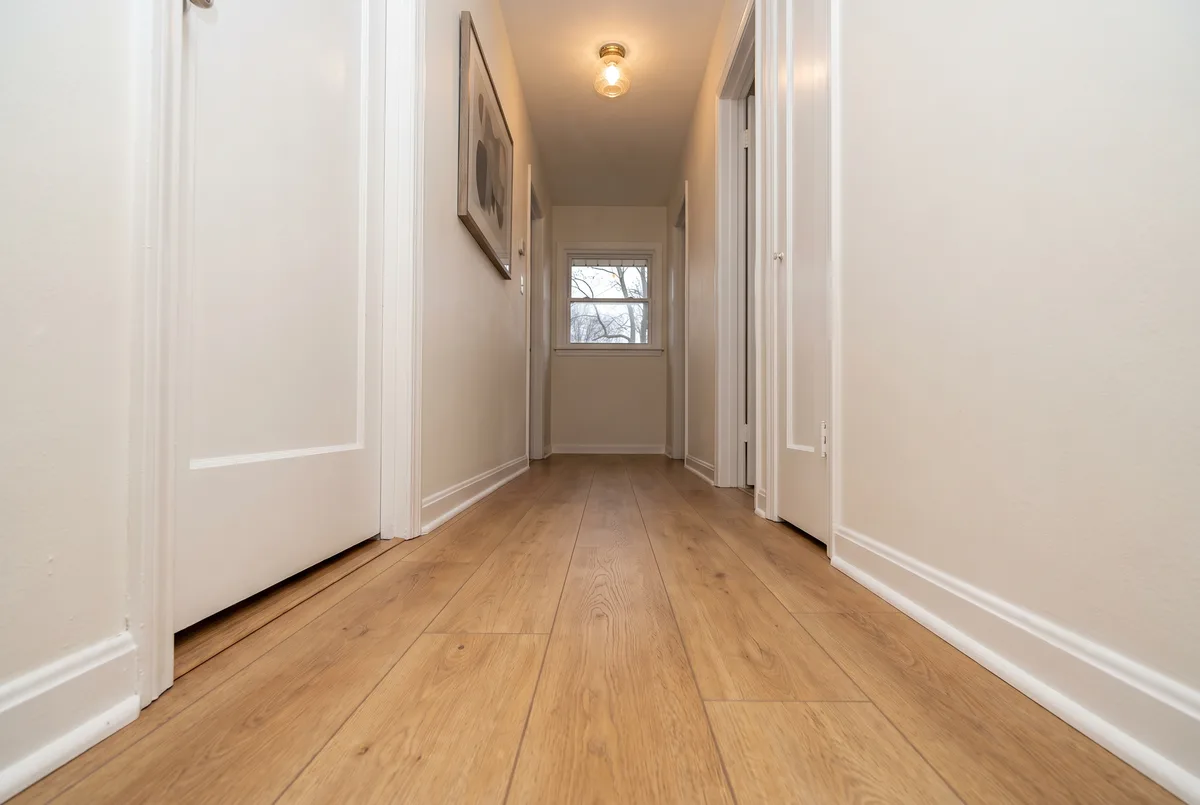
Cold rooms. A bonus room over an attached garage can run far colder than the house in January. Below the maker’s range, its planks contract until the end joints show it.
Sun swings. Low winter sun through a south-facing patio door heats one strip of planks while the rest stay cool, straining the end joints there. COREtec warns that direct sun can cause thermal expansion and suggests blinds at peak hours. Buckling is the opposite failure, covered in our Wisconsin climate guide.
Failed click joints. A long edge never tapped fully closed, or a tongue cracked during install, lets go under traffic. COREtec’s instructions say any gapping can compromise the locking system.
Uneven subfloors. Near downtown Oregon, some village houses are over a century old, with uneven subfloors to match. Over a dip beyond the maker’s flatness limit, a plank flexes at its joint until the joint gives.
Vinyl Plank Gaps by Symptom and Cause
The pattern of a vinyl plank gap points to its cause before anyone lifts a plank.
What you see |
Likely cause |
Next step |
|
Hairline end gaps across a cold room in January |
Shrinkage below the maker’s temperature range |
Warm the room steadily; recheck in spring |
|
End gaps at the edge of a sunny patch |
Uneven heating from low winter sun |
Shade the window; have the wall spacing checked |
|
Gaps widening away from an island, jamb or nailed trim |
A pinned floating floor |
Professional assessment of what holds it |
|
Gaps along the long edges |
A joint never fully locked, or a broken locking edge |
Professional assessment; rows may need resetting |
|
Gaps plus a dip, bounce or rocking plank |
A subfloor out of flat |
Subfloor check before any fix |
Seasonal Gaps vs Install Defects in Vinyl Plank
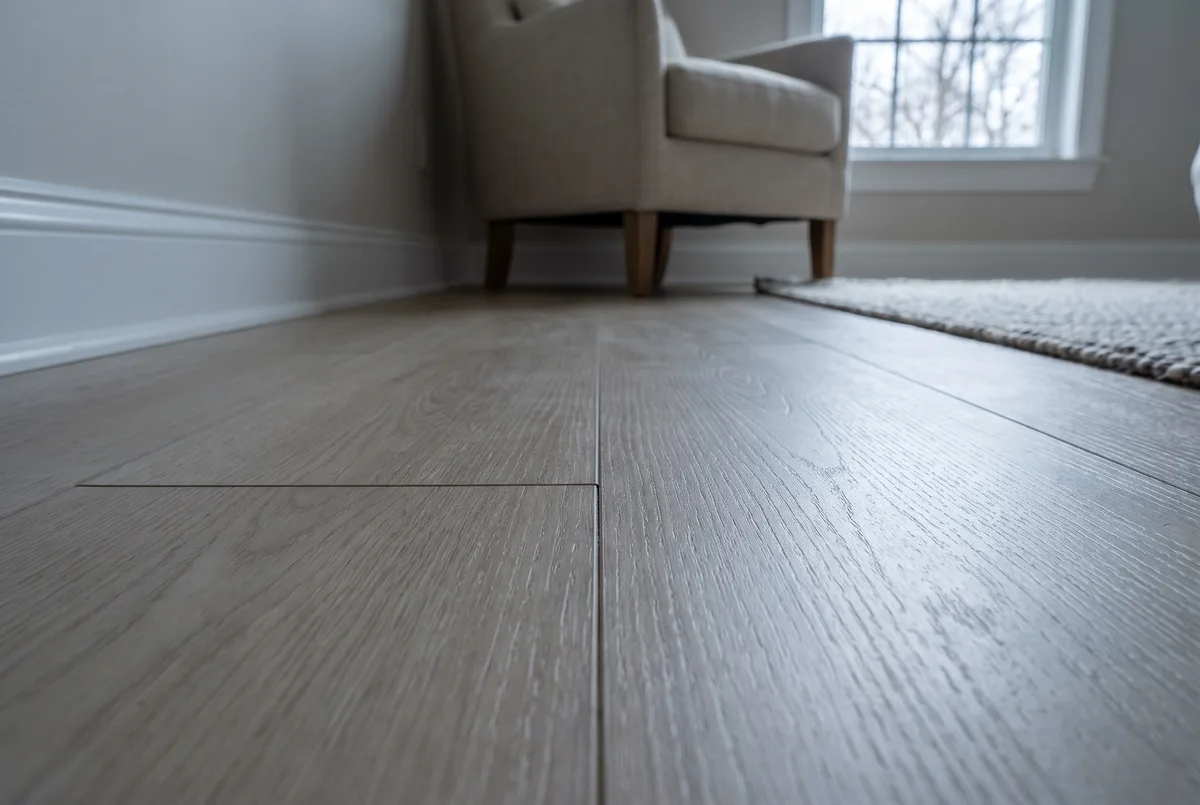
A seasonal vinyl plank gap is a hairline at the plank ends that opens in the coldest weeks and closes as the room warms. A defect gap grows, sits on a long edge, clusters near something fixed, or comes with a rocking plank.
Our acclimation guide covers why planks laid cold from a truck or garage can gap.
Why Gluing or Caulking Vinyl Plank Gaps Backfires
Gluing or caulking a vinyl plank gap backfires because it locks part of a floating floor in place, so the stress shifts to the next joint. Filler in a seasonal gap can also squeeze out as the planks expand in spring.
Glue can also foul the locking edge, so the row may not unclick cleanly for a reset. COREtec says never secure floating planks to the subfloor, and Pergo’s laminate installation guide says never fix or block a floating floor. Open seams also let spills reach the subfloor, as our waterproof vinyl plank guide explains.
Not sure which kind of gap you have? Let’s take a look at what your floor needs.
How Gaps in Vinyl Plank Flooring Get Fixed
Gaps in vinyl plank flooring get fixed by removing the cause first, then resetting the affected rows.
A small end gap with the lock still intact can often be tapped closed: a suction cup or a block taped to the plank, struck toward the gap with a rubber mallet. If the cause is still there, the gap comes back.
For a pinned or failed floor, a flooring installer frees whatever holds it, unclicks rows back to the nearest wall, swaps any plank with a broken edge, and closes the rows again, leveling any dip first. Spare planks matter here, as our LVP buying checklist explains.
Three things to do this week:
- Photograph each gap with a tape measure beside it, noting the date and room temperature.
- Look at what sits on the floor near the gaps: an island, built-ins, a tight jamb or nailed trim.
- Keep the room inside the maker’s temperature range, and skip caulk, glue and filler.
Sources: COREtec Stone installation instructions (Shaw), Pergo laminate flooring installation guide.
Vinyl Plank Separation FAQs for Madison Homes
Why is my laminate floor separating in a Wisconsin winter?
Laminate’s wood-fiber core also shrinks as furnace air dries. Pergo’s installation guide notes that open joints may appear during the heating season. Steady indoor humidity keeps them small.
Can radiant floor heat make vinyl plank separate in a Wisconsin winter?
It can, if the floor heats or cools too fast or runs too hot. COREtec Stone’s instructions cap a radiant floor’s operating temperature at 85 degrees F and call for raising the heat in small steps after install. Confirm the plank is rated for radiant heat, then keep the setting steady.
Can a piano or gun safe make a floating vinyl floor separate?
It can. A very heavy freestanding load acts like a cabinet, pinning one spot while the floor moves. Check the product’s load limit before one goes down.
Who can look at a separating vinyl plank floor near me in Madison?
Harmony Flooring can look at a separating floor anywhere in Madison and Dane County and tell you what it needs. If the answer is a new floor, Harmony coordinates the install through vetted installation partners.
How Harmony Flooring Works
Harmony Flooring follows Design · Measure · Install: we look at the gaps and anything pinning the floor, then tell you what it needs. When the answer is a new floor, we guide the pick, take the measurements, and coordinate the install through vetted installation partners, Covering Every Detail.
Schedule your free consultation or call or text us at 608-221-5500.
Planning New Floors in the Madison Area?
Get a free in-home estimate. We measure, bring samples to your kitchen table and give you one written price. No obligation.
Call or text 608-221-5500Schedule a Free Consultation
Shop our floors: Hardwood · Vinyl · Carpet · Tile · Laminate
Showroom: 2125 S. Stoughton Rd, Madison, WI 53716
You Might Also Like
-
- Basements and Wisconsin Climate
- Buying Guides
October 30, 2026
Best Flooring for Wisconsin’s Climate: A Four-Season Guide
-
- Basements and Wisconsin Climate
- Buying Guides
July 30, 2026
Basement Flooring in Madison: A Complete Buyer’s Guide
-
- Basements and Wisconsin Climate
- Buying Guides
June 23, 2026
Best Flooring for Radiant Heat and Heated Floor Options

