- Vinyl Plank
Glue-Down LVP vs Click: A Room-by-Room Madison Guide
November 12, 2026
Reviewed by Kevin Sill, Co-owner, Harmony Flooring
Glue-down vinyl plank beats click only where a floor has to hold still or be repaired one plank at a time; for most Madison main floors and dry basements, click (floating) vinyl plank is the better fit.
The Short Version: Click (floating) vinyl plank is the right call for most main floors and dry basements: it installs faster, bridges minor subfloor flaws, and often carries an attached pad. Glue-down wins in rentals, sunrooms and three-season rooms, very long open runs, and anywhere cabinets or heavy fixed loads would pin a floating floor. Glue-down needs a flatter, cleaner, drier subfloor, so the slab and flatness tests often decide.
The Difference Between Glue-Down and Click Vinyl Plank
Click vinyl plank is a floating floor: the planks lock to each other and rest on the subfloor without being fastened to it. Glue-down vinyl plank is bonded to the subfloor with adhesive, so every plank is held in place on its own.
Most click products are rigid core, either SPC (stone plastic composite) or WPC (wood plastic composite), often with an attached pad.
Most glue-down products are dryback vinyl plank, a thin, pliable plank with no locking edge that is set into adhesive. Some rigid products are also approved for glue-down by their makers.
Our LVP buying guide covers wear layer, thickness, and SPC vs WPC.
Harmony Flooring designs, measures, and coordinates vinyl installs across Dane County. When you are ready to compare looks, browse the vinyl plank flooring lines we carry in Madison.
Glue-Down vs Floating (Click) LVP Compared Side by Side
Click wins on speed, comfort, and tolerance for a less-than-perfect subfloor. Glue-down wins on stability, repairability, and fewer expansion limits.
Factor |
Click (floating) |
Glue-down (usually dryback) |
|
How it holds |
Planks lock to each other and float |
Each plank bonded to the subfloor |
|
Typical product |
Rigid core SPC or WPC, often with an attached pad |
Thinner, flexible plank; some rigid products where the maker allows |
|
Subfloor demands |
Flat to the maker’s tolerance; rigid core bridges minor flaws |
Flatter, smoother, cleaner, and dry enough for the adhesive |
|
Movement |
Expands and contracts as one piece; needs perimeter gaps |
Held in place; far less sensitive to temperature swings |
|
Long open runs |
May need expansion breaks past the maker’s limit |
Usually runs continuously |
|
Cabinets and islands |
Never pinned underneath; the floor stops at them |
Far less sensitive to fixed loads; confirm with the maker |
|
Sound and feel |
Attached pad softens footsteps; can sound hollow over poor prep |
Solid and quiet underfoot |
|
Replacing one plank |
Unclick rows back to a wall, or a careful cut-in patch |
Cut out one plank, glue in a matching one |
|
Install time |
Faster |
Slower: more prep, adhesive work, and cure time |
|
Removing it later |
Lifts out row by row |
Planks pried up; adhesive scraped or ground off the subfloor |
The rule that settles most rooms: if the floor must run under fixed weight, sit unheated part of the year, or be repaired one plank at a time, lean glue-down; otherwise click is usually the simpler fit.
Not sure which column your rooms belong in? Talk it through with us.
When Click (Floating) Vinyl Plank Is the Better Choice
Click is the better choice for most main floors, bedrooms, and finished basements that test dry. It installs faster, feels softer with an attached pad, and forgives small flaws a thin glue-down plank would show.
The catch is flatness: over a hump, a click floor rocks underfoot and strains its locking edges.
Where Glue-Down Vinyl Plank Wins
Glue-down vinyl plank wins wherever a floating floor would be asked to hold still through temperature swings, run unbroken across a long space, carry fixed loads, or allow single-plank repair.
- Rentals and multifamily. A glued plank can be replaced alone. Our apartment turnover guide covers the repair math.
- Three-season rooms and sunrooms. Floating floor makers state the temperature range their product tolerates. A room that sits unheated in January and bakes in July can fall outside it.
- Very long open runs. Past the maker’s stated limit, a floating floor needs an expansion break (a transition strip). Glue-down LVP usually runs continuously.
- Fixed and rolling loads. Islands, built-ins, and office chairs sit better on a bonded floor.
Why You Can’t Float Vinyl Plank Under Cabinets or an Island
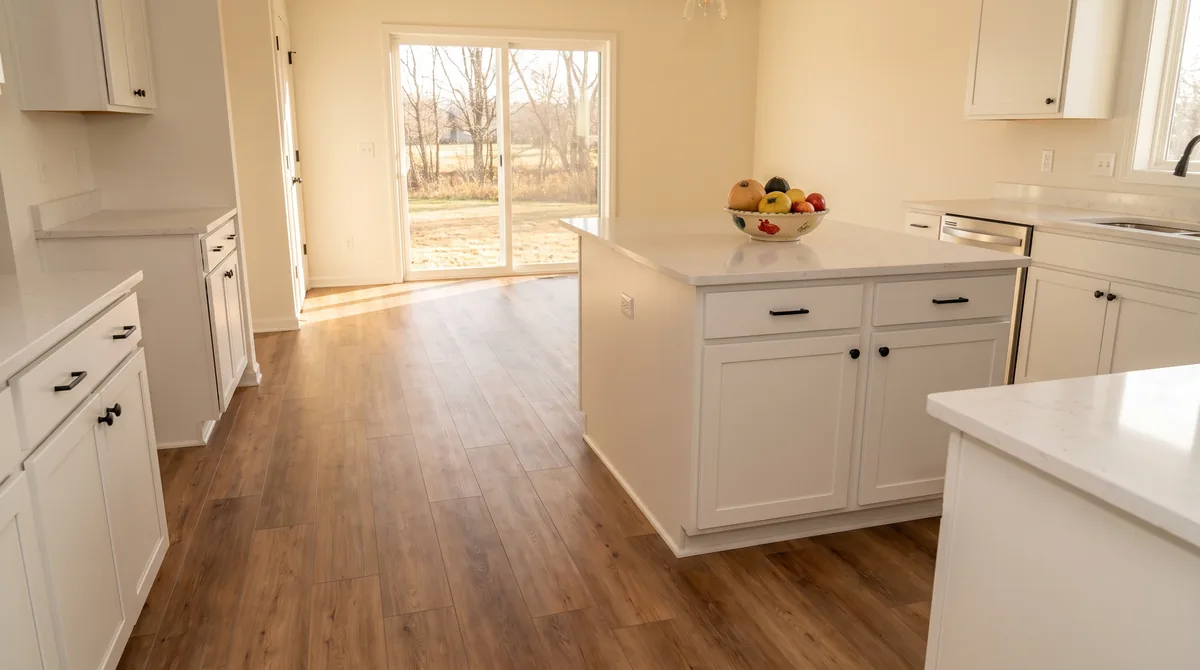
You can’t float vinyl plank under cabinets or an island because anything heavy and fixed pins it (holds one spot still), and a floating floor only stays flat while it is free to move. Pin it in one spot and it buckles somewhere else, and the product usually takes the blame.
A floating floor acts like one big sheet. As the house warms and cools, the sheet grows and shrinks a little, and the expansion gap hidden under the baseboard gives it room. Set a heavy island on top, or trap an edge under tight trim, and that spot can no longer move. The rest of the sheet still pushes, so it lifts into a ridge (peaking) at a doorway or the island, or pulls apart at the end joints.
Cabinets are not the only thing that pins a floating floor:
- Islands, built-in benches, and bookcases set on top of it
- Baseboard or quarter round nailed down into the planks instead of into the wall
- Door jambs and casings with no clearance cut beneath them
- Very heavy freestanding loads, such as a full aquarium, past the maker’s stated weight limit
The fix is planning. On a click floor, cabinets and islands go in first, and the floor stops at them with its gap covered by trim. Some makers allow one exception: under cabinets or an island, COREtec Stone’s instructions say that area “must be fully adhered to the subfloor,” plus 2 feet beyond them. Glue-down planks are already held in place, so weight on top does far less harm. Either way, ask what holds the floor at the island and cabinets before install day. Our Madison kitchen flooring guide covers the rest of that room.
Subfloor, Moisture, and Sound: What Each System Demands
Glue-down asks more of the subfloor than click does: flatter, smoother, cleaner, and drier. Both systems still have to meet the manufacturer’s flatness tolerance, and neither forgives a wet slab.
A thin dryback plank shows trowel ridges, plywood seams, even grit, and adhesive needs a clean surface free of paint and residue. Our flooring installer guide explains how to judge that prep.
Moisture rules differ too. Over concrete, a floating floor usually goes over a vapor retarder (a plastic sheet, or a pad with one built in). A glued floor cannot sit on plastic, so moisture is handled at the slab, by testing and sometimes a moisture-control product. Many makers reference ASTM F2170, a test that reads relative humidity inside the slab, and the adhesive carries its own limit separate from the plank’s. Our waterproof LVP guide explains where that label stops.
Glue-down feels solid and quiet underfoot, and some systems allow a thin acoustic underlayment beneath it.
Glue-Down or Click by Room: A Madison Decision Table
In most Madison homes, click covers the main floor and the dry basement, while glue-down covers rooms with temperature swings, repair needs, or fixed loads. Confirm any row against the product’s installation instructions.
Room or situation |
Recommendation |
Why |
|
Finished basement, slab tests dry |
Click (rigid core) |
Bridges minor slab flaws; vapor retarder per the maker |
|
Basement slab with borderline moisture |
Decide after testing |
Plank and adhesive limits both apply; mitigation may come first |
|
Kitchen with island and cabinets |
Click with cabinets set first, or glue-down |
A floating floor must stop at fixed cabinets |
|
Open main floor, long run |
Glue-down, or click with planned expansion breaks |
Avoids transition strips mid-room |
|
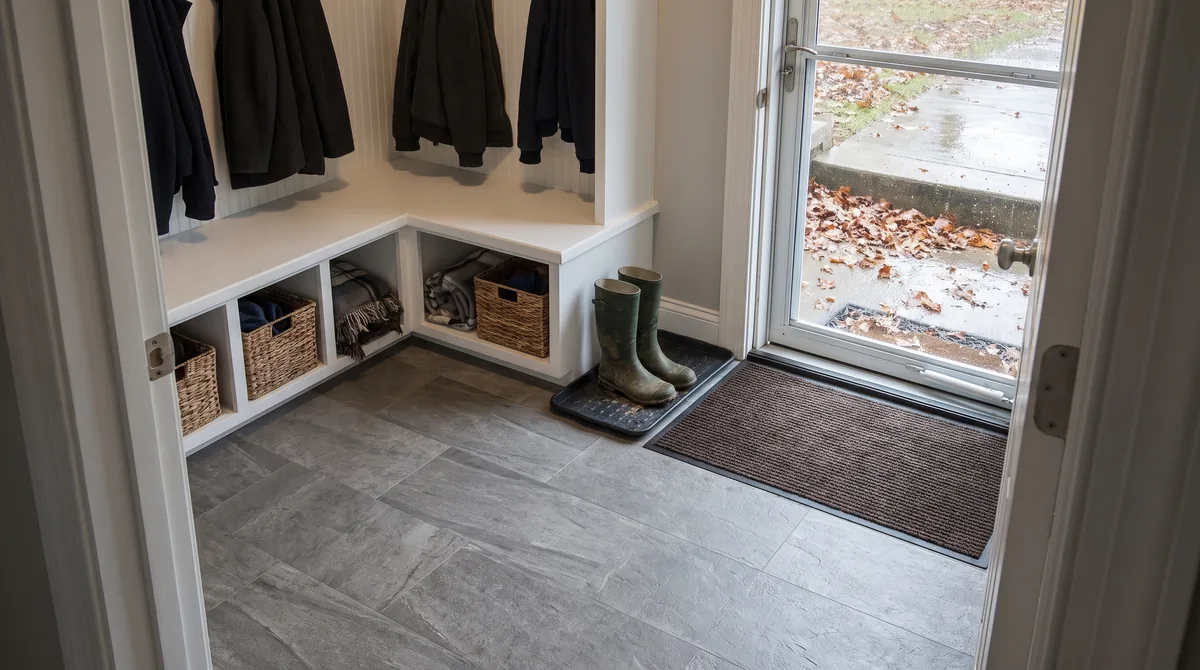
Mudroom or entry |
Click, or glue-down at a hard-used door |
Salt grit wears any surface; matting matters more than method |
|
Rental unit |
Glue-down |
Single-plank repair between tenants |
|
Three-season room or sunroom |
A product rated for unheated rooms, often glue-down |
Floating floors carry a stated temperature range |
|
Home office with a rolling chair |
Either, with a chair mat; glue-down handles rolling loads better |
Rolling loads work a floating floor’s joints |
|
Floor over radiant heat |
Either, if the maker rates the plank (and any adhesive) for radiant heat |
Our room-by-room LVP guide covers how each space lives with vinyl.
Once the method is settled, try the look: upload a photo of your room to our room visualizer, then narrow it to two or three looks.
Our basement flooring guide covers the full below-grade decision.
Vinyl Plank Install Methods in DeForest and Windsor Homes
North of Madison in DeForest and Windsor, the answer often splits by floor.
DeForest mixes established ranches and split-levels with newer open-plan subdivisions. A split-level’s lowest floor often sits on a slab while the levels above sit on wood framing, so one house can need a moisture test downstairs and a flatness check upstairs. In the open-plan homes, the island and the long run decide the method: keep click and plan the breaks, or go glue-down and run it through. See flooring in DeForest, WI for local service.
Windsor incorporated as a village in 2015 and has added subdivisions with finished lower levels and bonus rooms. Those lower levels sit on slabs, so a moisture test from a testing firm or the general contractor comes before the sample board, and a slab that tests dry usually points to click. For local service, see flooring in Windsor, WI.
Three-season rooms, a Wisconsin favorite, are the hardest room for any vinyl: through a Wisconsin winter an unheated porch sits far colder than the house, so the product’s rating comes first.
Harmony Flooring serves homeowners in Madison and throughout Dane County, including DeForest and Windsor.
Ask These Three Questions Before You Choose
Three questions settle most install-method decisions before you pick a color. Ask them at the measure.
- What did the subfloor and slab tests show? Flatness and slab moisture can each rule one system out.
- What will sit on this floor and never move? Islands, cabinets, built-ins: on a click floor, each is a planned stopping point.
- How will a damaged plank be replaced? If one-plank repair matters, glue-down earns its extra prep.
Sources: COREtec Scratchless installation instructions, COREtec Stone installation instructions, ASTM F2170.
Glue-Down vs Click Vinyl Plank FAQs
Should a Madison basement get glue-down or click vinyl plank?
A finished Madison basement usually does well with rigid core click plank over a slab that tests within the maker’s limits. Glue-down makes sense where the slab is flat and dry enough for the adhesive, or where a thinner floor helps at doors and transitions. The slab moisture test decides.
Can click vinyl plank go under kitchen cabinets?
No. Cabinets or an island set on a click floor pin it, which can make it buckle or separate as it moves. Set cabinets first and run the floor up to them with a gap covered by trim.
Does glue-down vinyl plank work in a Wisconsin three-season room?
It can, when both the plank and the adhesive are rated for an unheated room. An unheated Wisconsin winter can fall outside the range a floating floor allows, which is why glue-down is often the safer method there.
Can you glue down click vinyl plank?
Click vinyl plank can be glued down only when its manufacturer approves a glue-down method. Some rigid click products list one in their installation instructions, but gluing a plank that is not rated for it can void the warranty. If a room needs a bonded floor, choose a product made for glue-down from the start.
Is glue-down vinyl plank harder to remove than click?
Yes. A click floor lifts out row by row, while glued planks have to be pried up and the adhesive scraped or ground off before the next floor goes down.
How Harmony Flooring Works
The right install method is matched to your rooms before install day. Harmony Flooring follows Design · Measure · Install on every project: we compare methods room by room, check flatness, confirm any slab has been moisture tested by a testing firm or your general contractor, note every cabinet and long run, and manage the work through vetted installation partners. That is Covering Every Detail on a vinyl floor.
When you are ready to choose a method for your Madison home, schedule a free in-home consultation or call or text us at 608-221-5500.
Planning New Floors in the Madison Area?
Get a free in-home estimate. We measure, bring samples to your kitchen table and give you one written price. No obligation.
Call or text 608-221-5500Schedule a Free Visit
Shop our floors: Hardwood · Vinyl · Carpet · Tile · Laminate
Showroom: 2125 S. Stoughton Rd, Madison, WI 53716
You Might Also Like
-
- Vinyl Plank
- Basements and Wisconsin Climate
November 3, 2026
Why Is My Vinyl Plank Flooring Separating in Winter?
-
-