- Hardwood
Buying Hardwood Floors in Madison: A Local Guide
September 3, 2026

Reviewed by Kevin Sill, Owner, Harmony Flooring
Hardwood flooring is one of the best long-term investments for a Madison home, but the right choice depends on Wisconsin’s climate as much as your style. Harmony Flooring designs, measures and coordinates the installation of hardwood floors in Madison and across Dane County, and the floors that last here are the ones chosen with our humidity swings and forced-air winters in mind. This guide walks you through the decisions that matter locally, so you buy once and buy right.
The Short Version
- Solid vs engineered is the key local decision. Engineered hardwood handles Wisconsin’s humidity swings and works in more rooms, including over concrete and in lower levels. Solid hardwood is the classic choice for main floors and can be refinished more times.
- Wisconsin’s climate moves wood. Dry, forced-air winters shrink boards and can cause small gaps; humid summers make them expand. Proper acclimation and installation are what prevent problems.
- New build or renovation changes the answer. New homes in Verona and Waunakee often pair hardwood with an open plan, while older Middleton and Fitchburg homes may need subfloor prep or refinishing decisions.
- Professional installation protects the investment. Harmony Flooring follows a Design, Measure, Install process built around Madison-area homes.
Why hardwood works well in Madison homes
Hardwood works in Madison because it suits both the housing stock and the lifestyle here. Real wood adds lasting value to the older bungalows and Colonials common on Madison’s near-west and east sides, and it fits the clean, open layouts of new construction in the growing suburbs. It is warm underfoot in a Wisconsin winter, it can often be refinished while the boards are in good shape, and it appeals to buyers if you ever sell. The one thing hardwood asks in return is that it be chosen and installed for our climate, which is where local experience matters. You can browse the hardwood flooring options we carry in Madison to see what fits your home.
Solid vs engineered hardwood in Wisconsin’s climate

For most Madison-area homes, engineered hardwood is the more forgiving choice, while solid hardwood remains ideal for main-floor living spaces you plan to keep for decades. The difference comes down to how each reacts to Wisconsin’s seasons.
Solid hardwood is a single piece of wood. It is beautiful and can be sanded and refinished many times, but it expands and contracts more with humidity, so it is best kept to main and upper floors that stay climate-controlled. Engineered hardwood is real wood over a dimensionally stable core. That core resists the seasonal movement our climate causes, which makes engineered a strong option for rooms near grade, over concrete, and anywhere humidity is harder to control. Our engineered vs. solid hardwood comparison shows where each one wins.
| Factor | Solid hardwood | Engineered hardwood |
|---|---|---|
| Best rooms | Main and upper floors | Main floors, lower levels, over concrete |
| Wisconsin humidity swings | Moves more | More stable |
| Refinishing | Many times | Once or twice, depending on wear layer |
| Longevity | Decades with care | Decades with care |
Quick verdict: engineered hardwood is the pick for most Madison homes, especially over concrete or in lower levels, while solid hardwood wins on main and upper floors you plan to keep and refinish for decades.
If you are weighing hardwood against other products, our guide on hardwood vs. LVP flooring breaks down when each makes sense for a Madison home.
Picture it first: upload a photo of your room to our room visualizer to try hardwood colors and plank widths, then bring the looks you like to your free in-home visit.
Matching hardwood to your project: new build or renovation
The best hardwood for your home depends on whether you are finishing a new build or updating an existing one. New construction in Sun Prairie, Verona, and Waunakee usually means an open main floor, where a consistent wide-plank hardwood ties the space together and pairs well with today’s lighter, natural tones. In an established Middleton or Fitchburg home, the questions are different: what is under the current flooring, whether existing hardwood can be refinished instead of replaced, and how a new floor will meet the trim and transitions already in the house. Harmony Flooring measures each space in person so the product, plank width, and layout fit the home rather than a generic recommendation. Our guide to builder-grade flooring in new Madison homes covers the new-construction side.
Choosing species, width and finish
Once you have picked solid or engineered, three choices shape how a hardwood floor looks and lives in a Madison home: the species, the plank width and the finish.
Species. Oak is the most common choice in Wisconsin homes because it is hard, takes stain evenly and its grain hides everyday wear. Maple has a cleaner, more uniform look but shows scratches a little sooner. Hickory suits busy households with dogs and kids, thanks to its hardness and varied grain. Walnut brings deep color but is softer, so it fits lower-traffic rooms.
Width. Narrow strips of about two to three inches suit traditional and historic homes, while planks of five inches and wider feel current and make rooms read larger. The wider the board, the more its seasonal movement shows, which is why wide-plank projects here usually favor engineered construction.
Finish. Site-finished floors are sanded and sealed in your home for a smooth, seamless look. Factory-finished planks arrive cured and ready to walk on. Matte and low-gloss sheens hide dust, pet hair and small scratches far better than glossy ones, which is why they have become the default in busy Madison households.
Caring for hardwood through Wisconsin’s seasons

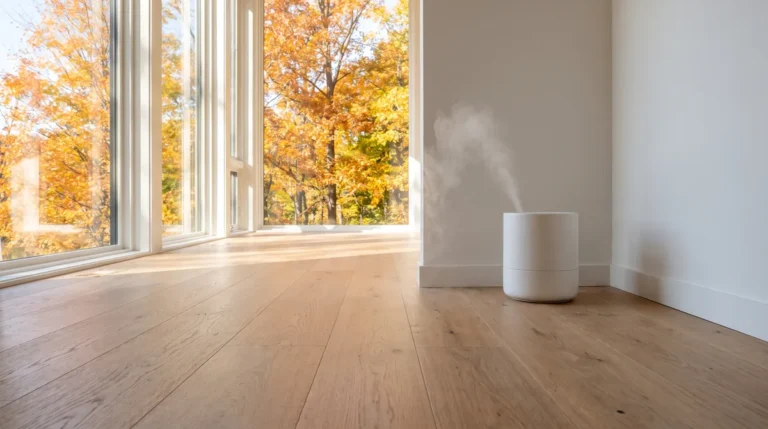
Hardwood in a Wisconsin home needs simple, season-aware care, and most of it comes down to managing humidity and grit. In winter, forced-air heat dries indoor air and can cause boards to shrink slightly and show thin gaps. Running a humidifier to hold indoor humidity in the NWFA’s range of 30 to 50 percent through the cold months reduces that movement, and our indoor humidity guide covers the settings. In humid summers, the reverse happens and boards expand, which is normal. The other local factor is what comes in on your shoes: road salt, sand, and slush are abrasive, so a good entry mat and prompt cleanup at doorways protect the finish. Clean with a product made for hardwood, skip standing water, and add felt pads under furniture. Cared for this way, a hardwood floor in Madison lasts for decades.
The Harmony Flooring process: Design, Measure, Install
Harmony Flooring serves Madison and the surrounding Dane County communities, including Sun Prairie, Middleton, Fitchburg, Verona, Waunakee, and DeForest, and every project follows the same three steps: Design, Measure, Install. We start with a consultation to match species, color, and plank width to your home and how you live. We measure in person, check the subfloor and the humidity conditions that matter in our climate, and plan acclimation so the wood settles before it is installed. Before the first board goes down, moisture readings on the subfloor and the new wood need to be close, and a hidden expansion gap under the baseboard gives the floor room to move in humid months. Then the trusted local installers we coordinate put the floor in and handle transitions and finishing details, with one coordinator keeping you posted. You can reach us at 608-221-5500 or through our contact page to schedule a free in-home consultation.
Sources: National Wood Flooring Association: Problem Prevention, NWFA: Types of Wood Floors and NWFA Wood Flooring Installation Guidelines.
Frequently Asked Questions
Do hardwood floors hold up to Wisconsin winters?
Yes, when they’re chosen and installed for our climate. Dry winter air shrinks boards a little and can open thin gaps that close again in summer. A humidifier and the right product for each room keep that to a minimum.
Is engineered or solid hardwood better for a Madison home?
Both work well. Solid hardwood is a great fit for main and upper floors you plan to keep a long time. Engineered hardwood is more stable over concrete, in lower levels and anywhere humidity is hard to control.
Can hardwood go in a Madison basement?
Solid hardwood isn’t recommended below grade. Some engineered products are rated for it, but most basements do better with luxury vinyl plank or tile. Have the slab moisture tested by a testing firm or your general contractor first, and the floor maker’s limit decides what will work.
Does new hardwood need to acclimate before it’s installed?
Yes. The wood needs time inside your home at normal temperature and humidity before it goes down. How long depends on the product and the season. We build acclimation into your schedule so the floor settles first.
Who installs the hardwood floors you sell?
We work with trusted local installers. One coordinator manages your project from the first visit to the final walkthrough.
Ready to choose your hardwood floor?
Hardwood is a floor you buy once when it is chosen for your home and our climate. If you are comparing options for a Madison-area home, Harmony Flooring can help you pick a floor that fits your space, your style, and Wisconsin’s seasons. Schedule a free in-home consultation or call or text 608-221-5500.
Questions About Your Floors?
Call or text 608-221-5500Schedule a Free Consultation
Shop our floors: Hardwood · Vinyl · Carpet · Tile · Laminate
Showroom: 2125 S. Stoughton Rd, Madison, WI 53716