- Flooring
New Build Flooring in Madison: What Builder-Grade Gets You
September 28, 2026
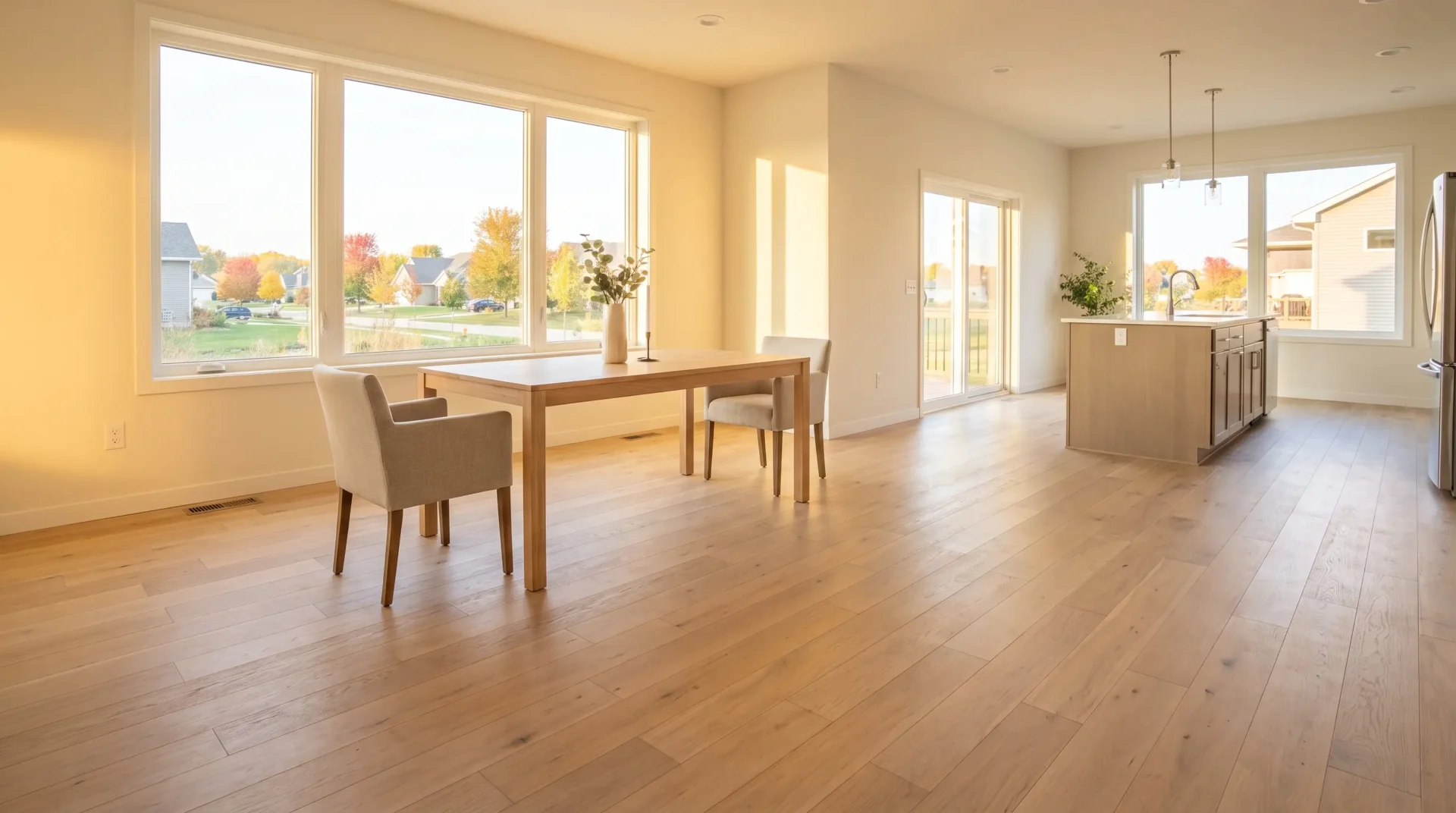
You picked the lot. You picked the plan. Now you are at a design center with a flooring allowance, a binder of standard selections, and a list of upgrades, and nobody has explained what separates one from the next. At Harmony Flooring, we walk Madison-area families through this every building season, and the questions never change. What does the standard package include, and which upgrades are worth taking?
The Short Version: Builder-grade flooring is a real performance tier, not a shortcut. What separates it from mid-range and premium comes down to measurable specs: wear layer thickness on vinyl, veneer thickness on engineered hardwood, carpet density, and cushion. Spend your upgrade allowance where the floor is hardest to change later, not where it is easiest.
What “Builder-Grade” Actually Means in a New Build
Builder-grade flooring is the standard package included in the base price of a new home, and in the Madison area it is chosen for broad appeal, consistent supply, and predictable installation across a whole subdivision. It is a specific set of specifications, not a lesser category of product, and those specifications are what you are choosing between on an upgrade list.
Most packages cover the same ground: a hard surface through the main living areas, carpet in bedrooms, tile or vinyl in wet rooms. Confirm early where the package stops, since basements, bonus rooms, and stair treads are often handled separately.
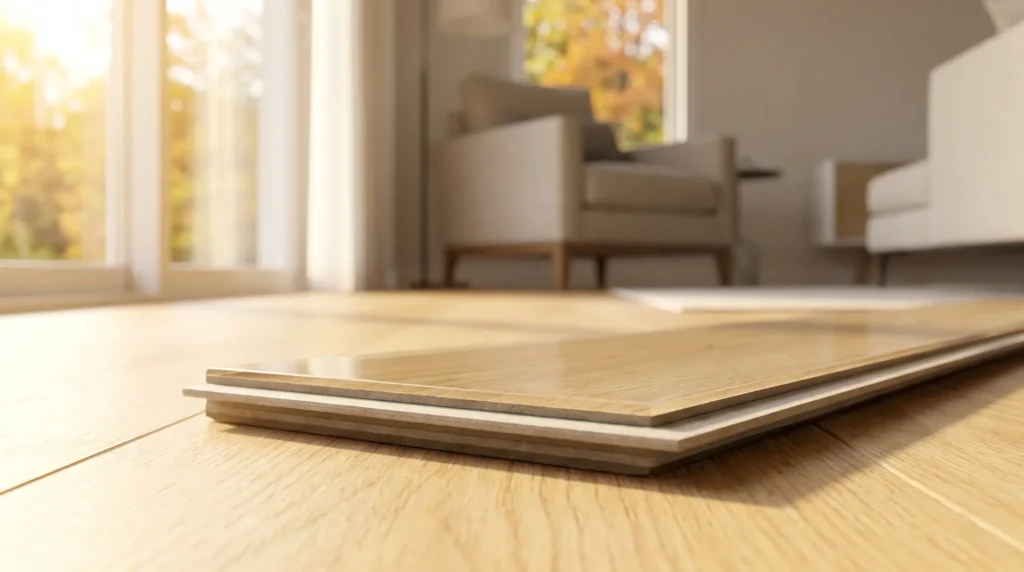
The Specs That Actually Separate the Tiers
The difference between entry-level, mid-range, and premium flooring is physical and measurable, not marketing. Wear layer thickness, veneer thickness, carpet density, and cushion decide how a floor in your Waunakee or Verona home looks in year ten. Ask for these numbers and the tiers stop being abstract.
What to ask about |
Entry-level |
Mid-range |
Premium and luxury |
|
Vinyl plank wear layer (clear top layer, in mils) |
Thinner, light traffic rooms |
Noticeably thicker, active households |
Thickest. Manufacturer specs commonly set 20 mil (0.5 mm) as the commercial minimum |
|
Engineered hardwood veneer (real wood top layer, in mm) |
Thin, generally not refinishable |
Meets the refinishable threshold |
Thicker, more refinishing life ahead of it |
|
Carpet construction |
Lower density and twist, shows traffic paths sooner |
Denser pile, higher twist, holds texture |
Dense construction built for stairs and main halls |
|
Carpet cushion |
Thinner or softer than the warranty prefers |
Matched to the carpet maker’s spec |
Firm, resilient, spec-matched |
|
Plank width and length |
Narrower, shorter, more seams |
Wider planks, longer boards |
Wide and long formats, fewer seams |
|
Transitions and trim |
Stock profiles |
Coordinated profiles |
Flush thresholds, finished stair nosings |
Two of those are permanent decisions.
On engineered hardwood, veneer thickness governs whether the floor can ever be sanded. The NWFA Wood Flooring Sand and Finish Guidelines state that a floor with less than 3/32 inch (2.5 mm) of wear thickness generally should not be sanded, and the NWFA Engineered Wood Flooring Refinishable Program uses that same 2.5 mm as its minimum. Engineered hardwood can often be refinished, typically once or twice, and thinner veneers never can. Solid hardwood carries several refinishes.
On carpet, the cushion is part of the system. The Carpet and Rug Institute’s guidance for residential cut pile is cushion no more than 7/16 inch thick and no less than 1/4 inch, at 6 pounds per cubic foot density, with a maximum of 3/8 inch at 8 pounds for berber. Cushion that does not match the carpet’s requirements can void the warranty.
One accuracy note. Luxury vinyl and porcelain tile are waterproof and belong in wet rooms, but vinyl cannot be sanded or refinished, so its wear layer is the whole story. Laminate cannot be refinished either, and standard laminate is not waterproof at the seams.
Our guide to what drives flooring cost in Madison homes covers the wider picture: https://www.harmonyflooring.com/flooring-cost-madison-value-guide/ . You can also reach out for a consultation before your selection deadline at https://www.harmonyflooring.com/contact/ .
Most New-Build Buyers Get the Upgrade Decision Backwards
Here is the pattern we see in new Dane County homes: buyers agonize over bedroom carpet, then take the standard option in the rooms they will never realistically change. That is backwards. The question is not which floor you like most, it is which floor you are effectively stuck with.
Carpet is the easiest surface to replace. It has a genuinely shorter service life than any hard surface, it lives behind closed doors, and swapping it in five or seven years means one room, one day, no disruption elsewhere.
The high-consequence ones, roughly in order:
1. Anything running continuously through an open main floor. Today’s plans put kitchen, dining, and living space on one uninterrupted run, so changing it later is a whole-level project and your family lives somewhere else while it happens.
2. Tile in the primary bath. Replacing it means demolition, dust, and a bathroom out of service, and the vanity and shower curb get pulled into it.
3. Stair treads. The most labor-intensive surface in the house, and they connect every level.
4. Entry and mudroom tile. Grouted into place beside rooms you have already finished.
5. Whatever the finished basement will meet. A later lower-level finish is constrained by the transitions and the main-level product.
The takeaway: put your upgrade allowance into the continuous main floor, the primary bath tile, and the stairs. Take the standard carpet in bedrooms with a clear conscience.
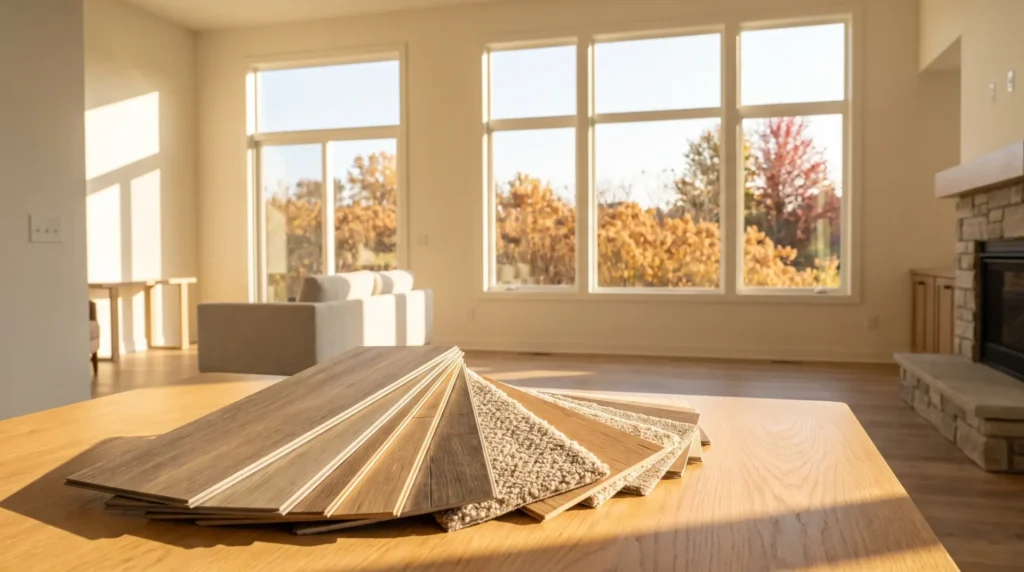
What a New Wisconsin Home Asks of Its Floors in the First Year
A brand new house in Verona, Waunakee, or DeForest asks things of its floors that an established home does not, and it happens in the first twelve months. New construction carries construction moisture. Slabs release moisture long after pour, and fresh drywall, joint compound, and paint add their own load to the indoor air. Per ASTM F2170, concrete is typically tested with in-slab relative humidity probes before a moisture-sensitive floor goes down. Just moved in? Our page on flooring for a new house covers what to do first.
Then the first Wisconsin winter arrives. A new home is tight, the forced-air furnace runs hard, and indoor humidity drops fast. NWFA guidance is that wood flooring performs best when the interior stays between 30 and 50 percent relative humidity and 60 to 80 degrees Fahrenheit. A new house often sits below that range in January while it is still drying out, which is exactly when wood movement shows up in Madison hardwood floors: https://www.harmonyflooring.com/hardwood-floor-cupping-summer-madison/ .
Two more local realities. Many new builds in the northern Dane County corridor go in with the lower level unfinished, so plan the eventual basement product before you lock the main level. And Wisconsin entries take salt, slush, and grit for four months a year.
How Harmony Flooring Works With New-Build Buyers
Many new-construction buyers can bring in their own flooring partner, and many builders are glad to coordinate it. Whether that is available depends on your purchase agreement, so ask how allowances and outside selections work on your contract. We work with homeowners at the selection stage, and we supply flooring for builders in Madison, WI as well.
Either path starts the same way. Design is a conversation about how you live and what each room has to handle. Measure brings us to the home for real dimensions and the conditions that affect what can be installed and when. Install is handled by our team from first plank to final walkthrough, timed around your build schedule and the moisture in the house rather than a generic calendar. Harmony Flooring serves Madison and Dane County, including Verona, Waunakee, and DeForest, with free in-home consultations, Covering Every Detail.
New Build Flooring Questions From Madison-Area Buyers
What flooring should I pick for a new build in Verona, Waunakee, or Sun Prairie?
Match the product to the room and to how long you plan to stay. For the continuous main level of a new Dane County home, most families are best served by mid-range or premium luxury vinyl plank with a thicker wear layer, or engineered hardwood with a veneer thick enough to refinish later. Use waterproof tile or vinyl in bathrooms, mudrooms, and laundry.
Is upgrading flooring through the builder worth it?
It depends on the room. Upgrades earn the most in spaces that are disruptive to change later: the open main floor, primary bath tile, and stair treads. They earn the least in secondary bedrooms, where carpet is quick and contained to replace. Ask for the specs behind each tier before deciding.
Does Harmony Flooring work with new construction in Dane County?
Yes. We work with homeowners at the design-center stage, and we supply and install flooring for builders in Madison, WI and the surrounding communities. If you are building in Verona, Waunakee, or DeForest, we can review your package and upgrade list before your selection deadline.
When should I choose flooring for a house that is still being built?
Earlier than feels necessary. Selections usually lock well before framing is complete, and lead times on premium products run longer than on standard ones. Choosing early also gives us time to plan around the moisture in a new Wisconsin house, the most overlooked factor in how a new-build floor performs through its first winter.
Get a Second Read on Your Selection Sheet Before It Locks
You have a deadline, a list, and a set of specs nobody has translated for you. That is solvable. Bring us your builder’s standard package and upgrade options, and we will walk through what each tier delivers and where your allowance does the most good.
Schedule a free consultation at https://www.harmonyflooring.com/contact/ or call 608-221-5500. Design · Measure · Install, start to finish.
Questions About Your Floors?
Call or text 608-221-5500Schedule a Free Consultation
Shop our floors: Hardwood · Vinyl · Carpet · Tile · Laminate
Showroom: 2125 S. Stoughton Rd, Madison, WI 53716