- Buying Guides
Flooring Quality Tiers: How to Pick a Level That Lasts
August 27, 2026
Ask about flooring cost and you’ll usually get one of two answers. Either a range so wide it tells you nothing, or a flat “it depends.” Both are frustrating when you’re trying to plan a real project. For everything else that moves the price, see what affects flooring cost in Madison.
Here’s the truth: flooring cost genuinely does depend on a handful of variables, and no honest flooring company in Madison, WI can hand you an accurate number without seeing your home. What we can do is more useful. We can show you exactly what “it depends” depends on, so you can make smart decisions before anyone measures a single room. If you haven’t picked a material yet, compare flooring types for Madison homes.
The Short Version: Flooring cost comes down to six things: the product tier you choose, the size and layout of your rooms, the condition of your subfloor, the complexity of the installation, tear-out and disposal of the old floor, and timing. An in-home measure is the only way to turn those variables into a real number. We break each one down on our flooring cost factors page.
What Goes Into a Flooring Quote
Every flooring quote is built from the same ingredients. The product itself, the labor to install it, the prep work to make your home ready, and the removal of whatever is there now. Two houses on the same street can land in very different places because of how those ingredients combine.
Here’s the counterintuitive part most homeowners never hear. The product is often not the biggest driver. On plenty of projects, prep work and installation complexity outweigh the difference between one plank and another. Let’s walk through each factor.
Product Tier Sets the Starting Point
Flooring products sort into four broad tiers: entry-level, mid-range, premium, and luxury. Moving up a tier generally buys thicker wear layers, denser cores, better finishes, longer warranties, quieter footsteps, and a floor that still looks right years from now.
The tier question matters more than the category question. A premium luxury vinyl plank can sit above an entry-level hardwood in both performance and price. So instead of asking “is hardwood expensive,” ask “which tier fits how we actually live.” A busy household with big dogs has different tier needs than a quiet condo near downtown Madison.
Room Size, Layout, and Access Shape the Labor
Square footage matters, but not the way most people assume. Larger spaces spread the fixed parts of a job (setup, equipment, trim work) across more floor. Choppy spaces concentrate that same effort into fewer square feet.
Layout adds its own wrinkles. Open-concept main levels, common in newer Sun Prairie and Waunakee builds, install in long clean runs. Older homes with many small rooms and angled doorways require more cuts, more transitions, and more time. Access counts too. A third-floor room or a basement with one narrow entry changes how materials move through your home.
What’s Under Your Floor Matters More Than You’d Guess
The subfloor is the single biggest source of quote surprises, and it’s invisible until the old floor comes up. Flatness, moisture, soft spots, and old layers stacked underneath all affect what prep is needed before anything new goes down.
Here’s what pros check that homeowners almost never do: we run a straightedge across the subfloor to find dips and humps, and we check moisture conditions, especially over concrete and in basements. A floor installed over an uneven or damp subfloor will fail no matter how good the product is. Historic homes in Maple Bluff and near the Capitol often hide decades of old flooring layers, so the prep conversation matters there more than anywhere.
Installation Complexity: Stairs, Patterns, and Transitions
A simple rectangular room is the baseline. Everything beyond it adds skilled labor. Stairs are the clearest example, since each step is essentially a small custom project. Split-level homes around Verona and Monona often have short staircases plus multiple transitions between levels, and that shapes the quote as much as the flooring choice does.
Patterns matter too. Herringbone, diagonal layouts, and borders look incredible and take real time to execute, and transitions around fireplaces and into tile zones require careful detail work. None of this is a reason to avoid those features. It’s just where the craftsmanship, and the labor, lives.
Tear-Out, Disposal, and Timing Round Out the Picture
Removing the old floor is its own line of work. Glued-down vinyl and old tile take far more effort than stapled carpet, and everything has to be hauled out and disposed of properly.
Timing plays a quieter role. Spring and summer are peak renovation season around Madison, so planning ahead gives you the widest selection and scheduling flexibility. Winter installs work well too, with proper acclimation time for products like hardwood. If you’re at the comparison stage, reach out for a free in-home consultation and get numbers built on your rooms instead of averages.
How Flooring Cost Compares Across Quality Tiers
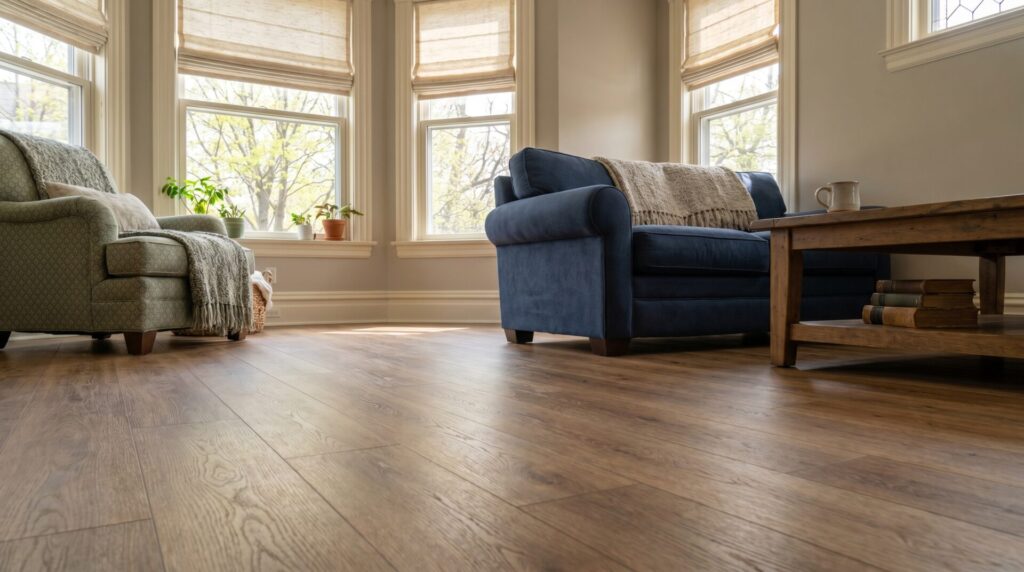
Since we don’t quote prices in a blog post, here’s what each tier really gets you:
- Entry-level: Functional and presentable, with thinner wear layers and shorter lifespans. A sensible fit for rental units or rooms you plan to renovate again soon.
- Mid-range: The sweet spot for many Madison families. Solid durability, good warranties, and visuals that hold up to kids and pets.
- Premium: Noticeably better materials, deeper texture, and longevity measured in decades. Built for the home you plan to stay in.
- Luxury: Wide planks, rare species, custom patterns, and finishes chosen for a specific design vision. The floor becomes part of the architecture.
The honest guidance: match the tier to how long you’ll own the home and how hard you live on the floor. Overbuying for a short stay and underbuying for a forever home are both costly mistakes, in opposite directions.
Long-Term Value Is the Part Nobody Quotes
The number on a quote is the cost to install a floor. The value shows up over the years that follow. Lifespan is the biggest piece, and the differences are dramatic. Our guide to what flooring lasts the longest breaks down what each category realistically delivers.
Maintenance matters too. Some floors need refinishing or resealing over time, while others ask almost nothing of you. Resale is real as well. We’ve covered whether new flooring increases home value for Wisconsin sellers, and floors are one of the first things buyers judge. Finally, there’s livability: warmth underfoot, quiet rooms, easy cleanup during slush season. You pay for a floor once. You live on it every day.
Why an In-Home Measure Is the Only Real Quote
Online calculators can’t see your subfloor, your stairs, or the slope in that one hallway. An in-home measure can. It maps every room, checks the conditions that drive prep work, and catches complications early. That’s why a measured quote holds up while a guessed one grows. Prep needs found before the project starts get planned and priced honestly instead of appearing mid-install as a surprise.
Flooring Cost FAQs, Answered Honestly
How much does new flooring cost in Madison, WI?
It depends on the six drivers above: product tier, room size and layout, subfloor condition, installation complexity, tear-out, and timing. A bedroom in entry-level vinyl and a main level in luxury hardwood sit at opposite ends of a wide spectrum. The only accurate answer comes from an in-home measure.
What is the most expensive part of a flooring project?
Often not the product. On many projects, subfloor prep and skilled installation labor are the largest pieces, especially in older homes or layouts with stairs and patterns. That’s also where quality matters most, since prep and installation determine how long the floor lasts.
How much should I plan for surprises like subfloor repair?
It depends on your home’s age and history. Newer builds usually need minimal prep, while century-old homes can hide layered flooring and uneven subfloors. The good news: a thorough in-home measure identifies most of this up front, so the quote you approve reflects reality.
Is carpet or hard flooring the better value?
It depends on the room. Carpet typically involves a simpler installation, while hard surfaces last longer and suit Wisconsin’s muddy seasons in busy areas. Our flooring vs carpet cost comparison walks through where each one earns its keep.
How much more does premium flooring cost than entry-level?
Think of it as paying for performance per year rather than a bigger upfront number. Premium products carry thicker wear layers, better cores, and much longer lifespans, so the gap narrows when spread across the decades the floor will serve. For homes you plan to keep, mid-range and premium tiers usually deliver the strongest long-term value.
Ready for a Number That’s Actually Yours
You came here wanting a price, and we get it. The most useful thing we can offer is clarity on what drives that price, plus a fast way to get the real one. We coordinate everything, Design · Measure · Install, starting with a consultation where we measure your rooms, check your subfloor, and build a quote around your goals. Request your personalized quote and get an answer with your address on it, not an average.
Questions About Your Floors?
Call or text 608-221-5500Schedule a Free Consultation
Shop our floors: Hardwood · Vinyl · Carpet · Tile · Laminate
Showroom: 2125 S. Stoughton Rd, Madison, WI 53716