- Flooring
Flooring Underlayment and Carpet Pad: A Madison Guide
October 5, 2026

You are holding two flooring quotes. You have compared the plank colors, the carpet styles, the timelines. Then you notice a line partway down that neither quote really explains, and that nobody at either appointment brought up: the underlayment. Or the pad. Or the cushion, depending on who wrote it.
At Harmony Flooring, we see it every week in Madison homes. Homeowners will spend a month choosing a color and about four seconds on the layer underneath. That layer decides how the floor feels, how it sounds, how it handles Wisconsin moisture, and whether the manufacturer will honor the warranty if something goes wrong.
The Short Version: The layer under your floor controls comfort, sound, moisture protection, and warranty validity. Carpet cushion has published spec limits, and too thick voids warranties. Many rigid core vinyl planks arrive with a pad already attached, and adding another can cause the joints to fail. Tile does not use a pad at all. Over a Wisconsin slab, moisture control matters more than cushion.
What the Layer Underneath Actually Does
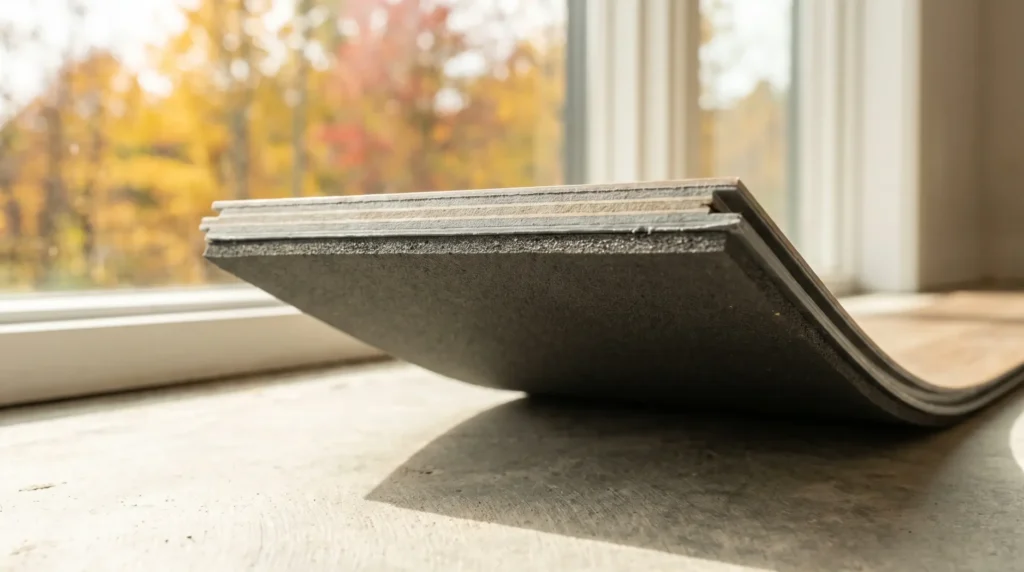
Underlayment is the material installed between your subfloor and your finished floor, and in Madison homes it does four jobs at once: it smooths minor subfloor variation, it controls sound, it manages moisture moving up from below, and it satisfies the manufacturer’s installation requirements so the warranty stays intact. It is not padding for the sake of softness.
That last job is the one homeowners never hear about. Flooring warranties are written around a specific installation method. If the layer underneath falls outside what the manufacturer specifies, a claim can be denied even when the flooring itself is fine.
Different floors want different things underneath. Carpet wants resilient cushion. A floating vinyl plank often wants nothing added. Tile wants something rigid. Treating them as one category is where problems start.
Carpet Cushion Has Published Limits, and Thicker Is Not Safer
Carpet cushion is the one underfloor material with clear, public specifications, and the Carpet and Rug Institute publishes them. For residential cut pile, cut-loop, or high-level loop carpet, CRI calls for a resilient, firm cushion with a thickness of 7/16 inch, no less than 1/4 inch, at 6 pounds per cubic foot density. For berber, thinner loop, or wide-loop carpet, cushion thickness should not exceed 3/8 inch, and these carpets perform best on a stable, low-flexing cushion rather than a thick, soft one.
Density is the number that matters most, and the one that gets ignored. It describes how much material is packed into the cushion, which is what resists compression under years of traffic. A thick, low-density cushion feels wonderful in the showroom and flattens out in a hallway.
Going too soft or too thick has consequences CRI spells out directly. The wrong cushion can produce wrinkling, buckling, seam separation, and breakdown of the carpet structure itself, and improper cushion selection may void the carpet manufacturer’s warranty. In practical terms, the carpet moves independently of the floor beneath it, the backing works against itself, and the seams give up first.
Traffic should drive the choice. Bedrooms, dens, and lounge areas can carry a thicker, softer cushion comfortably. Living rooms, family rooms, hallways, and stairs need thinner and firmer, because those are the places where a soft cushion turns into a wear pattern. If you are still weighing carpet styles for those rooms, our carpet page is a useful starting point: https://www.harmonyflooring.com/carpet/
Under Vinyl Plank and Laminate, More Cushion Can Break the Floor
Here is the part that surprises almost everyone comparing quotes: many rigid core luxury vinyl plank products ship with a pad already bonded to the back of each plank, and adding a second underlayment on top of it is often prohibited by the manufacturer. One major manufacturer’s rigid core installation instructions state it plainly: the product has an attached pad, and an additional underlayment is not recommended.
The reason is mechanical, not commercial. The same document warns that soft underlayment and soft substrates will compromise the product’s locking ability and reduce its resistance to indentation. Rigid core planks hold together through a click joint that depends on a firm, flat base. Stack cushion under a floor engineered to sit firm and every footstep flexes the joint a little. Over a few years, that flex is what opens seams and pops planks apart. It is one of the few situations in flooring where paying for an extra layer actively shortens the life of the floor.
The allowance does vary by product line. Some vinyl lines permit a thin secondary underlayment within a stated thickness limit, while others prohibit it outright, which is exactly why the answer is to read the instructions for the specific product being installed rather than apply a general rule.
Laminate is a different animal. Laminate planks generally do need a separate underlayment, often one that combines a foam or felt layer with a vapor retarder, and over concrete that vapor retarder is not optional. Laminate is also not waterproof at the seams the way luxury vinyl and porcelain tile are, so controlling moisture from below is a real durability question rather than a comfort upgrade.
Wood Floors Care About Moisture and Movement, Not Softness
For engineered hardwood, the layer underneath is about moisture management and movement, not cushion. The National Wood Flooring Association’s guidelines call for the subfloor to be within 4 percent moisture content of the properly acclimated wood flooring before installation, and for a wood subfloor, an acceptable underlayment is a vapor retarding material with a perm rating between 0.7 and 10 when tested per ASTM E96.
How the floor is attached changes what goes under it. A floating engineered floor uses an underlayment much like a laminate install, with a vapor retarder over concrete. A glued engineered floor may use a moisture-control adhesive that does the job instead. A nailed floor over a wood subfloor typically uses a vapor retarding underlayment sheet.
Getting this right is what protects the option to refinish later. Engineered hardwood can often be refinished depending on the thickness of its wear layer, and a floor that has cupped or delaminated from moisture below has lost that option regardless of how thick the veneer was.
Tile Does Not Get a Pad at All
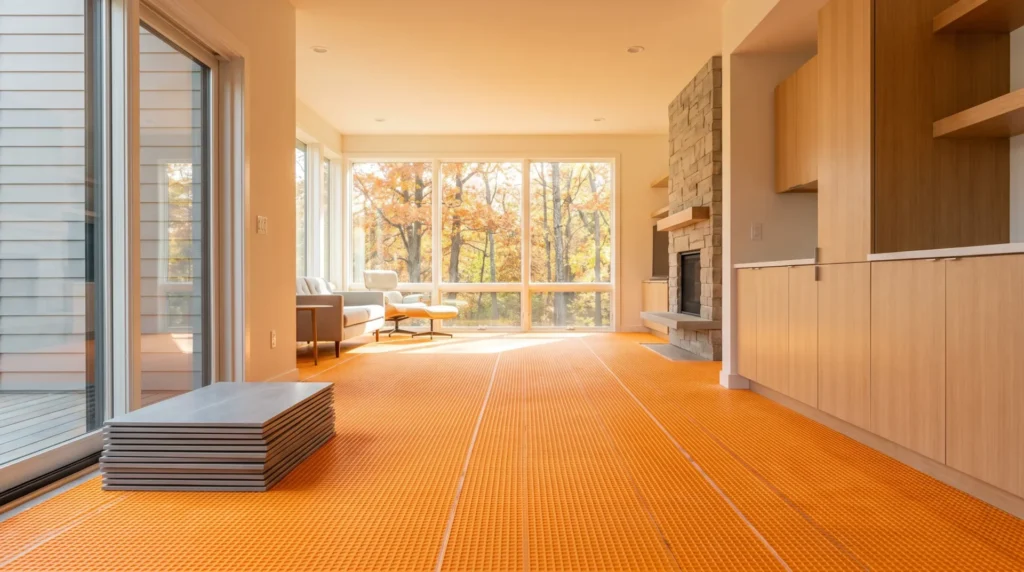
Tile is the one material where cushion is the enemy, because tile and grout are rigid and any movement underneath shows up as a cracked tile or a cracked grout line. Instead of a pad, tile installations use a rigid or specialized layer: cement backer board, or an uncoupling membrane, or a crack isolation membrane meeting ANSI A118.12.
An uncoupling membrane is worth understanding, because the name describes exactly what it does. It is a shaped layer that separates the tile from the substrate just enough to let the two move independently, so seasonal movement in the subfloor is not transferred straight into the tile. In a Wisconsin home with real seasonal swing, that separation is doing quiet, useful work every year.
The right choice depends on the substrate, the room, and whether waterproofing is required. It is a structural decision made before a single tile is set, so it belongs in the design conversation, not a change order.
A Quick Comparison of What Goes Underneath
Floor type |
What goes underneath |
Why it matters |
|
Carpet |
Separate cushion, spec matched to the carpet construction |
Comfort, sound, and warranty validity. Wrong spec causes wrinkling and seam separation |
|
Rigid core luxury vinyl plank |
Often an attached pad only, plus a vapor retarder over concrete |
Adding cushion can flex and fail the click joints |
|
Laminate |
Separate underlayment, usually with a vapor retarder over concrete |
Sound control and moisture protection at seams that are not waterproof |
|
Engineered hardwood, floating |
Underlayment with a vapor retarder |
Manages moisture and allows controlled movement |
|
Engineered hardwood, glued or nailed |
Moisture-control adhesive or a vapor retarding sheet |
Protects the bond and the ability to refinish later |
|
Tile |
Cement backer board, uncoupling membrane, or crack isolation membrane |
Rigidity and separation prevent cracked tile and grout |
Wisconsin Slabs, Wisconsin Winters, and Two Kinds of Madison Home
In Dane County, the layer under your floor is doing more work than it would almost anywhere else, and the reason is the slab. Concrete releases moisture for a long time, and manufacturers set hard limits on how much they will accept. The rigid core instructions referenced above cap moisture at 8 pounds per 1,000 square feet in 24 hours by ASTM F1869 calcium chloride testing, or 90 percent relative humidity by ASTM F2170 in-situ probe, with slab pH between 6 and 10. Those are not suggestions. They are the conditions the warranty is written against, and they are why a proper vapor retarder over a Madison basement slab is a requirement rather than an upgrade. If your lower level has a history of dampness, that is a separate conversation worth having first: https://www.harmonyflooring.com/basement-floor-moisture-mold-wisconsin/
Winter pushes from the other direction. Forced-air heat runs for months here and pulls indoor air very dry, which shrinks wood and stresses seams, while summer humidity swings it back. A floor that moves twice a year needs the correct layer beneath it to absorb that cycle instead of fighting it.
The two housing types we work in call for different answers. In Cross Plains and the older neighborhoods around Madison, we are usually working over wood subfloors, sometimes with decades of settling and a few flat spots to address. In newer McFarland construction, we are more often on slab-on-grade or a finished lower level, where moisture testing and the vapor retarder carry the load and the flatness is usually already there. Same product, same brand, genuinely different layer underneath.
If one of your quotes is quiet about this layer, ask. We are happy to walk through what a specific product requires in your home: https://www.harmonyflooring.com/contact/
Questions Worth Asking Before You Sign
1. Does this flooring come with an attached pad, and does the manufacturer allow anything added under it?
2. What cushion thickness and density is specified, and does it match the carpet construction?
3. What moisture testing is being done on the slab, and what are the results?
4. What vapor retarder is included, and is it required for this product?
5. Is the subfloor flat enough for this product’s tolerance, and what prep is included if it is not?
A quote that answers those five questions is complete. One that does not is leaving the decision to install day.
Frequently Asked Questions
What kind of underlayment do I need for a Madison basement floor?
Over a Madison basement slab, moisture control matters more than cushion. Concrete gives off moisture for years, and manufacturers require the slab to test within specific limits before installation, so the layer that matters most is a vapor retarder appropriate to the product. If you are putting carpet in a lower level, the cushion also needs to be rated for below-grade use rather than a standard bedroom pad.
Do I still need underlayment if my vinyl plank already has a pad on it?
Usually no, and adding one can create a problem. Manufacturers of rigid core vinyl with an attached pad frequently state that additional underlayment is not recommended, because a soft base compromises the locking system and reduces indentation resistance. Over a concrete slab you may still need a separate vapor retarder, which is a moisture layer rather than a cushion layer.
Can you tell whether my carpet pad was the wrong spec?
Often, yes. Carpet installed on cushion that is too thick or too soft tends to wrinkle, buckle, or separate at the seams sooner than it should, and traffic lanes flatten early. The Carpet and Rug Institute sets residential cut pile cushion at 7/16 inch maximum, no less than 1/4 inch, at 6 pounds per cubic foot density, with berber capped at 3/8 inch. A cushion outside those limits is worth investigating.
How does a Wisconsin winter affect what goes under my floor?
Wisconsin homes swing from humid summers to very dry forced-air winters, and floors expand and contract with that cycle. The layer underneath either absorbs that movement or transmits it into your seams and grout lines. That is why vapor retarders under wood and vinyl, and uncoupling membranes under tile, are worth more here than in a mild, stable climate.
Do you offer in-home flooring consultations around Dane County?
Yes. Harmony Flooring serves Madison and the surrounding Dane County communities, including McFarland, Cross Plains, and the neighboring towns, with free in-home consultations. We measure the space, check the subfloor conditions, and confirm what each product you are considering actually requires underneath it.
How Harmony Flooring Works
We are a full-service flooring company in Madison, Wisconsin, and our process is Design · Measure · Install. It starts with a conversation about the room, how it gets used, and what you want it to feel like. Then we measure in your home, evaluate the subfloor, and confirm moisture conditions before anything is ordered, because the layer underneath is specified then, not improvised later. Our installers follow each manufacturer’s published requirements, which is what keeps your warranty intact. One team, first sample to final walkthrough. Covering Every Detail is the part of the job the customer never sees.
Ready to Find Out What Belongs Under Your Floor
If you are comparing quotes and want a straight answer about the underlayment line, we will give you one. Schedule a free in-home consultation and we will look at your subfloor, test what needs testing, and show you exactly what each product you are considering requires underneath it, before you commit to anything.
Reach us at https://www.harmonyflooring.com/contact/ or call 608-221-5500. We serve Madison, Dane County, and the surrounding communities.
Questions About Your Floors?
Call or text 608-221-5500Schedule a Free Consultation
Shop our floors: Hardwood · Vinyl · Carpet · Tile · Laminate
Showroom: 2125 S. Stoughton Rd, Madison, WI 53716