- Hardwood
Indoor Humidity for Wood Floors in Wisconsin Homes
October 12, 2026
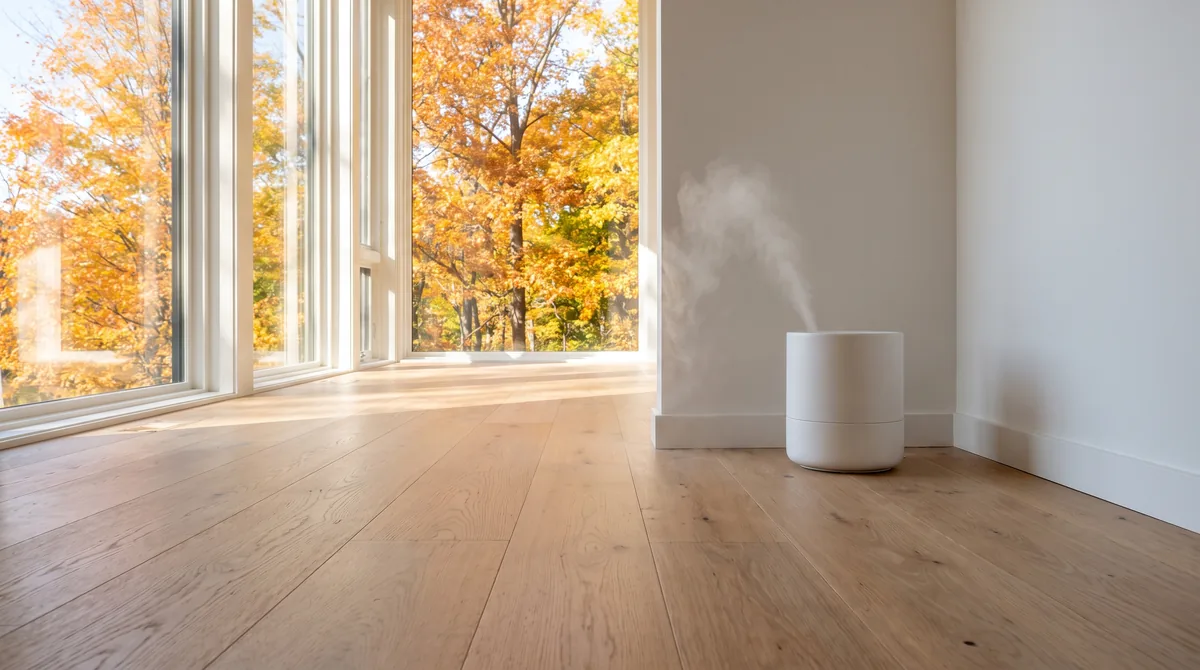
Every October the same thing starts happening in Madison homes. The furnace kicks on, the air dries out, and by January there are thin gaps between hardwood boards that looked flawless in September.
That is not a defect. That is your floor doing exactly what wood does. Understanding indoor humidity for wood floors is the single most useful thing we can hand a Wisconsin homeowner, because it prevents more problems than any cleaning routine ever will. At Harmony Flooring, it is the conversation we have most often once the weather turns. If you’re still choosing a floor, start with the hardwood floors we carry in Madison.
The Short Version: Wood floors perform best when indoor conditions stay between 30 and 50 percent relative humidity and 60 to 80 degrees Fahrenheit, according to the National Wood Flooring Association. Wood trades moisture with the air around it, so it swells through humid Wisconsin summers and shrinks under dry forced-air heat. Put a hygrometer in your main living space, humidify in winter, dehumidify in summer, and make changes gradually. Steady matters more than perfect.
Key Takeaways
– The NWFA target for wood flooring is 30 to 50 percent relative humidity and 60 to 80 degrees Fahrenheit.
– Wisconsin homes cross that band twice a year, humid in summer and dry in winter, which is why Madison floors move more than floors in milder climates.
– A hygrometer is the whole toolkit. You cannot manage a number you are not measuring.
– How fast conditions change matters more than the exact reading on any given day.
– Thin seasonal gaps that open in winter and close by summer are normal. Gaps that stay open through July are not.
– Engineered hardwood moves less than solid across the same swing, and luxury vinyl plank has no wood in it at all.
What Indoor Humidity Actually Does to a Wood Floor
Wood is hygroscopic, which means it absorbs moisture from humid air and releases it into dry air, forever, for as long as the floor exists. In a humid Wisconsin July your boards take on moisture and expand slightly across their width. In a dry January they give that moisture back and contract. Nothing about this is a failure. It is the material behaving normally.
The scale is what surprises people. Per the NWFA, a wood floor exposed to a relative humidity change of just 30 percentage points, moving from 30 percent up to 60 percent, can experience enough dimensional change to affect both the appearance and the performance of the floor. Width matters too. A 5-inch plank moves more than twice as much as a 2-1/4 inch strip, because the movement is proportional to the board’s width. That is why wide-plank floors in Dane County homes tend to be the ones that show a season most clearly.
When the underside of the boards takes on more moisture than the top, the edges lift and you get cupping. We wrote about that pattern in detail in our guide to hardwood floor cupping in summer, because in Madison it is a June-through-September call.
Why 30 to 50 Percent Is the Target
The National Wood Flooring Association recommends holding interior conditions between 30 and 50 percent relative humidity and 60 to 80 degrees Fahrenheit for wood flooring. That band is not arbitrary. It is the range where a wood floor’s moisture content stays close to equilibrium, so seasonal movement stays small enough that you never notice it underfoot.
Here is roughly what happens across the range. Treat this as general wood behavior rather than a set of hard thresholds, and check your manufacturer’s care sheet, since some specify a narrower band for their product.
Indoor relative humidity |
What your wood floor is doing |
What to do about it |
|
Below 25% |
Boards shrink noticeably. Thin gaps open between planks. Some species can develop fine surface checks. |
Add humidification, and bring levels up gradually rather than all at once. |
|
25 to 30% |
Winter gapping becomes visible, most obviously on wide planks. |
Work back toward the 30 to 50 band over days, not hours. |
|
30 to 50% |
Stable. Movement is minimal and mostly invisible. |
Hold it here. This is the NWFA target. |
|
50 to 60% |
Boards take on moisture. Winter gaps close. Edges may start to swell. |
Run air conditioning consistently, or add dehumidification. |
|
Above 60% |
Real swelling. Boards press tight against each other and cupping risk climbs. |
Dehumidify, and look for a moisture source below the floor. |
Notice that both ends of the table are a problem. Most homeowners only worry about the dry end.
Measuring It: A Hygrometer Is the Whole Toolkit
You cannot manage indoor humidity you are not measuring, and almost no one can guess it accurately. A digital hygrometer, which is a small meter that reads both temperature and relative humidity, is all the equipment this job requires.
Put it in the main living space at roughly furniture height, on an interior wall, away from vents, exterior doors, fireplaces, and direct sun. Any of those will skew the reading. If you have hardwood on more than one level, a second meter in the lower level is worth having, because basements and walkouts routinely read very differently from the floor above.
Then just look at it. Checking once a week through October and November tells you more about your home than a whole afternoon of reading about humidity, because you learn how your particular house behaves when the heat is running.
Humidifying in Winter, Dehumidifying in Summer
Wisconsin asks a home to do two opposite jobs six months apart, and the routine care for wood floors follows that rhythm.
In heating season, the goal is adding moisture. A whole-home humidifier integrated into your furnace is the more consistent option, because it conditions the entire house evenly and runs off a single humidistat setting. Portable units work well for one room or one level, and are a reasonable answer if your hardwood is concentrated in a living room and hallway rather than spread across the house. Whichever you use, set it to hold the low-to-middle part of the range rather than the top.
In cooling season, the goal is removing moisture. Air conditioning is doing double duty here, cooling and dehumidifying at once, which is why leaving the AC off during a muggy August stretch is one of the more reliable ways to make a floor move. If your lower level runs damp, a dedicated dehumidifier down there does more for your hardwood upstairs than anything you could do to the boards themselves.
If you would rather have our team take a look at how your specific floor is holding up before heating season, we are happy to help.
Speed of the Swing Matters More Than the Number
This is the part that gets missed, and it is the most useful thing in this article.
The NWFA’s guidance notes that wood flooring is always undergoing slight moisture changes from both seasonal and daily fluctuations, and that these changes are usually gradual. That word is carrying real weight. Gradual change is change the wood can accommodate. Short-term fluctuations tend to influence only the surface of the boards. The floor absorbs the shift and you never see it.
Fast change is a different situation. Manufacturer technical guidance built on NWFA standards is direct about it: when humidity drops too quickly, or stays out of range for too long, the consequences become more significant and can be permanent. The same drop spread across a season is often invisible. Compressed into a few weeks, it concentrates stress in the boards faster than they can relieve it. The same principle governs a floor before it is ever installed, which is what acclimation is for.
So the practical goal is not chasing a perfect number. It is smoothing the transition. Start humidifying when the furnace starts, not in January after the gaps appear. Move your settings in small steps. Avoid large, sudden swings in temperature as well, since heat drives drying. A floor eased across the seasons behaves better than a floor that hits the ideal reading in December after a rough November.
Seasonal Gapping, and When It Stops Being Normal
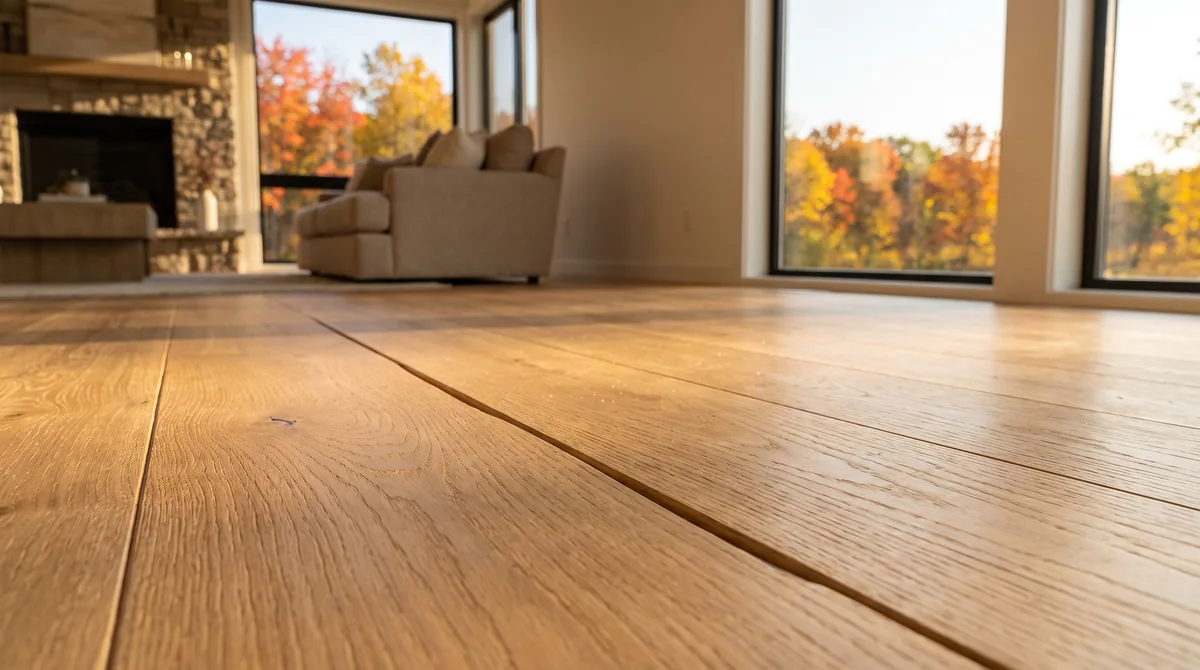
Thin gaps between boards in a Wisconsin winter are normal, expected, and not a sign that anything went wrong with your floor or your installation. Wood shrinks when it dries. Narrower boards gap less, wider boards gap more, and the same floor will look different in February than it does in August.
The reliable test is whether the gaps close. Normal seasonal gapping opens as the heating season deepens and shuts again as spring humidity returns. It appears fairly evenly across the room. You might slide a business card into a gap, but not a coin.
What is worth a professional look: gaps that are still open in the middle of summer, gaps concentrated in one area while the rest of the floor sits tight, boards that have gone loose or started to lift, or any gapping paired with cupping, a musty smell, or a soft spot. Those patterns point at something other than seasonal humidity, and they need a diagnosis rather than a humidifier.
Madison Homes and the Two-Season Squeeze
Madison-area homes put wood floors through a harder annual cycle than most of the country, and it happens in both directions.
Our summers are genuinely humid, and homes near Lake Monona and Lake Mendota tend to run damper than comparable homes further inland, especially in lower levels. Then winter arrives and the mechanism flips. Cold outdoor air holds very little moisture. When your furnace pulls that air in and heats it to 70 degrees, its relative humidity falls off a cliff. Forced-air heat then circulates that dried air across every room in the house, all day, for months. That is why a Dane County floor can sit at the humid end of the range in September and the dry end by January.
Housing stock changes the picture too. Older homes in established communities like Stoughton and Mount Horeb often run on hot-water radiators or boilers, which do not blow dried air the way a forced-air system does, but those houses also tend to be leakier, so outdoor conditions carry inside more readily. Newer, tightly built homes hold conditioned air much better, which helps in winter but means summer moisture has fewer ways out. Neither is better or worse for hardwood. They simply fail differently, and they need different settings.
Harmony Flooring serves Madison and Dane County, including Stoughton, Mount Horeb, and the surrounding communities, and our full-service process covers Design · Measure · Install from the first consultation through the final walkthrough.
What to Avoid
A few habits do more harm than the dry air itself.
– Blasting a humidifier to 60 percent or higher in January. This is the most common overcorrection we see. In a Wisconsin winter, that much indoor moisture condenses on cold window glass and finds its way into wall cavities. It can also push your floor toward the swollen end of the range, which is the opposite problem from the one you were trying to solve.
– Waiting for the gaps before you act. By the time you see them, the swing has already happened. Set up in early fall.
– Big, abrupt changes to heat or humidity. Small steps over days. Sudden shifts add stress rather than relieving it.
– Wet mopping to “add moisture back.” Standing water is not humidity control. Hardwood, engineered hardwood, and laminate are not waterproof, and none of them benefit from a wet floor.
– Shutting the AC off for a week in August. Air conditioning is dehumidification. Turning it off during a muggy stretch is a fast way to swell a floor.
– Ignoring the lower level. Moisture rising from a damp basement loads the underside of the boards above it, and no amount of managing the living-room air will offset that.
When to Call Harmony Flooring
Home humidity management is yours. Anything structural is ours. Running a humidifier, watching a hygrometer, and cleaning the floor properly are all normal homeowner care. Repair, refinishing, board replacement, and subfloor work are not, and attempting them usually costs more floor than it saves.
Reach out when you see gaps that do not close by midsummer, cupped or crowned boards, planks that have lifted or gone hollow underfoot, a floor that moves or creaks in a way it did not last year, or humidity readings you cannot get into range no matter what you run. Those are diagnosis situations. We use moisture readings on the boards and the subfloor to find out what is actually happening before anyone recommends a fix, because the wrong sequence on a moisture problem can turn a recoverable floor into a replacement.
Wood Floor Humidity FAQs for Madison and Wisconsin
Why do my hardwood floors gap in winter and cup in summer in Madison?
Because Madison’s climate moves your indoor humidity across the entire range wood tolerates, twice a year. Dry forced-air heat in winter pulls moisture out of the boards and they shrink, opening thin gaps. Humid summer air, often combined with moisture rising from a lower level, adds moisture back and the board edges swell upward into a cupped shape. Holding indoor humidity between 30 and 50 percent year-round is what shrinks both effects to the point where you stop noticing them.
Do hardwood floors hold up to Wisconsin winters and dry forced-air heat?
Yes. Hardwood performs well in Wisconsin homes and has for generations, including in plenty of century-old Madison-area houses still on their original floors. Forced-air heat is not damaging on its own. The issue is unmanaged dryness and fast swings. With humidification through heating season and a hygrometer to keep an eye on the number, hardwood handles a Wisconsin winter without difficulty.
What humidity level should my basement be?
Aim to keep a finished basement in roughly the same 30 to 50 percent range as the rest of the house, and it should not sit above 60 percent for extended stretches. Basements are the most common source of hidden moisture in Dane County homes, and a damp lower level affects the flooring above it as well as the flooring in it.
Is engineered hardwood more dimensionally stable than solid hardwood?
Yes. Engineered hardwood is more dimensionally stable than solid hardwood because its core is built from cross-layered plies rather than a single piece of wood, so the layers restrain each other and the plank moves less across the same humidity swing. That is why engineered is frequently recommended for environments with large seasonal humidity variation, and it is a real advantage in Wisconsin. It still responds to moisture, so the 30 to 50 percent target applies to engineered floors as well. Our guide to engineered vs solid hardwood for Madison homes walks through the full comparison.
Does laminate or luxury vinyl plank have the same humidity problem?
They behave differently from each other. Laminate has a wood-fiber core, so it does respond to indoor humidity and benefits from the same 30 to 50 percent range. Luxury vinyl plank contains no wood, so it does not swell and shrink with humidity the way wood-based floors do, though it does respond to temperature changes. Keep in mind that hardwood, engineered hardwood, and laminate are none of them waterproof, whatever their humidity behavior.
Getting Ahead of Heating Season
Wood floors are not fragile. They are responsive. A floor that gaps in January and closes up in June is telling you it is alive and doing its job, and the whole practice of caring for one comes down to keeping the air around it steady and changing it slowly when it has to change.
Put a hygrometer in your main living space this month, before the furnace has been running long enough to matter. That one step will tell you more about your floor than anything else you could do this fall.
If you would like a professional set of eyes on your floors heading into winter, or you are weighing a new floor and want one that handles Wisconsin’s swings gracefully, schedule a free consultation with Harmony Flooring or call or text us at 608-221-5500. We are a full-service flooring company serving Madison and Dane County, and Covering Every Detail is how we work.
Questions About Your Floors?
Call or text 608-221-5500Schedule a Free Consultation
Shop our floors: Hardwood · Vinyl · Carpet · Tile · Laminate
Showroom: 2125 S. Stoughton Rd, Madison, WI 53716