- Buying Guides
Basement Flooring in Madison: A Complete Buyer’s Guide
July 30, 2026
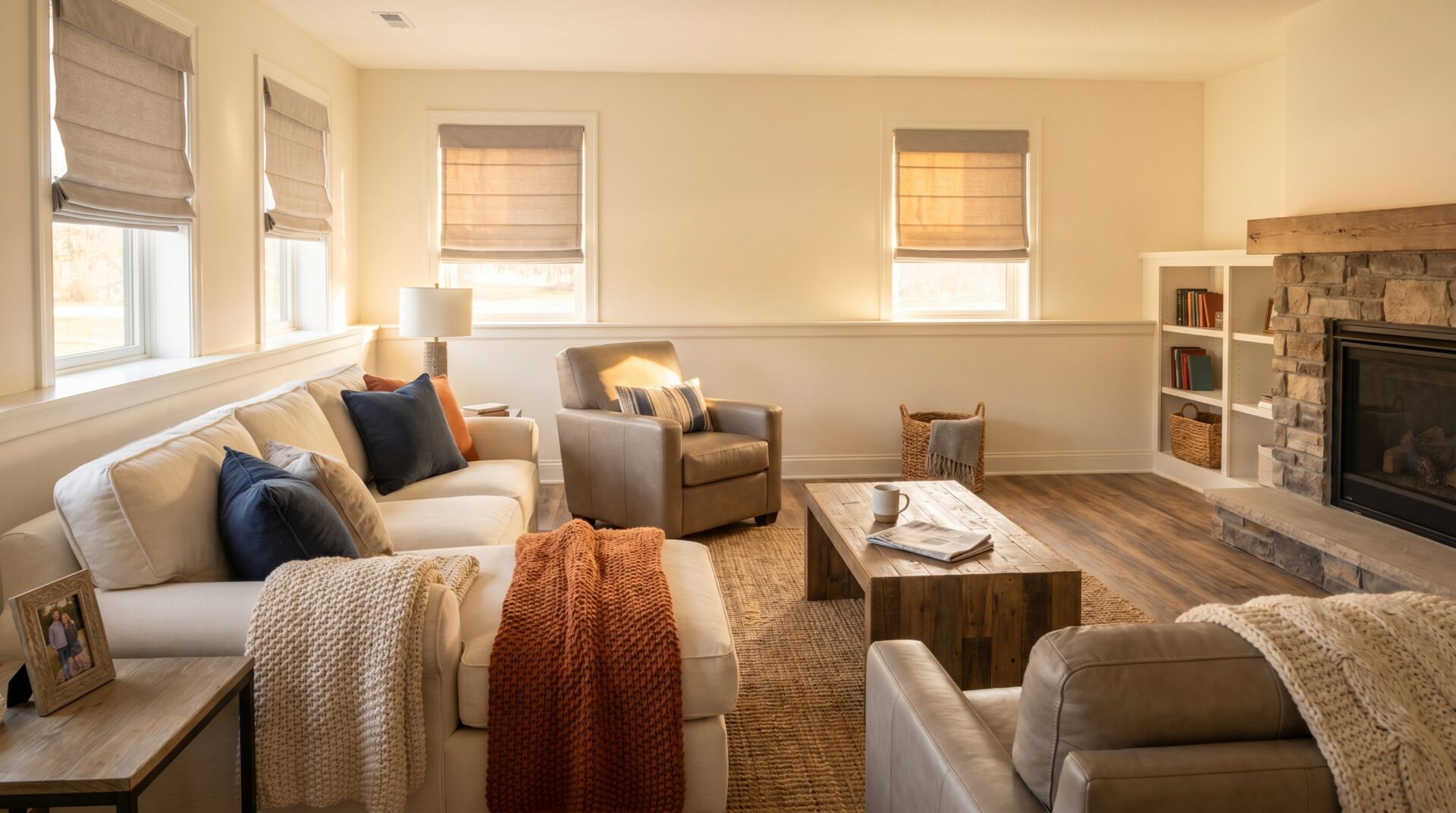
Finishing a basement is the single biggest jump in usable space most homes ever get. It’s also the room where flooring decisions go wrong most often. Below grade, the rules change, and a floor that performs beautifully upstairs can fail within a year or two downstairs. This guide is for Madison, WI homeowners planning to finish a basement, or refinish one that’s seen better days. We’ll rank the best basement flooring options, flag the ones to avoid, and walk through the moisture, subfloor, and ceiling-height questions that decide whether your new floor lasts. See the vinyl plank floors we carry.
The Short Version: For most Madison basements, rigid-core luxury vinyl plank is the best flooring choice. Porcelain tile is a close second. Water-resistant laminate and low-pile carpet can work in dry, well-tested basements. Solid hardwood should stay upstairs. Before anything goes down, the slab needs a professional moisture test.
Key Takeaways
- Concrete slabs constantly release water vapor, even when they look and feel dry.
- Rigid-core LVP is the most reliable basement flooring for Madison-area homes.
- Porcelain tile is waterproof and durable, but it runs cool without radiant heat or rugs.
- Water-resistant laminate and low-pile carpet are conditional picks, not default picks.
- A professional moisture test before installation is the step that protects everything else.
- Older Madison basements add ceiling-height and egress wrinkles that affect flooring choices.
Why Basement Flooring Is a Different Decision Below Grade
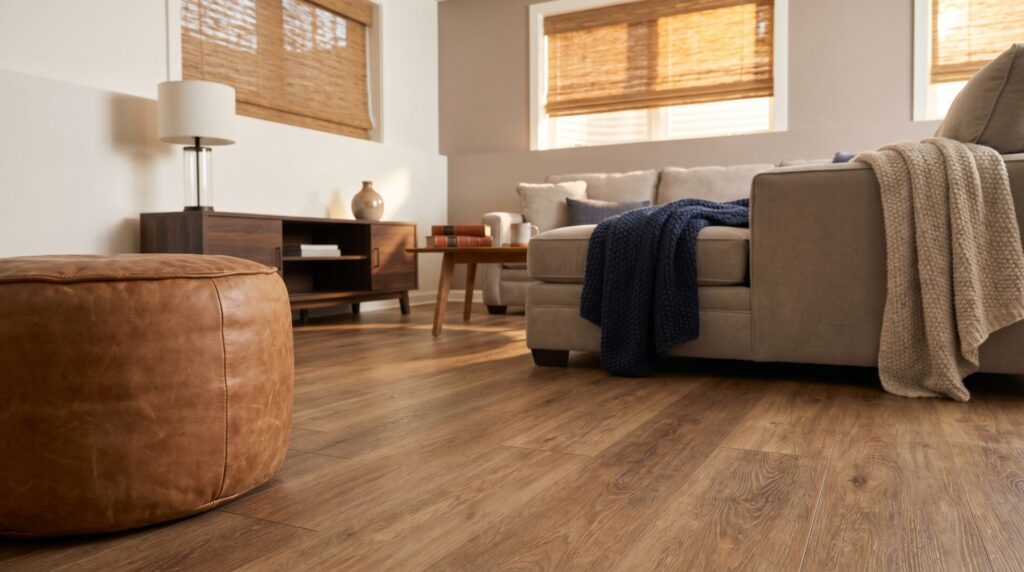
A basement floor sits on a concrete slab, and that slab sits on Wisconsin soil. Concrete is porous. Ground moisture moves through it as vapor, a process called vapor drive, and it never fully stops. The slab can look bone dry in January and still push measurable moisture into whatever sits on top of it.
Madison’s climate makes this harder, not easier. Spring thaw raises the water table. Summer humidity condenses on cool concrete. Freeze-thaw cycles work on the soil around the foundation all winter. Your basement floor lives with all three, every single year.
That’s why the question isn’t “what flooring do I like?” It’s “what flooring can live on a concrete slab in this climate?” Get that answer right and the design choices get fun. Get it wrong and you’re tearing out cupped planks or musty carpet in two years.
The Best Basement Flooring Options, Ranked
Here’s how the main contenders stack up for below-grade use in Dane County homes.
1. Luxury vinyl plank (LVP). This is our default recommendation for Madison basements, and it earns the spot. Rigid-core LVP (often labeled SPC) is waterproof, dimensionally stable, and comfortable enough underfoot for family rooms and home gyms. It’s inorganic, so it won’t feed mold. It floats over minor slab imperfections, handles humidity swings, and looks convincingly like wood. If you want to see the range of styles, start with our luxury vinyl options.
2. Porcelain or ceramic tile. Tile is waterproof, very scratch-resistant, and ideal for basement bathrooms, laundry areas, and bar zones. The trade-offs are comfort and temperature. Tile runs cool over a basement slab, so plan on area rugs in lounging spaces or pair it with an electric radiant heat system where the ceiling height and slab allow it.
3. Water-resistant laminate, with caveats. Modern laminate has come a long way, and some products carry genuine water-resistance ratings. But laminate’s core is still wood-based, and its seams remain the weak point if vapor builds beneath the floor. It belongs only in basements that have tested dry and have no moisture history. We covered exactly when it works in our guide to the best laminate for Wisconsin basements.
4. Low-pile carpet, with caveats. Carpet makes a basement feel warm and quiet, which matters for media rooms and kids’ play spaces. Below grade, the spec matters: low-pile synthetic fiber with a synthetic backing, never natural fiber. Carpet is also the least forgiving option if water ever shows up, so it’s best reserved for basements with a clean moisture record. Skip it entirely near utility areas, and never use it in a basement bathroom.
What to Avoid Below Grade
Solid hardwood does not belong in a basement. Period. Solid planks absorb vapor from the slab, then expand, cup, and buckle. No finish or sealer changes that, because the moisture arrives from underneath. If you love the wood look downstairs, rigid-core LVP delivers it without the risk.
Standard laminate without a water-resistance rating is nearly as risky. Its seams swell with absorbed vapor, and swollen laminate cannot be repaired or refinished, only replaced. Solid hardwood at least survives upstairs. Unrated laminate below grade is simply a countdown.
Moisture Testing: The Step Pros Never Skip
Here’s the professional insight that saves Madison homeowners the most money: test the slab before choosing the floor. A pro uses a calcium chloride test or an in-slab relative humidity probe to measure what the concrete is actually emitting. Homeowners almost never do this, because the slab looks dry. Looks tell you nothing. Vapor drive is invisible until it ruins something.
The counterintuitive part is that a waterproof floor doesn’t fix a wet basement. It just hides the symptom. Trapped vapor under a waterproof floor can condense, feed mold on the slab, and create the musty smell every basement owner dreads. If your floor has ever felt damp or smelled off, start with our breakdown of why basement floors get wet or moldy in Wisconsin before you invest in finishes.
Timing matters too. A slab that tests dry in October can read very differently during the April thaw. Pros account for seasonal swing; a one-time reading in the driest month tells only part of the story.
If you’re at the testing-and-deciding stage right now, this is a great moment to bring us in. Schedule a free consultation and we’ll evaluate your slab, your moisture picture, and your shortlist in one visit.
Subfloor and Underlayment Systems Worth Knowing
You don’t have to install finished flooring directly on concrete. Modern subfloor systems put a vapor-managing layer between the slab and your floor, and in many basements they’re the difference between good and great.
- Interlocking subfloor panels combine a vapor barrier with an insulated or air-gapped surface. They add warmth underfoot and give vapor a path to dissipate.
- Sheet vapor barriers and specialty underlayments do a lighter version of the same job under floating LVP or laminate.
- For carpet, a proper synthetic pad over a sealed or barriered slab keeps the fiber away from concrete moisture.
These systems add height, typically an inch or so once finished flooring goes on top. In a new build that’s nothing. In an older basement, it can matter a lot, which brings us to the next point.
Ceiling Height, Egress, and Older Madison Basements
Madison’s housing stock spans a century, and basements show it. Many pre-1960s homes near the isthmus, in Monona, and on the near east side have basement ceilings at or near seven feet, sometimes lower under ductwork. In those spaces, every inch of floor buildup counts. A low-profile installation, such as glue-down LVP or thin floating planks over a sheet barrier, preserves headroom that a full subfloor panel system would eat.
Newer construction is a different world. Homes built in the last couple of decades in Sun Prairie, DeForest, and Windsor typically have taller poured foundations, often with nine-foot basement ceilings. There you can run a full insulated subfloor system and never notice the height.
One more reality check for older basements: if your finished plan includes a bedroom, it will need proper egress, and finishing work can trigger permit requirements. We’re flooring experts, not code officials, so confirm specifics with your municipality or general contractor early. It’s much easier to plan flooring around an egress window project than to redo it afterward.
What Drives the Cost of a Basement Floor
We don’t quote prices in a guide, but we can tell you what moves the number. Slab condition is the big one. A flat, dry, crack-free slab needs little prep. A slab with low spots, cracks, or moisture readings needs leveling, sealing, or a barrier system before anything else happens, and that prep is where value is won or lost.
Material tier is the second driver. Entry-level LVP and premium rigid-core products look similar in a photo and perform very differently under furniture, sunlight from egress windows, and years of family traffic. Tile sits higher on installation complexity. Carpet varies with fiber and pad quality. The third driver is the system around the floor: underlayment, subfloor panels, transitions, and stair treatment.
Basement Flooring FAQs for Madison Homeowners
What is the best flooring for a basement that gets moisture?
Rigid-core luxury vinyl plank is the most reliable choice for a basement with any moisture history. It’s waterproof and won’t support mold growth. That said, flooring is the second step. The moisture source should be identified and managed first, and the slab should be tested, so the new floor isn’t just covering up an active problem. If your basement already flooded, start with our page on water-damaged floors.
Can you put laminate flooring in a basement?
Sometimes. Water-resistant laminate can work in a basement that has tested dry, has no history of seepage, and sits behind a quality vapor barrier. Standard laminate is a poor bet below grade because vapor swells the seams, and swollen laminate can’t be repaired. If your basement has ever felt damp, choose rigid-core LVP instead.
Is carpet OK in a basement?
Low-pile synthetic carpet with a synthetic backing can be a comfortable choice for a dry, well-tested basement, especially in media rooms and play areas. It should never go in basement bathrooms or near utility and laundry zones. If your basement has any seepage history, carpet is the first thing moisture will ruin, so weigh that honestly.
Why can’t you put solid hardwood in a basement?
Concrete slabs release water vapor year-round, and solid wood absorbs it from below. The planks expand, cup, and eventually buckle, no matter how good the finish on top is. Engineered wood tolerates more than solid wood, but below grade in Wisconsin, wood-look luxury vinyl is the safer way to get the same style.
Do I need a subfloor over the concrete in my basement?
Not always, but it’s often worth it. A subfloor or vapor-barrier system manages slab moisture, adds warmth underfoot, and protects the finished floor above it. The deciding factors are your slab’s moisture readings, your ceiling height, and how you’ll use the room. A professional evaluation will tell you whether your basement needs one.
How much does basement flooring cost in Madison?
It depends on three things: slab prep, material tier, and the system underneath. A dry, level slab with entry-level LVP sits at one end. A slab needing leveling and a vapor barrier, topped with premium tile or luxury vinyl, sits at the other. A consultation with exact measurements is the only honest way to get a real number for your basement.
How Harmony Flooring Works
Every basement project follows our Design · Measure · Install process, covering every detail from slab to baseboard.
- Design: We start with a one-on-one consultation, talk through how you’ll use the space, and narrow the options to floors that fit your basement’s moisture picture and style.
- Measure: We evaluate the slab, check moisture and flatness, measure precisely, and spec any underlayment or subfloor system the space needs.
- Install: Our trusted local installers handle prep, installation, transitions, and cleanup, then walks the finished floor with you.
Your basement should be the easiest room in the house to love and the hardest one to get wrong. If you’re ready to compare options for your Madison-area basement, request your free in-home consultation and we’ll help you choose a floor built for life below grade.
Questions About Your Floors?
Call or text 608-221-5500Schedule a Free Consultation
Shop our floors: Hardwood · Vinyl · Carpet · Tile · Laminate
Showroom: 2125 S. Stoughton Rd, Madison, WI 53716