- Flooring
Best Flooring for Classrooms and School Facilities in Wisconsin
December 30, 2025
Floors Work Hard In Schools. Make Sure Yours Can Keep Up.
In a typical school day, classroom floors see hundreds of footsteps, rolling chairs, dropped backpacks, art projects, spilled snacks, and the occasional science experiment. Multiply that across hallways, cafeterias, offices, and gyms, and it becomes clear: flooring in schools has to work a lot harder than flooring in a single-family home. See our commercial flooring page.
If you manage a school or district in the Madison area, you are probably balancing multiple priorities: durability, safety, acoustics, maintenance, and of course, budget. At Harmony Flooring, we work with schools and educational facilities in and around Madison to help them choose flooring that withstands daily use while creating a comfortable learning environment.
This guide breaks down the best flooring options for classrooms and school facilities, where each one works best, and what to consider as you plan your next renovation or new construction project.
What Classrooms And School Facilities Need From Their Floors
Before choosing materials, it helps to think about what a school really needs from its flooring:
- Durability and longevity
High foot traffic, rolling carts, and frequent cleaning can wear out lesser products quickly. - Easy maintenance
Custodial teams need floors that are simple to clean, resist stains, and don’t require constant refinishing. - Acoustic comfort
Reducing noise in classrooms, libraries, and corridors helps students focus and creates a calmer environment. - Safety
Slip resistance, good traction when floors are wet, and a consistent surface for students of all ages. - Comfort underfoot
Teachers stand and walk most of the day, and younger students spend more time on the floor for activities. - Budget awareness
School flooring projects usually involve large square footage, so material and lifecycle costs matter.
With those priorities in mind, let’s walk through the main flooring options we recommend for classrooms and school facilities.
Luxury Vinyl Tile (LVT) & Luxury Vinyl Plank (LVP)
For many modern schools, LVT and LVP have become go to choices, especially in classrooms, corridors, and administrative areas.
Why LVT/LVP Works Well In Schools
- Durable wear layer that resists scratches, scuffs, and chair movement.
- Water resistant or waterproof, ideal for spills, tracked in snow, and routine cleaning.
- Available in wood, stone, and abstract patterns, giving designers flexibility while keeping maintenance practical.
- Easier replacement of individual planks or tiles if damage occurs, rather than replacing entire sheet goods.
Best School Areas For LVT/LVP
- General education classrooms
- Offices and administrative spaces
- Corridors and common areas
- Libraries and media centers
LVT and LVP offer a strong balance of durability, design, and budget, which is why so many school districts around Madison and southern Wisconsin are moving in this direction.
Sheet Vinyl Flooring
Sheet vinyl has long been a staple in school facilities, and for good reason.
Benefits Of Sheet Vinyl In Schools
- Very few seams, which is helpful in spaces that need excellent spill and moisture resistance.
- Smooth, continuous surface that is easy to clean and disinfect.
- Available in homogeneous and heterogeneous constructions, depending on performance needs and budget.
- Great for spaces that might see frequent spills, wheeled equipment, or heavy cleaning schedules.
Best Areas For Sheet Vinyl
- Art rooms and science labs
- Nurses’ offices and health rooms
- Special education classrooms where ease of sanitation is a priority
- Multi purpose spaces with frequent spills and messes
Sheet vinyl gives schools a practical, hygienic surface where ease of cleaning is a major concern.
Rubber Flooring
Rubber flooring is a strong choice for certain school areas where impact absorption, slip resistance, and comfort are critical.
Why Rubber Flooring Shines In Schools
- Excellent underfoot comfort, ideal where students and staff stand or move constantly.
- Slip resistant, even when slightly damp, which supports safety goals.
- Naturally sound absorbing, helping control noise levels.
- Very resilient and long lasting when properly maintained.
Best Areas For Rubber Flooring
- Gymnasiums and weight rooms
- Multi purpose rooms and activity spaces
- Corridors and stairwells that see heavy daily use
- Entry areas where traction is important in wet or snowy conditions
Rubber is not typically used in standard classrooms, but it plays a key role in athletic and high impact areas across many school campuses.
Carpet Tile
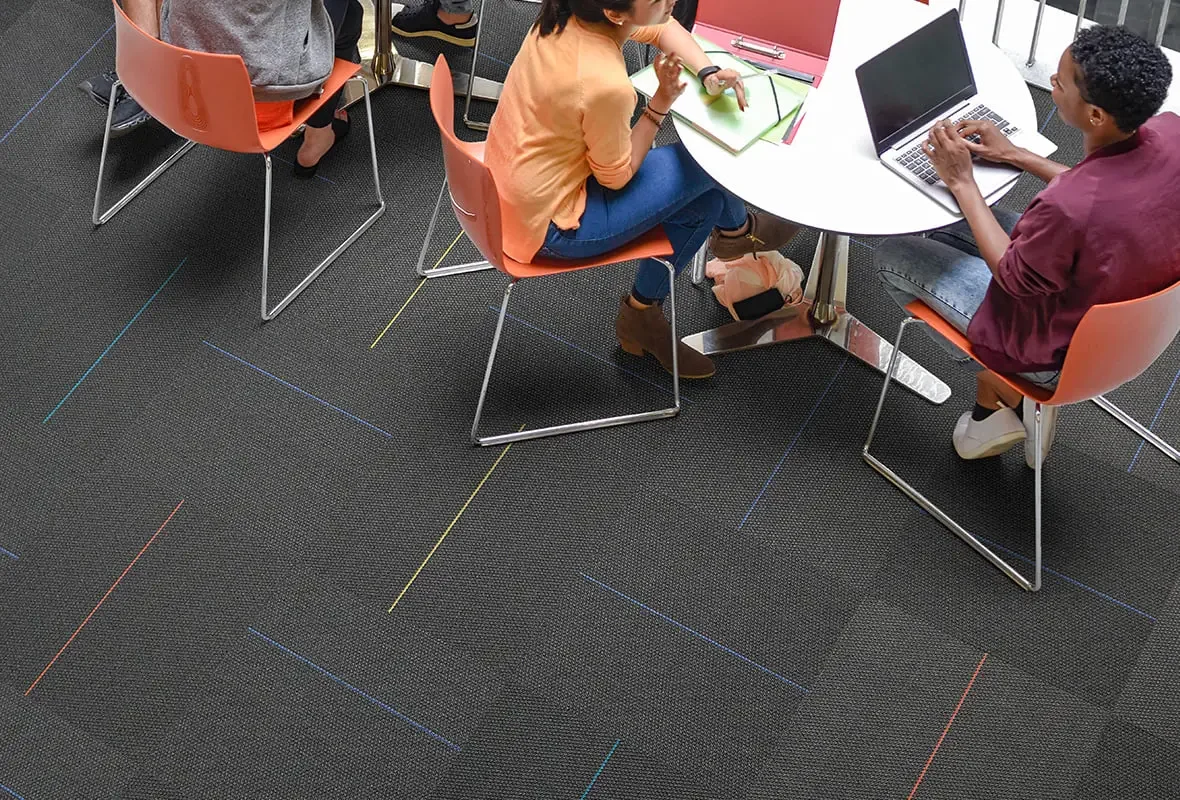
Carpet tile is a favorite in many classroom and library designs, especially where acoustics matter.
Advantages Of Carpet Tile In Educational Spaces
- Excellent sound absorption, which helps reduce noise and echo in classrooms, libraries, and resource rooms.
- Modular design allows individual tiles to be replaced if stained or damaged, rather than replacing the entire carpet.
- Provides a soft, comfortable surface, ideal for younger students who spend time sitting on the floor.
- Available in varied patterns and colors that hide stains and traffic patterns.
Best Areas For Carpet Tile
- Classrooms (especially elementary and special education)
- Libraries and media centers
- Administrative offices and conference rooms
- Teacher lounges and workrooms
Many schools in Wisconsin pair carpet tile in classrooms and libraries with LVT or rubber in corridors and high traffic areas to balance comfort and durability.
Polished Concrete With Area Rugs
In some newer or renovated school buildings, polished concrete has become part of the design.
Pros Of Polished Concrete
- Extremely durable and long lasting, especially in high traffic corridors and common areas.
- Can be sealed and finished for easier maintenance and improved stain resistance.
- Works well with flooring insets, such as LVT or rubber, to create defined zones.
Where Polished Concrete Fits
- Large common areas and atriums
- Cafeterias and dining spaces
- Some hallways and lobby areas
Because polished concrete is hard and reflective, it is often paired with other materials (like carpet tile or rubber) to address acoustics and comfort.
Specialty Flooring For Labs, Kitchens, And Support Spaces
Certain school spaces need more specialized flooring:
- Science labs
Often use resilient flooring (LVT or sheet vinyl) with chemical resistant finishes. - Commercial kitchens and food prep areas
May pair slip resistant tile or specialty resilient flooring with cove bases and welded seams. - Mechanical rooms and maintenance areas
Often use epoxy or sealed concrete for heavy wear and chemical resistance.
When Harmony Flooring works with a school or district, we look at each space type individually to select the right combination of materials.
Matching Flooring To School Spaces: A Quick Guide
Here is a practical way to think about flooring choices across a school:
Classrooms
Priorities: acoustics, comfort, durability, and easy cleaning
Top options:
- Carpet tile (for sound and comfort)
- LVT (for easy cleaning and long term durability)
Many districts choose carpet tile in younger grade classrooms and LVT in upper grade or specialized classrooms.
Corridors And Hallways
Priorities: high traffic durability, easy maintenance, noise control
Top options:
- LVT with durable wear layers
- Rubber flooring for slip resistance and sound absorption
- Polished concrete in some designs, often combined with other materials
Libraries & Media Centers
Priorities: quiet, comfortable, inviting
Top options:
- Carpet tile for sound and comfort
- LVT around perimeter shelves or high traffic areas
Gymnasiums & Fitness Areas
Priorities: impact absorption, safety, and durability
Top options:
- Rubber sports flooring or synthetic gym flooring systems
- Specialty wood sports floors for competition gyms
Cafeterias & Multipurpose Spaces
Priorities: easy cleanup, stain resistance, and durability
Top options:
- LVT or sheet vinyl for easy maintenance
- Polished concrete in some designs, with area rugs where needed
Restrooms & Locker Rooms
Priorities: water resistance, cleanability, and slip resistance
Top options:
- Porcelain or ceramic tile with appropriate slip resistance
- Specialty resilient flooring with welded seams in some applications
Key Considerations When Choosing School Flooring
When we consult with schools and facility managers around Madison and surrounding communities, we look beyond just “what’s popular” and dig into real use:
1. Lifecycle Cost, Not Just Initial Price
A floor that is slightly more expensive up front but lasts longer and needs less maintenance can be the smarter investment over 15 to 20 years.
2. Maintenance Capacity
Every district has a different custodial staff and budget. Some can manage more intensive maintenance schedules, while others need low touch solutions. Floor choices should match your team’s reality.
3. Acoustics And Student Experience
Quiet classrooms support learning. The right mix of carpet tile, resilient flooring, and acoustic treatments can significantly improve the overall environment.
4. Safety And Accessibility
Floors should provide good traction, smooth transitions, and surfaces that comply with ADA guidelines. This is especially important in corridors, ramps, and entry points.
5. Phasing And Installation Timing
School projects often need to be completed over summer or during tight breaks. Some flooring types install faster than others, which can influence material selection for large areas.
How Harmony Flooring Supports Schools And Educational Facilities
Working with schools is different from working with a single homeowner. The stakes are higher, the spaces are larger, and the decisions affect hundreds or thousands of students and staff every day.
Harmony Flooring can help with:
- Product selection tailored to classrooms, corridors, gyms, cafeterias, and specialized spaces.
- Coordinating finishes and color palettes that support school branding and wayfinding.
- Phased installation planning around school calendars and construction schedules.
- Professional installation that takes care of subfloor preparation, transitions, and long term performance.
We serve school districts and educational facilities in Madison, Verona, Middleton, Sun Prairie, Monona, Waunakee, McFarland, Cottage Grove, Fitchburg, Stoughton, and the surrounding Wisconsin communities.
Keep Reading
- Quiet Flooring Solutions for Open Office Designs
- How to Choose Flooring for High-Traffic Businesses
- Commercial Flooring in Madison, WI: how we help businesses plan floors
Ready To Upgrade Flooring In Your Classrooms Or School Facilities?
The best flooring for classrooms and school facilities is rarely one single material. It is usually a smart combination of LVT, carpet tile, rubber, sheet vinyl, and other solutions, chosen strategically for each area of the building.
If you are planning a school renovation, addition, or new facility near Madison, Harmony Flooring is here to help you evaluate options, compare lifecycle costs, and design a flooring plan that supports learning, safety, and long term value.
Ready to explore flooring options for your school or campus?
Contact Harmony Flooring to schedule a consultation or site visit. Together, we will create durable, attractive, and practical flooring solutions for your classrooms and school facilities, truly “Covering Every Detail.”
Questions About Your Floors?
Call or text 608-221-5500Schedule a Free Consultation
Shop our floors: Hardwood · Vinyl · Carpet · Tile · Laminate
Showroom: 2125 S. Stoughton Rd, Madison, WI 53716