- Buying Guides
Stair Flooring in Madison Homes: Hardwood, Carpet, or Runner?
May 26, 2026
A Madison homeowner told us recently that their stair flooring decision took longer than any other room in their renovation. They weren’t being indecisive. Stairs are one of the trickier flooring calls in a Wisconsin home, and the right answer depends on more than what looks good in a showroom. See the hardwood and carpet we carry.
Stair flooring in Madison WI needs to hold up to daily traffic, handle pets and kids, work with the rest of the house, and stay safe at every step. The three real options most homeowners weigh are full hardwood (solid or engineered), full carpet, and a hardwood base with a center runner. Each has a clear best-fit situation, and the wrong call shows itself within a year or two of living with it.
This guide is for the Madison-area homeowner who knows the stairs need to be addressed but is still figuring out which direction to go.
Key Takeaways
- Hardwood looks beautiful and lasts decades, but it can be slippery and noisy without a runner.
- Carpet is the safest and quietest option, but it wears down in the center of each tread first.
- A hardwood base with a runner is often the best balance, and frequently the most cost-effective option over the ownership window.
- Engineered hardwood usually fits Madison’s humidity swings better than solid hardwood.
- The right choice depends on who’s using the stairs (kids, dogs, older adults), how the house sounds, and how the stairs connect to the floors at the top and bottom.
Stair Flooring Options for Madison Homes: The Three Real Choices
Most stair flooring decisions in Madison come down to three options. Each is a real choice, not a fallback. Here’s how each one actually performs.
Hardwood (Solid or Engineered)
Hardwood stair treads and risers give a house warmth, design continuity with adjacent floors, and a finished, traditional look. They last decades with proper finishing, and solid treads in good shape can often be refinished to extend their life.
For Madison homes, engineered hardwood is often the smarter pick. Solid hardwood expands and contracts more with the humidity swings between Wisconsin summers and dry forced-air winters. Engineered stays more dimensionally stable, which matters on a stair tread that’s constantly flexed by foot traffic and exposed to changing moisture levels.
The trade-off: bare hardwood stairs are slippery, especially in socks. They amplify footstep noise. And they show every scratch from dog nails, dragged backpacks, and dropped objects.
Carpet
Full carpet on stairs is the safest and quietest option. Cushioned underfoot, naturally slip-resistant, dramatically quieter than hardwood, and easier on knees and joints over a long staircase. For households with young kids, older adults, or pets that struggle on slick surfaces, full carpet is hard to beat.
The wear pattern is the real consideration. Carpet on stairs doesn’t wear evenly. It wears most in the center of each tread first, right where every footstep lands. After five to seven years of family use, that center wear line is visible even on a quality product. Replacement timing on stair carpet is usually shorter than on the same carpet installed in a bedroom.
Hardwood with Runner
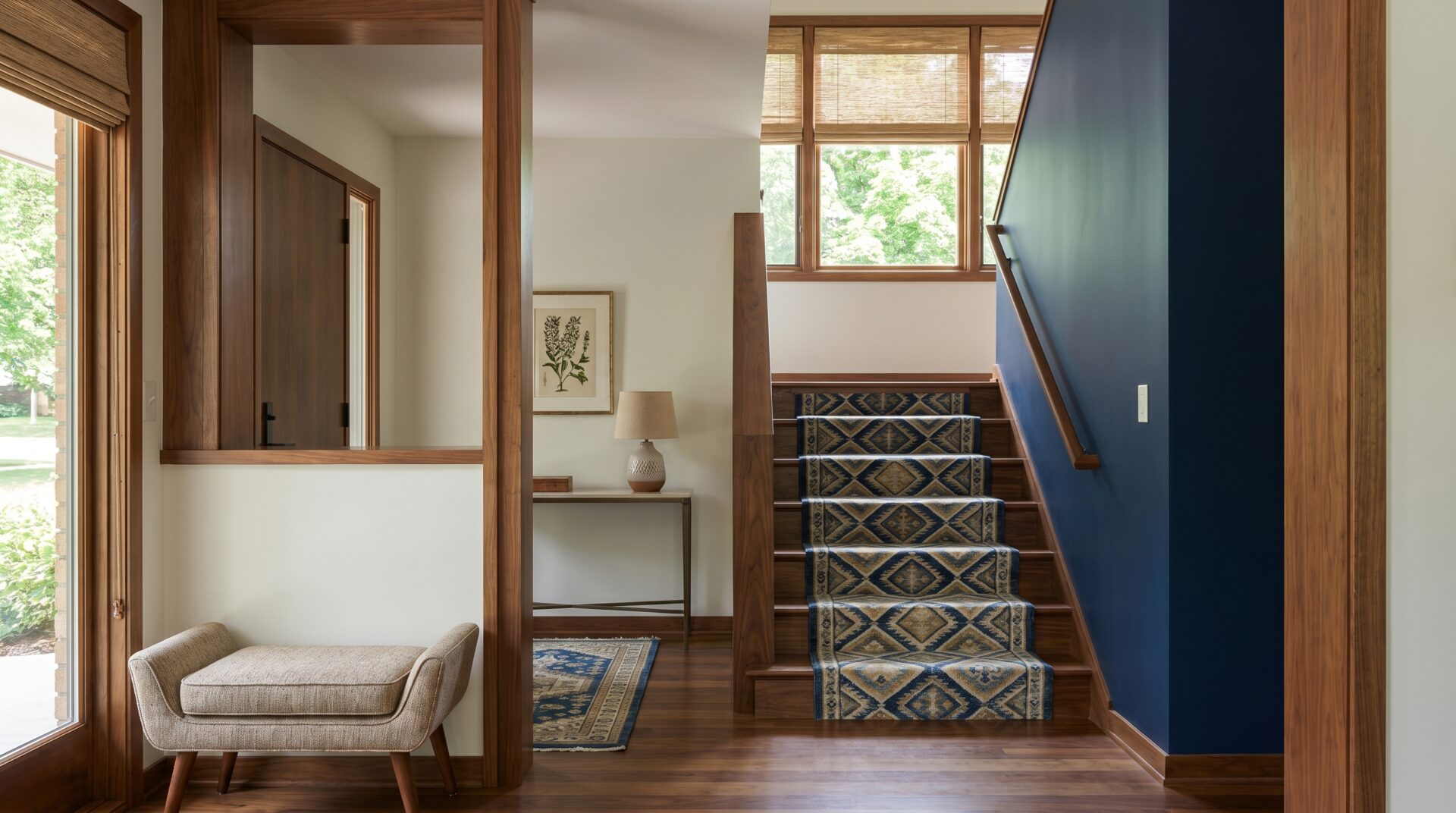
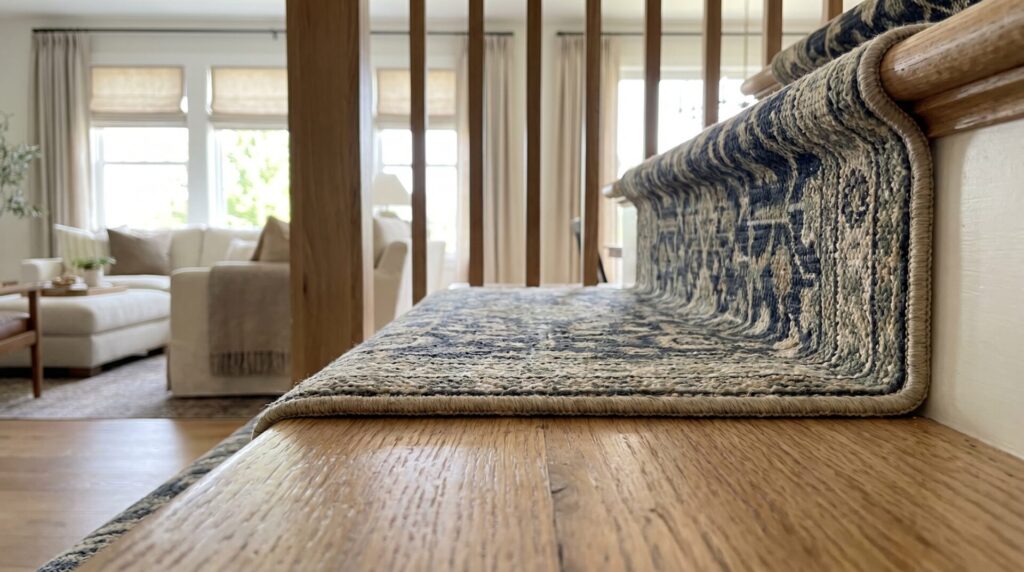
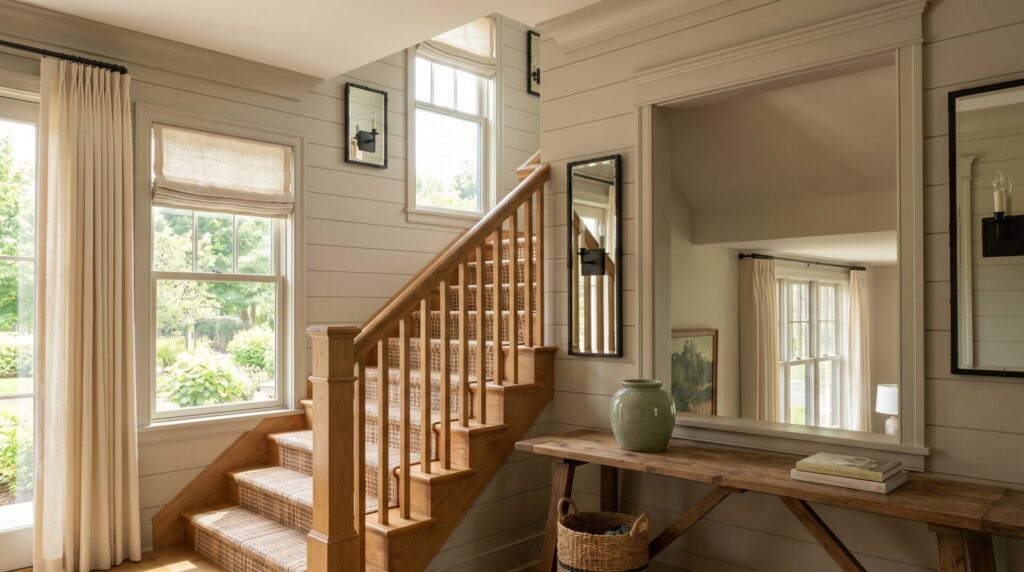
The third option is the one most flooring pros quietly recommend for high-use stairs in Madison homes: a hardwood base (solid or engineered) with a runner down the center. You get the hardwood look on the sides, the safety and noise reduction of carpet down the middle, and a design element that finishes the stairs in a way neither full hardwood nor full carpet does on its own.
The hidden advantage is replacement economics. A runner is much smaller than full stair carpet. When it wears out in the center (and it will), you swap the runner without touching the wood underneath. Most homeowners are surprised when they see the long-term math.
The Decision Factors That Actually Matter
Picking stair flooring isn’t really about which option you like the look of. The five factors below drive every recommendation we make in a consultation.
Safety and Traction
Stairs are the highest-risk flooring surface in any home. Slip resistance matters more here than anywhere else. Hardwood without a runner is the slipperiest option, especially with socks, slippers, or wet shoes after a Madison winter walk. Carpet and runners both add real traction. If your household includes anyone with mobility concerns, kids under ten, or older adults, lean toward carpet or a runner.
Noise
A hardwood stairwell in a two-story Madison home carries footstep noise into every room nearby. In a Maple Bluff or Shorewood Hills home with open floor plans and adjacent living spaces, the noise difference between bare hardwood and a runner is significant. Carpet and runners both absorb impact noise. Hardwood reflects it.
Pets
Dogs especially struggle with bare hardwood stairs. Their paws slide, they lose confidence, and older or large breeds often refuse the stairs entirely. We’ve seen Madison families add a runner specifically because their dog had stopped using the second floor. Both carpet and runner solve this. If pet-friendly is a priority across the whole home, our guide to the best flooring for pet owners in Wisconsin homes covers the room-by-room picture.
Design Continuity
How the stairs connect to the floors above and below matters more than people expect. A hardwood-floored main level with hardwood stairs reads as one continuous design. Carpet on the stairs in an otherwise hardwood home draws a hard visual line. Sometimes that’s the desired effect, sometimes it isn’t. A runner threads the needle: you get the hardwood continuity on the edges and the carpet zone in the middle.
Wear Pattern and Lifespan
Hardwood lasts decades. Carpet on stairs usually shows tread-center wear within five to seven years of family use. Runners wear similarly to full carpet but are much easier and less expensive to replace because of the size. Over a 25-year ownership window, the math often favors hardwood (with periodic refinishing) or hardwood with replacement runners over fully replacing stair carpet.
Which Option Fits Your House?
Decision frameworks help here. These are the patterns we see most often in Madison-area consultations.
Hardwood (or engineered) makes the most sense if:
- The main level is hardwood and you want visual continuity
- Adults make up most of the household, with no young kids and no mobility concerns
- The stairs are in a quieter part of the home where footfall noise isn’t an issue
- You’re planning area-style rugs in adjacent rooms and want a coordinated look
Full carpet makes the most sense if:
- Safety is the top priority, with older adults, young kids, or pets that struggle on slick surfaces
- The home is older, with stairs near bedrooms or living spaces where noise transmission matters
- The upstairs is already fully carpeted and design continuity flows that way
- Replacement is built into the long-term plan (every five to ten years for active households)
Hardwood with a runner makes the most sense if:
- You want both the look and the safety, and aren’t willing to fully commit to either
- Pets are part of the household but you still want hardwood elsewhere
- The stairs are visible from a main living area where the design moment matters
- You’re updating an older Madison home and want to preserve the original wood while adding modern function
What Affects Stair Flooring Value (No Prices)
Stair flooring tends to cost more per square foot than the same product on a flat floor. Three things drive that.
Installation Complexity
Every stair tread and riser is custom-cut. There’s no rolling out a piece of carpet or clicking together planks across a long open space. Each step is fit individually, fastened individually, and finished individually. Stair flooring is one of the most labor-intensive installations in a home.
Stair Construction Variables
What’s underneath the surface matters. Pre-finished stair treads, retrofit nosing, hidden squeaks, and the depth of each tread all affect how the new flooring goes on. Some homes need stair-tread refurbishment before any new product can be installed. A professional measure visit catches all of this before the project starts.
Product Choice and Pattern
Solid hardwood stair treads cost more than engineered. A patterned runner with stair-specific binding costs more than a basic carpet roll. Custom matching to existing main-floor hardwood adds time and product cost.
The most useful way to think about cost on stairs is over the ownership window: 10 years, 25 years, the lifetime of the house. Quality matters more here than almost anywhere else because the wear is concentrated and the labor is the larger share of the total project. Our page on what affects flooring cost in Madison covers the rest.
Inside a Madison Stair Consultation
Stair projects need an in-person visit before any product can be recommended. Tread depths, riser heights, existing finishes, and how the stairs connect to adjacent floors all affect what works.
When we walk a stair project, we look at the existing tread and riser condition, the nosing detail at each step edge, how the stairs join the floors above and below, the household traffic pattern (who uses these stairs and how), and any safety considerations for kids, pets, or older adults. From there we narrow the recommendation to one or two options and explain why.Most of our Madison stair projects end up with hardwood, hardwood with a runner, or full carpet, in roughly equal shares depending on the household. There’s no single right answer. There’s a right answer for each home. If you’re weighing your options, talking through your house and lifestyle with our team leads to a much better recommendation than guessing from a magazine spread.
Keep Reading
- Flooring for Aging in Place: The 6 Best Options
- Pet-Friendly Flooring for Madison Homes
- Hardwood Flooring in Madison, WI: styles, brands and how to choose
How Harmony Flooring Works
Every stair project at Harmony Flooring runs on the Design · Measure · Install framework. We help you choose the right stair flooring system for your house, your household, and how the stairs actually get used. We come to you for a professional measure and tread assessment so nothing’s left to guesswork. Our trusted local installers handle the full project, including custom tread fitting and finish detailing. Covering Every Detail is how we approach every set of stairs we touch.
FAQ: Stair Flooring in Madison Homes
What is the safest flooring for stairs?
Carpet and stair runners are the safest options for most households. Both add traction, cushion the impact if someone slips, and provide more stable footing for kids, older adults, and pets. Hardwood with a runner gives you most of the safety benefit alongside hardwood’s longevity. Bare hardwood is the least slip-resistant option, especially in socks or after winter weather is tracked indoors.
Can you put luxury vinyl plank on stairs?
LVP on stairs is a contested product choice. Some manufacturers warrant their LVP for stair use, but many don’t, because the click-lock construction wasn’t designed for the stress of stair nosings and step edges. If LVP is being considered, the specific product has to list stair use as an approved application, and dedicated stair-tread versions need to be ordered rather than cutting flooring planks. Most Madison stair projects work better with hardwood or carpet for that reason.
Do hardwood stairs need a runner?
Not strictly, but most households benefit from one. Bare hardwood is slippery and noisy. A runner addresses both without losing the hardwood character. Households without pets, young kids, or mobility concerns can skip the runner. Everyone else should at least consider it. Runners can also be added later if the stairs feel too slick after living with them for a while.
Is carpet or hardwood better for stairs in homes with dogs?
Both work, but they solve different problems. Carpet or a runner gives the dog traction and confidence. Hardwood looks beautiful and is more scratch-resistant once a dog’s nails are kept trim. The hybrid approach, hardwood with a runner, is often the right answer for a Madison home with a dog, because the dog uses the runner and the hardwood looks finished from any angle.
Should my stairs match the flooring upstairs or downstairs?
The stairs usually look best when they match the upper-level floor, because that’s where the stair color reads as you climb. If the main level is hardwood and the upper level is carpeted, full carpet stairs (matching upstairs) or hardwood with a runner (matching downstairs while softening the steps) both work. The goal is intentional design, not strict matching. A stair that contrasts both floors can read as a deliberate choice when handled well.
Are stairs more expensive to redo than regular floors per square foot?
Yes. Stair installations are more labor-intensive than flat floors because every tread and riser is fitted individually. Custom cutting, hidden fastener work, and finish detailing all add to the project. The square footage is small, but the labor share is large. This is why product choice matters more on stairs. Saving on the product doesn’t move the total much, but choosing the right product extends the lifespan dramatically.
Ready to Sort Out Your Stairs?
Stair flooring isn’t a one-size answer. Walking through the house, talking through who uses the stairs and how, and looking at what’s installed elsewhere gives a much clearer recommendation than any guide can on its own. We work with homeowners across Madison, Middleton, Sun Prairie, Shorewood Hills, and the surrounding communities. Schedule a free consultation or call or text 608-221-5500. Our hardwood page and carpet page have more on the products we work with.
Questions About Your Floors?
Call or text 608-221-5500Schedule a Free Consultation
Shop our floors: Hardwood · Vinyl · Carpet · Tile · Laminate
Showroom: 2125 S. Stoughton Rd, Madison, WI 53716