

- Stair Flooring
Best Flooring for Stairs in a Madison Home
June 9, 2026
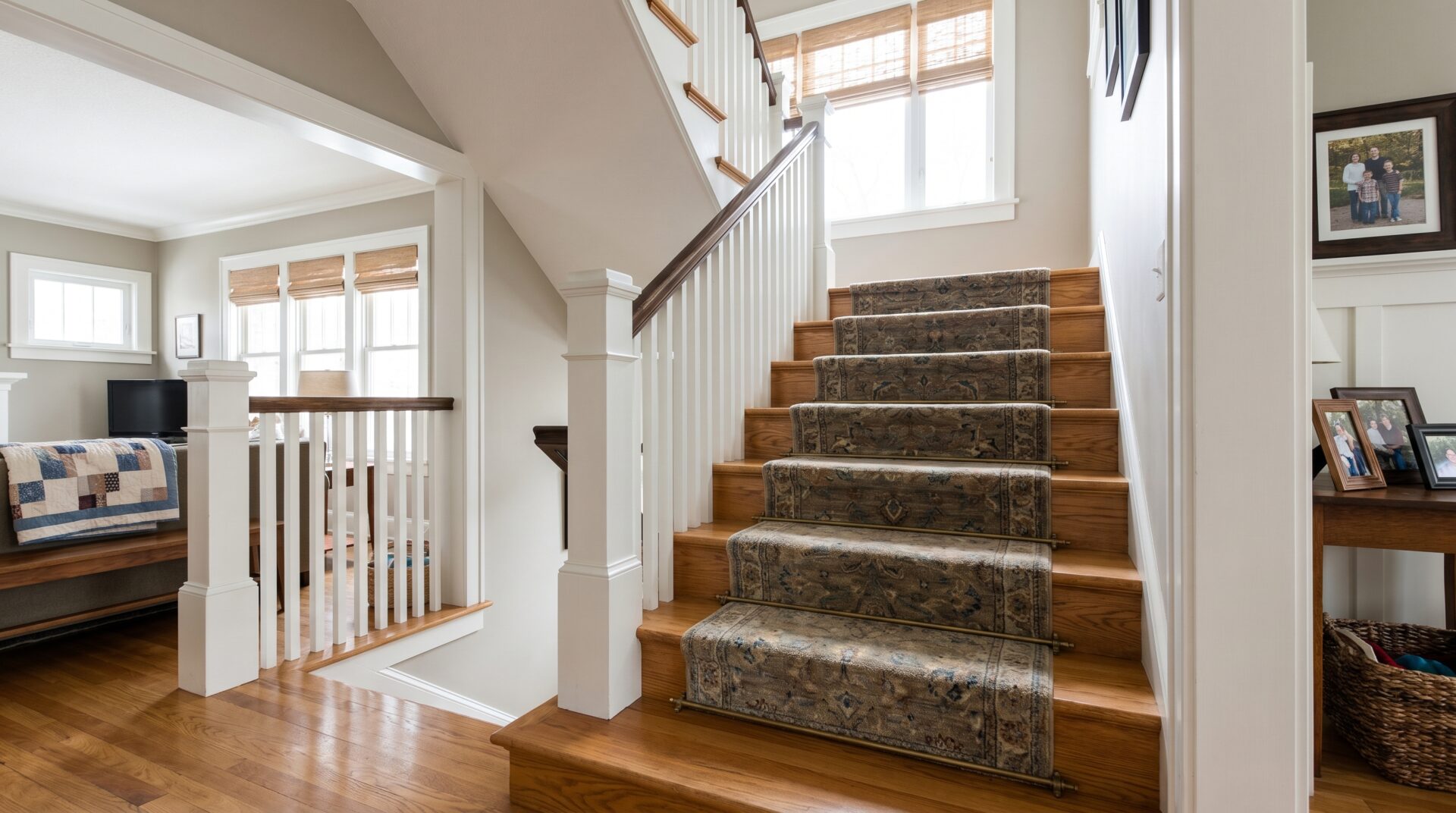
Stairs are the last thing most people think about during a flooring project, and the first thing guests notice when they walk through the front door. They are also one of the trickier surfaces in your home to get right. A floor that works beautifully in your living room can look wrong on a staircase or feel unsafe under your feet. A floor that holds up in a basement can fail under the constant friction of foot traffic on a riser.
The best flooring for stairs in a Madison home depends on three things at once: how the stairs look, how they feel, and how they handle the way your household actually uses them. This guide walks through the options that hold up in Wisconsin homes, the decisions that matter, and what most homeowners get wrong when they pick.
The Short Version: For most Madison homes, the strongest stair flooring options are solid or engineered hardwood with anti-slip treatments, carpet runners over hardwood, or wall-to-wall low-pile carpet. Luxury vinyl plank can work on stairs but needs specialty stair-rated products. Tile is rarely the right answer above ground.
Key Takeaways
- Stairs need traction, durability, and visual continuity with the rooms above and below.
- Carpet runners over hardwood are the classic Madison choice and one of the strongest combinations for safety, style, and longevity.
- Solid hardwood and engineered hardwood both work on stairs, but the species and finish matter.
- LVP can work on stairs with the right product, but standard LVP planks are not stair-rated.
- Basement stairs and main-floor stairs often call for different products in the same house.
What Stairs Actually Need From a Floor
Before picking a product, get clear on what a stair floor has to do. Three things matter most.
Traction. Stairs are where slips and falls happen most often in a home. The flooring needs enough grip that bare feet, socks, and shoes all stay in place, especially when someone is moving fast. Smooth, glossy finishes look beautiful and are dangerous on stairs.
Durability. The nose of each tread takes more abuse than almost any other surface in the house. Every step lands on the same narrow strip of material thousands of times a year. The product has to hold its finish, edge, and structure under that kind of repeated wear.
Continuity with the floors around it. Stairs almost never live alone. They connect a main floor to an upper level or a basement, and they have to make visual sense with both. The right stair floor flows naturally from what’s already there or gives an intentional contrast that looks designed, not accidental.
Get all three right and you have a staircase that lasts decades, looks built-in, and stays safe through the years your family lives on it.
Your Best Flooring Options for Stairs
There are five categories worth considering for a Madison home. Each has a real use case.
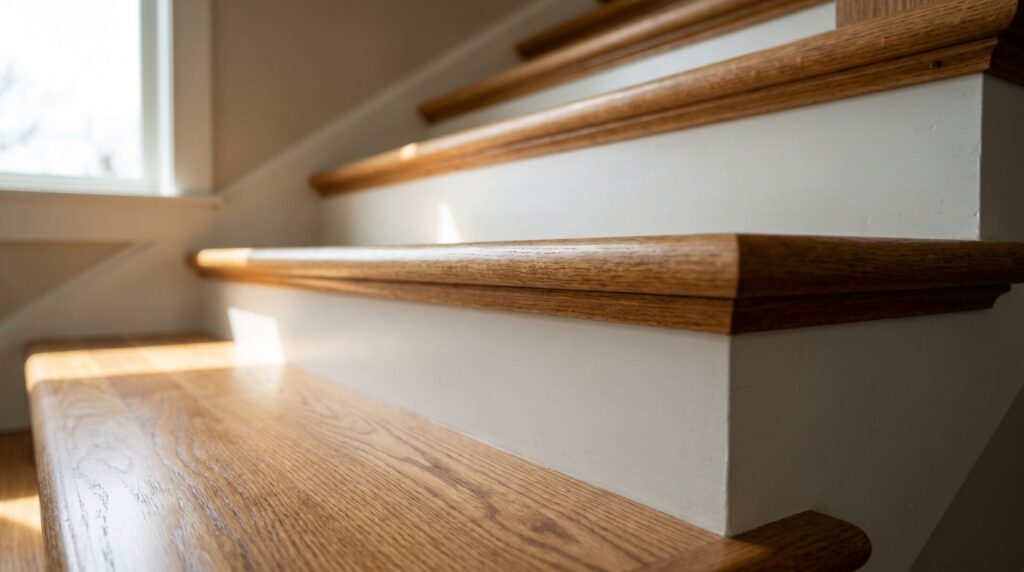
Hardwood (solid). The classic answer for primary staircases, especially in older Madison homes where the original stair hardwood is part of the architecture. Oak, maple, and hickory are common species that handle stair wear well. Cherry and walnut are softer and show dents more quickly. The finish matters as much as the species. A satin or matte finish provides better traction than a glossy one. For homes where the stairs are a real focal point, hardwood is hard to beat.
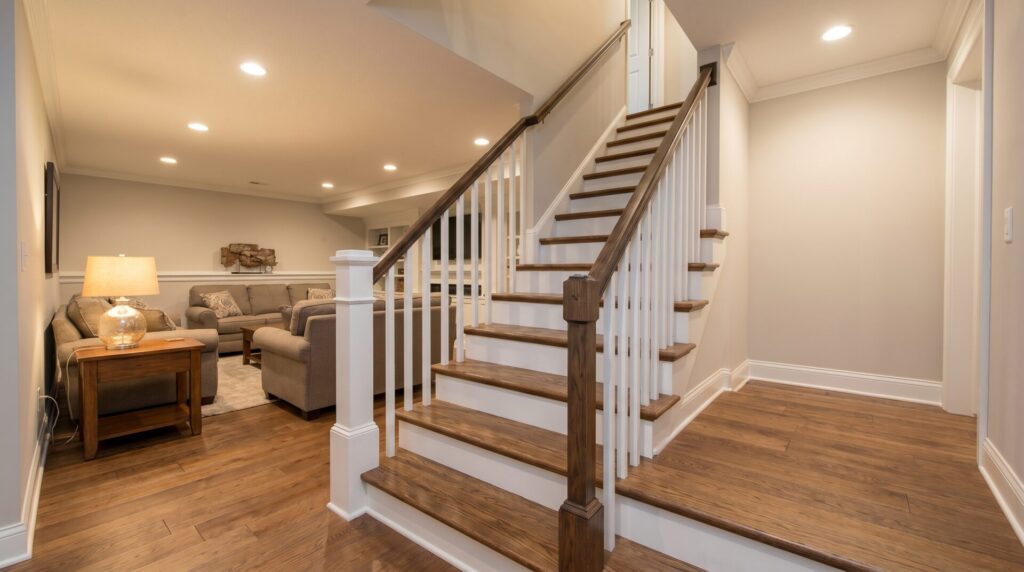
Engineered hardwood. Looks like solid hardwood, behaves more predictably across humidity changes. Engineered floors work especially well in Wisconsin because forced-air winter heating dries out solid wood in ways that show up on stair noses first. A premium engineered hardwood with a hard finish handles stairs beautifully, and it can be installed in basement stairwells where solid wouldn’t be the right call.
Carpet runners over hardwood. The classic combination, and a personal favorite for many Madison homes. You get the warmth, beauty, and acoustic dampening of carpet where feet land, and the architectural feel of hardwood at the edges and risers. Runners protect the hardwood from concentrated wear and add real traction. Choose a low-pile wool or nylon runner that handles foot traffic without bunching.
Wall-to-wall carpet on stairs. Soft, safe, quiet. Low-pile, tightly woven products like Berber or commercial-grade nylon hold up best on stairs. Carpet excels on stairs leading to bedrooms or finished basements where comfort matters more than a designer statement. The trade-off is staining and wear in heavy-traffic households, so cleanability and replacement cost matter at the spec stage.
Luxury vinyl plank. LVP can work on stairs, but standard planks are not designed for stair installation. The right product is a stair-rated LVP or LVT system with matching stair noses, properly installed by a team that has done it before. When done well, LVP on basement stairs or secondary staircases looks great and handles water, mud, and tracked-in snow far better than carpet ever will.
If you are weighing how a few of these compare in your house, explore your stair flooring options with us and we can walk through what fits the actual space.
Carpet Runners Over Hardwood: The Classic Madison Choice
This combination deserves its own section. In older homes around Maple Bluff, Shorewood Hills, and the historic neighborhoods near downtown Madison, original wood staircases are part of what makes the house feel like home. Stripping out that hardwood to install carpet would erase real character. Carpet runners solve the problem: they preserve the wood at the edges where you see it, while adding the warmth and grip your feet want where they land.
A good runner project starts with refinishing the existing hardwood if needed, then selecting a runner that complements the wood and the home’s style. Wool runners feel warm and age beautifully. High-quality nylon runners hold their look longer in heavy-traffic homes and resist stains better. The runner gets attached with stair rods or hidden brackets, which means it can be lifted for cleaning and replaced without redoing the wood underneath.
For homes where stairs are visible from the entry or living room, this combination delivers a high-end look that nothing else quite matches. It also happens to be one of the safer options for anyone with mobility concerns or older adults in the household.
The Wisconsin Climate Factor for Stair Flooring
Madison’s climate shapes the right answer in ways that national guides skip.
Forced-air winter heating pulls humidity down indoors from December through March. Solid hardwood reacts to that swing, and stair treads are the part of a solid wood floor most prone to showing seasonal movement. Engineered hardwood handles this better. If your home runs especially dry in winter, an engineered product is often the safer call.
Tracked-in salt and slush is hard on entryway stairs. Basement and main-floor stairs that lead from a garage or exterior door take serious abuse from November through April. A waterproof flooring on those specific stairs (LVP with stair-rated installation, or a porcelain tile at the landing) handles what hardwood cannot.
Older home staircases in Madison’s near-east side, Maple Bluff, and similar neighborhoods often have wood treads that are decades old but still salvageable. The right call there is usually refinishing rather than replacement, sometimes paired with a new runner. Our hardwood refinishing guide covers what that process looks like in detail.
How to Decide What’s Right for Your Stairs
A simple framework for thinking about it.
- If your main staircase is the architectural focal point of the home, start with hardwood or carpet runners over hardwood. Both feel intentional and high-end.
- If your home has young children, older adults, or anyone with mobility concerns, prioritize traction. Carpet runners over hardwood or full wall-to-wall carpet are typically the safer picks.
- If your stairs lead from a garage or back door, consider stair-rated LVP or a porcelain tile landing with carpet runners up the rest of the staircase. The first stairs from an entryway take the most abuse.
- If your stairs lead to a finished basement, engineered hardwood, LVP, or low-pile carpet all work. Match the floor at the bottom of the stairs for visual continuity.
- If you have pets, especially older or larger dogs, carpet runners or full carpet provide much better traction than bare hardwood. Slipping on hardwood stairs is a real injury risk for dogs.
When in doubt, the question to ask is: what’s at the top of the stairs, what’s at the bottom, and what does the household actually do on those stairs every day? The right answer follows from there.
What Professional Installation Catches
Stair flooring is one of the trickier installations in residential flooring, and most of the problems homeowners later notice trace back to installation, not the product itself.
Stair treads have specific tolerances for overhang, nose depth, and how the flooring wraps the edge. Cutting around balusters, newel posts, and curved sections requires real skill. Transitions at the top and bottom of the staircase need to land cleanly without trip hazards. Glue-down stair installations on hardwood or LVP need to fully bond at the nose, because a tread that lifts is both annoying and unsafe.
When our team measures a staircase, we are noting the rise and run of each step, the condition of the substructure, the wall-side trim, and the spindle layout. In older Madison homes, no two staircases are exactly alike, and the right approach often involves custom-fitting treads rather than installing standard pieces. That work is invisible when it’s done right and obvious when it isn’t.
Frequently Asked Questions About Stair Flooring
What’s the safest flooring for stairs?
Carpet, in low-pile woven products like Berber or commercial-grade nylon, is generally considered the safest because of the traction and forgiveness it provides. Carpet runners over hardwood deliver similar safety with more visual flexibility. Hardwood, tile, and LVP all need anti-slip considerations on stairs to perform as well as carpet on traction.
Can you put hardwood on basement stairs?
You can put engineered hardwood on basement stairs in most Madison-area homes. Solid hardwood is more sensitive to the humidity changes that come with below-grade spaces and is not always the right call. Engineered handles the conditions better and visually matches a solid hardwood floor at the bottom of the stairs.
Are carpet runners better than full carpet on stairs?
It depends on what you are after. Carpet runners look more designed, preserve the hardwood underneath, and are easier to replace when worn. Full wall-to-wall carpet is softer, warmer, and the safest underfoot. For primary staircases in homes where the staircase is visible from main living areas, runners usually win. For bedroom-only or basement stairs, full carpet often makes more sense.
Can luxury vinyl plank be installed on stairs?
Yes, but only with stair-rated LVP and matching stair nose pieces. Standard LVP planks designed for flat installation are not built to wrap a stair tread and will fail at the nose. A proper LVP stair installation uses a system designed for the application, installed by a team that has done it before.
How long does stair flooring installation take?
A typical residential staircase runs one to three days depending on the product, the complexity of the staircase, and any prep work needed. Custom-cut hardwood treads on a curved staircase take longer than a straight run with simpler geometry. Carpet runner installation over existing hardwood is one of the faster projects we do.
Does stair flooring need to match the floor at the top and bottom?
It does not need to match exactly, but it should make visual sense. Continuous hardwood that flows from the main floor onto the stairs creates a cohesive look. Carpet runners over hardwood can transition between two different floor types at the top and bottom. The decision is more about intention than rules. A staircase that looks accidentally mismatched feels wrong even when each individual floor is beautiful.
Choosing the Best Floor for Your Madison Stairs
Stairs are a small fraction of the square footage in your home and a huge fraction of how the home feels. Getting them right comes down to honest answers about how your household uses them, what the architecture wants, and which products genuinely belong on a staircase versus which are just being asked to do something they were not built for.
If you are starting a flooring project and trying to figure out where your stairs fit in, start the conversation with our team at Harmony Flooring. We will look at the staircase you actually have, walk through the right products for your house, and make sure the floor you choose performs the way you need it to from the day it goes down.

