

- Costs, Value and Buying Tips
- |
- Buying Guides
7 Signs It’s Time to Replace Your Flooring
April 15, 2026
Reviewed by Kevin Sill, Owner, Harmony Flooring
Flooring takes a lot of punishment in Wisconsin homes. Salt and slush tracked in from November into April. Humidity swings between summer and a dry heated winter. Kids, pets, and daily foot traffic doing what they do. At some point, every floor reaches the end of its useful life, and the question shifts from “how do I maintain this?” to “is it time to replace your flooring entirely?”
The answer isn’t always obvious. Here are 7 signs that lean toward replacement, whether you have hardwood, carpet, luxury vinyl plank, tile, or laminate underfoot. If replacement is on the table, you can compare flooring types for Madison homes next.
The Short Version: Replace a floor when the damage has reached the subfloor or keeps coming back. Water damage below the surface, odors that cleaning can’t remove and repeat repairs in one spot are the clearest signs. Age, soft spots and a floor that no longer fits the space add to the case. Any two or more of these together usually make the case.
Sign 1: Water Damage That Has Reached the Subfloor
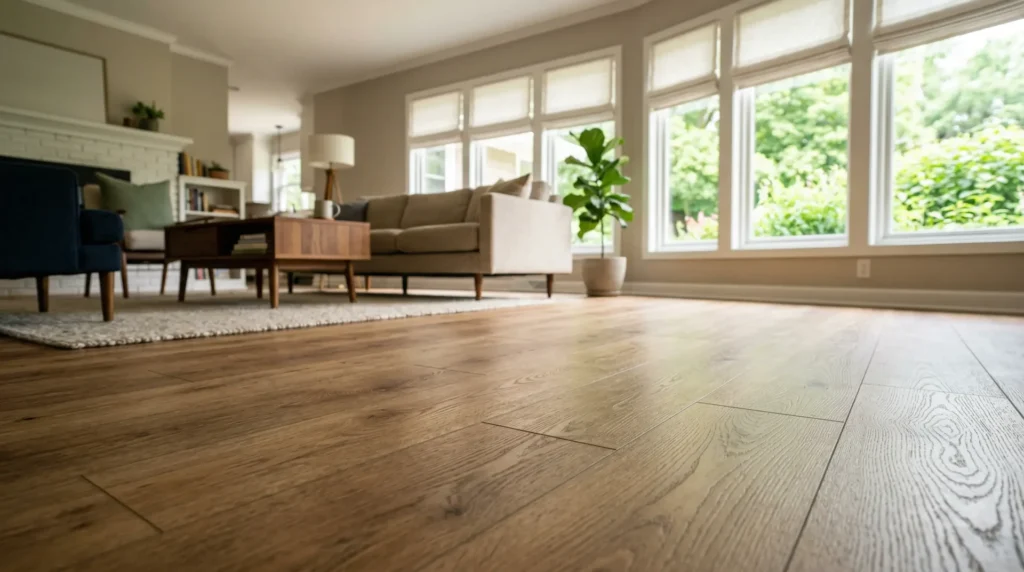
Surface water stains are often manageable. A refinish on hardwood, a plank swap on LVP, a re-grout on tile. The story changes when moisture has worked its way down to the subfloor. Our guide to refinishing or replacing worn hardwood covers the wood side of that call.
Soft spots underfoot, boards that give when you walk on them, or warped planks that won’t lie flat regardless of how they’re secured all point to damage below the top layer. In Madison-area homes, entryways, bathrooms, and below-grade spaces see enough repeated moisture exposure across our freeze-thaw seasons that the subfloor absorbs what the flooring material can’t shed.
When subfloor damage is involved, replacing just the surface layer solves only half the problem. A professional inspection can tell you how far the damage has spread.
Sign 2: Warping, Buckling, or Cupping
A board lifting at the edges (cupping) or bowing upward in the middle (buckling) signals a change in its moisture environment. These responses are common in hardwood and laminate, and Wisconsin’s seasonal humidity swings are particularly hard on both. It is one reason we talk through solid versus engineered options for hardwood flooring in Madison before anyone picks a color.
A wet summer followed by dry forced-air heat in winter creates expansion and contraction cycles that, over years, can push a floor past its ability to recover. If the boards won’t lie flat after the humidity normalizes, they probably won’t on their own. A flooring professional can tell you whether a targeted fix is viable or whether the floor has crossed into replacement territory. Our guide to why hardwood floors cup in summer explains the moisture side.
Sign 3: Persistent Odors That Cleaning Can’t Resolve
Old carpet holds pet odors, moisture, and years of embedded debris in its pad and backing. When repeated cleaning no longer removes the smell, the material itself has absorbed what no surface treatment can reach. At that point, new pad and carpet for your Madison home (or a hard surface) is the real fix.
The same applies to hardwood or laminate with long-term moisture exposure. Musty odors rising from floor level often point to mold or mildew in the subfloor material below, not the flooring on top. One thing worth knowing: you often adapt to household odors over time and stop noticing them. Guests don’t. If the smell returns after a thorough cleaning, the source is deeper than the surface. For a lower level, our guide to a wet or moldy basement floor walks through the causes.
Sign 4: You’re Repairing the Same Area More Than Once
A single repair is a reasonable response to isolated damage. Returning to the same spot a second time is a pattern worth paying attention to.
Tile that cracks repeatedly in one section often indicates movement or a problem with the substrate underneath. A section of hardwood that keeps lifting despite being secured suggests an unresolved moisture or adhesion issue at the source. When the same area needs work again and again, the repair is treating symptoms rather than the cause.
This is also where the practical math shifts. Ongoing repair costs without the floor stabilizing is a signal. Knowing what realistic lifespans look like for different materials helps put that in context, and our guide to flooring that lasts the longest for Wisconsin homeowners covers that in detail.
Not sure whether your situation calls for repair or replacement? Talking it through with a flooring professional can save a lot of guessing.
Sign 5: Your Flooring Has Crossed Its Replacement Threshold
Every flooring material has a realistic lifespan, and age combined with wear tells a clearer story than either one alone.
Carpet in a busy household typically runs 7 to 10 years before high-traffic zones show significant deterioration. Laminate can last 10 to 25 years depending on product quality and conditions. Luxury vinyl plank generally performs for 15 to 25 years with normal care. Hardwood can last much longer with refinishing, though it has a finite number of times it can be sanded before the boards are too thin to go again.
Age alone isn’t a reason to replace. Age combined with any other sign on this list usually is.
Sign 6: Soft Spots, Widespread Squeaking, or Visible Flex
An occasional squeak is common in older homes. Widespread squeaking, soft patches underfoot, or a floor that visibly flexes when you walk across it points to structural changes below the surface.
In older Madison neighborhoods and homes in areas like Maple Bluff, subfloor movement can develop over decades as the structure settles. Our guide to flooring for historic homes in Maple Bluff covers those houses. Newer construction in Waunakee or Fitchburg can develop moisture-related subfloor issues if a basement or crawl space has seen water infiltration. Here’s what professionals look at that most homeowners don’t: the finish material is almost secondary. It’s the condition of what the floor is sitting on that determines the scope of the job.
Sign 7: The Floor No Longer Fits the Space
Sometimes flooring reaches the end of its useful life before it reaches the end of its functional life. An outdated finish, a color that clashes with a recently updated kitchen, or a style that conflicts with an open floor plan renovation can make a floor feel like it’s working against the space rather than with it.
Homeowners planning to sell, reconfiguring a main level, or refreshing a space that has aged out of step with the rest of the house often reach this point. It’s a legitimate reason to replace, and worth folding into the broader renovation conversation.
When Multiple Signs Point to Replacement
A single sign can go either way. Two or more appearing together, especially when structural issues or subfloor damage are part of the picture, usually point clearly toward replacement. Surface-level repairs on a compromised foundation rarely hold, and continuing to patch the same problems adds cost without resolving the underlying issue.
A professional walkthrough takes the guesswork out of it. You don’t have to make the call alone. Our guide to what to expect from a flooring replacement covers the next steps.
Sources: National Wood Flooring Association: Problem Prevention and EPA: A Brief Guide to Mold, Moisture and Your Home.
Frequently Asked Questions
How do you know when your floors need to be replaced?
The clearest signals are water damage that has reached the subfloor, persistent odors that cleaning doesn’t resolve, repeated repairs to the same area, and floors that have passed their typical lifespan. Surface wear alone doesn’t always mean replacement is needed, but when structural signs appear, a professional assessment is the right next step.
What is the rule of 3 in flooring?
The rule of 3 is a practical decision framework: if your repair cost approaches or exceeds about 30 percent of what replacement would cost, replacement is generally the better investment. It prevents a cycle of ongoing maintenance costs that add up without solving the underlying issue.
Is it better to repair or replace damaged flooring?
It depends on what’s damaged and how far the damage extends. Surface scratches, isolated cracked tiles, or a few warped planks are often good repair candidates. Water damage into the subfloor, persistent odors, or repeated failure in the same area are signals that repair will be a temporary fix at best.
How long should flooring last before replacing?
Carpet typically lasts 7 to 10 years in active households. Laminate runs 10 to 25 years. Luxury vinyl plank lasts 15 to 25 years with normal care. Hardwood can last much longer with refinishing, though it has a finite number of sanding cycles before replacement becomes necessary. Age combined with visible wear or structural issues is the more useful benchmark than age alone.
If you’re seeing more than one of these signs, it’s worth having someone take a look before you spend more on repairs that won’t hold. Harmony Flooring serves homeowners throughout Madison, Middleton, Verona, and the surrounding area. Schedule a free consultation or call or text 608-221-5500, and we’ll give you an honest read on what your floor actually needs. Covering Every Detail.
Harmony Flooring is a Madison, Wisconsin flooring company serving homeowners and businesses across Dane County. Our team helps clients choose hardwood, luxury vinyl plank, tile and carpet, with installation coordinated through trusted local installers. We follow a Design · Measure · Install process to make sure every project fits the space, the home, and the people who live in it.
Questions About Your Floors?
Call or text 608-221-5500Schedule a Free Consultation
Shop our floors: Hardwood · Vinyl · Carpet · Tile · Laminate
Showroom: 2125 S. Stoughton Rd, Madison, WI 53716
You Might Also Like
-
- Installation and Project Planning
- Buying Guides
October 21, 2026
New Floors Before the Holidays in Madison: What’s Realistic
-
- Floor Care and Cleaning
- Buying Guides
October 19, 2026
Protect Entryway Floors From Salt and Ice Melt in Wisconsin
-
- Commercial Flooring
- Buying Guides
October 16, 2026
Municipal Building Flooring: A Wisconsin Buyer’s Guide

